









The second phase of quay wall deepening calls for longer tie rods
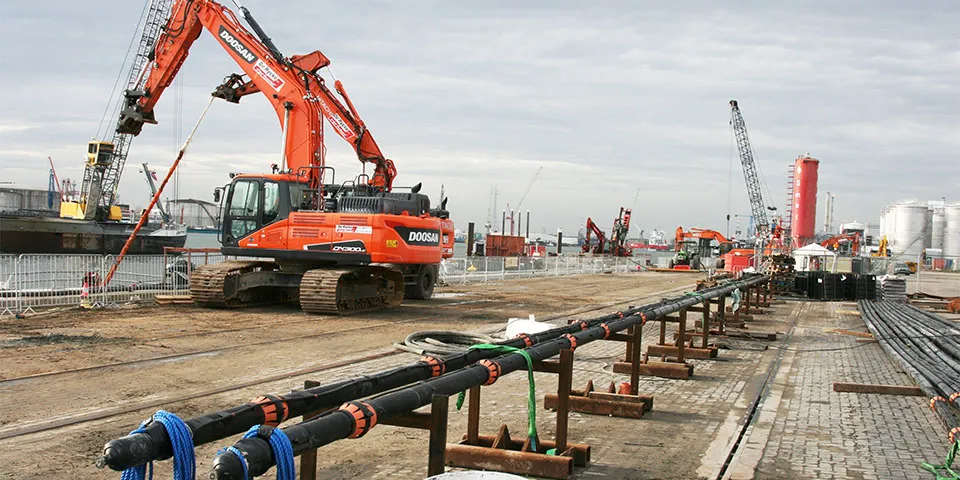
To allow larger vessels to access Noord Natie Terminals’ tank storage facilities in the Port of Antwerp, the quay wall on the north side of the Vierde Havendok was deepened and extended in 2017. This was done using 154 tie rods with a nominal diameter of no less than 75 mm, manufactured by DYWIDAG-Systems International. That first phase was followed by further work from late 2019, with more than 300 anchors planned over three years.
Noord Natie Terminals specialises in the storage and handling of liquids. The existing quay wall at the company’s port terminal, on the north side of the Vierde Havendok, had to be deepened to allow vessels with a draught of 14 metres to berth there. This required both dredging to deepen the foundations of the existing quay wall and the construction of a new quay wall.
“1.155 tonnes per anchor”
In this first phase, 154 tie rods with a nominal diameter of 75 mm (75 TR) and lengths of between 29.5 and 33 metres provide stability. In total, this amounts to just over 225 tonnes of anchor material, custom-manufactured and supplied by specialist DYWIDAG-Systems International (Dywidag). “This was the first time we had to manufacture prefabricated anchors of this diameter for a project in Belgium,” says Piet Vandaele, Business Manager at Dywidag. “The overall length of the anchors and their associated weight presented an additional challenge. Tie rods with a diameter of 75 TR weigh 35 kilos per metre, which means the heaviest ones weigh 1.155 tonnes per anchor.
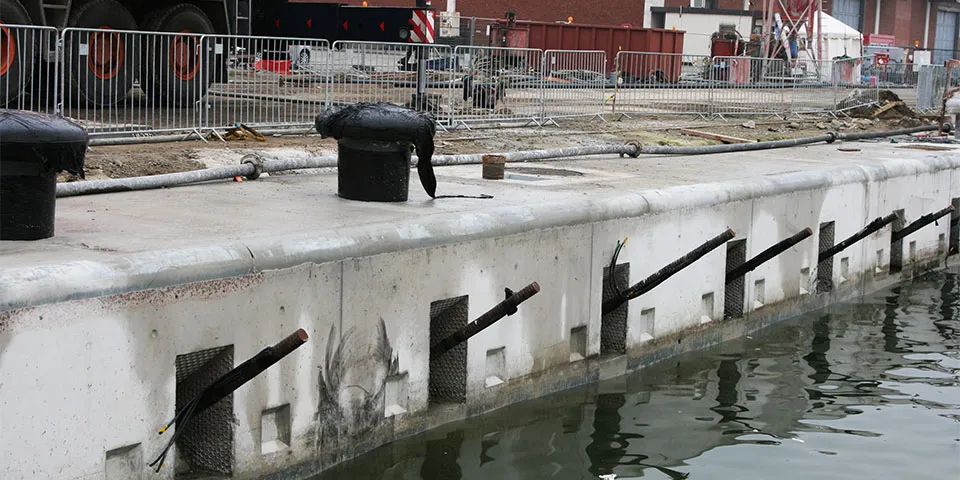
For the second phase of the work, Dywidag is supplying more than 300 new 38-metre anchors.
Perfect alignment using a coupling sleeve
A new order was placed with Dywidag in late 2019. For the second phase of the work, the company is supplying more than 300 new 38-metre anchors, even longer than those used in phase 1. As in the first phase, they are joined together on site using a hardened coupling sleeve. Using a system of trestles, Smet-F&C was able to connect the anchor sections in perfect alignment. “First, we used a special screw mechanism to ensure that the coupling sleeve was positioned exactly in the centre,” explains Piet Vandaele. “We then fitted a custom-cut plastic pipe with an 8 mm wall thickness over it, and filled the space between the coupling sleeve and the plastic pipe with grease, injected through two small holes. Finally, the assembly was sealed with heat-shrink tubing. All in all, there is hardly any increase in thickness: the clearance between the coupling sleeve protection and the pipe’s outside diameter is just a few millimetres, the absolute minimum. So all the pieces fitted together perfectly.”
Extendable lorries
Dywidag also had to solve a logistical puzzle. The company split each anchor in two and transported the sections from its German facility in Königsbrunn on extendable lorries. In the Port of Antwerp, they were joined together and installed in one piece in the anchor recesses. “We also had to get the rods, each 19 metres long, rolled within three weeks of the start of the work,” says Vandaele, listing some of the challenges.
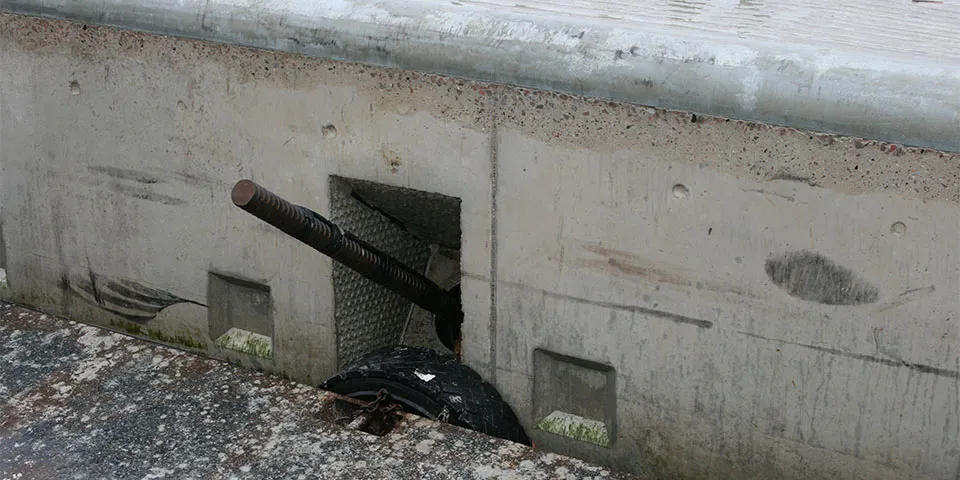
During installation in the borehole, the rods are encased in cement once again.
Corrugated duct with grout
The rods also feature a double corrosion protection system. “At the factory, they are encased in a corrugated duct, which is itself filled with grout,” explains Piet Vandaele. “A spacer kept the rods centred in the corrugated duct and allowed the cement to be distributed evenly. The rods were then encased in cement once again during installation in the borehole. All in all, this was a very successful project, particularly as, as always, we supplied the complete package: not only the anchors themselves, but also all the accessories (sleeves, grease, anchor plates, nuts …) and assembly drawings. This made the work clear and easy to check for all parties. One major advantage was that we were able to work with the same parties in this second phase: Smet-F&C, the Port of Antwerp Authority and inspection body Seco.”
Question about this story? Ask your question
Keep following this
Get an email when a new story is published. No account needed.
- ThemeStrengthening waterways and coastlines
- SubjectGeneral







