Infrabel continues to seek alternatives for an increasingly green rail network
The ‘hot-water train’: an innovation to reduce herbicide use in the future
Infrabel has been working for several years to reduce the use of herbicides. But in Belgium and elsewhere, these chemicals are still needed to control weeds on the tracks and ensure the safety of rail traffic and staff. To keep the tracks free of weeds, Infrabel has been granted exemptions from the pesticide ban by the regional authorities. The infrastructure manager is also continuing its efforts to find technically and economically viable alternatives, so that it can dispense with herbicides as soon as possible. A ‘hot-water train’, a made-in-Belgium development currently being tested in the east of the country, offers promising prospects in this respect.
Herbicides: a necessary evil
At Infrabel, no one wants to defend the prolonged use of weedkillers when it is not necessary. These chemicals, which are now strictly regulated in Europe, must be replaced as soon as possible with more environmentally friendly alternatives.
Even so, weedkillers remain ‘a necessary evil’ in Belgium and on other European rail networks to ensure the safety of rail traffic and staff. Vegetation growing in the ballast, the layer of stones beneath the rails that acts as a shock absorber, can disrupt the millimetre-precise track geometry and its drainage properties, for example, the removal of rainwater, putting train safety at risk. Overgrown vegetation close to the tracks can also obstruct maintenance staff, who have to inspect the rail network on foot. It can also conceal certain defects or obstruct the view of signals.
Infrabel, which manages more than 8,000 km of railway lines, has obtained exemptions from the pesticide ban from the regional authorities for limited, potentially renewable periods. In addition to these exemptions, Infrabel is increasingly using mechanical techniques to control weeds on ‘secondary tracks’, such as marshalling yards. To treat ‘main lines’, Infrabel has committed to finding technically and financially viable alternatives. The ‘hot-water train’ being tested in the east of the country is already a promising development.
Swiss and Belgian
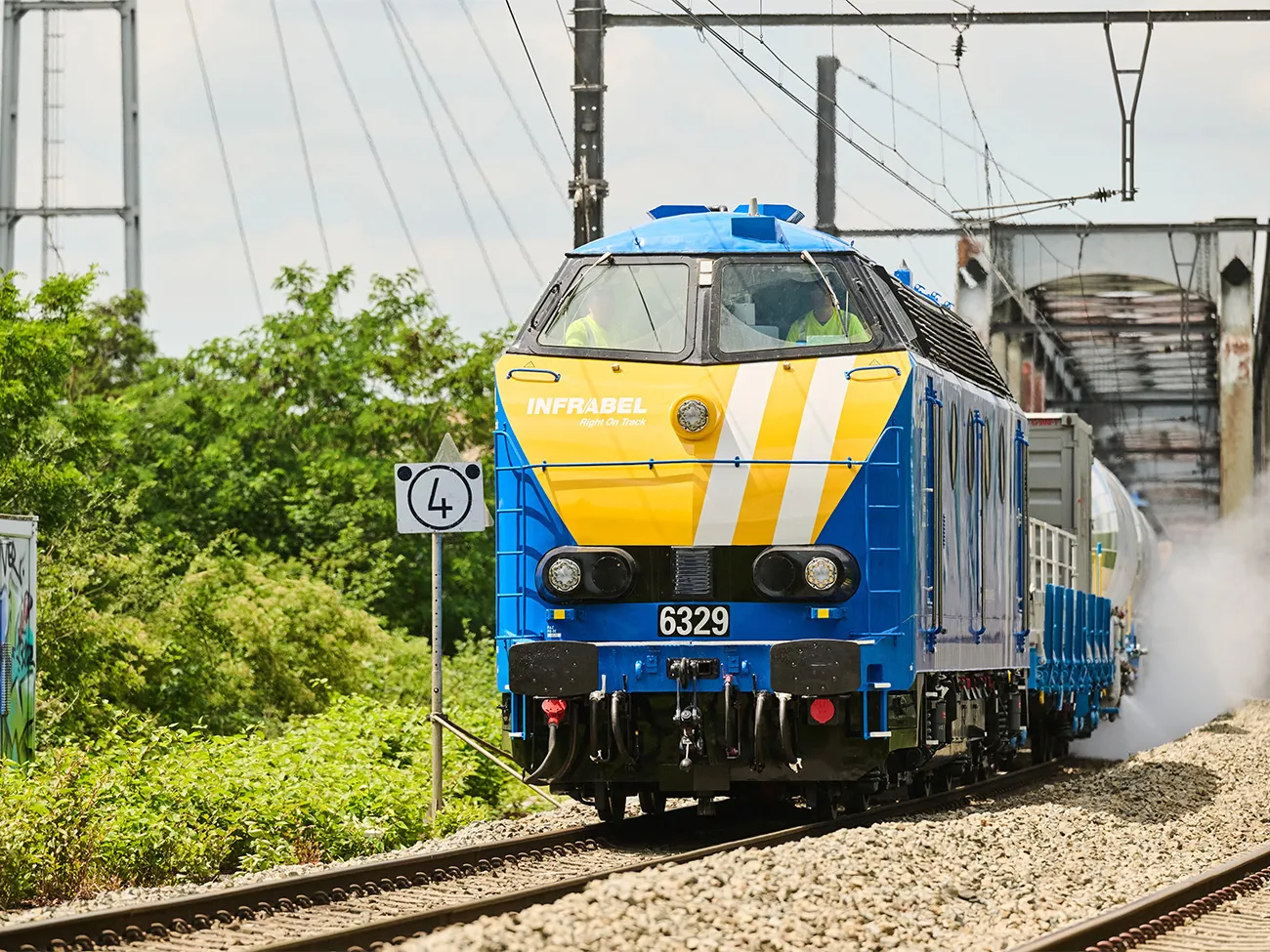
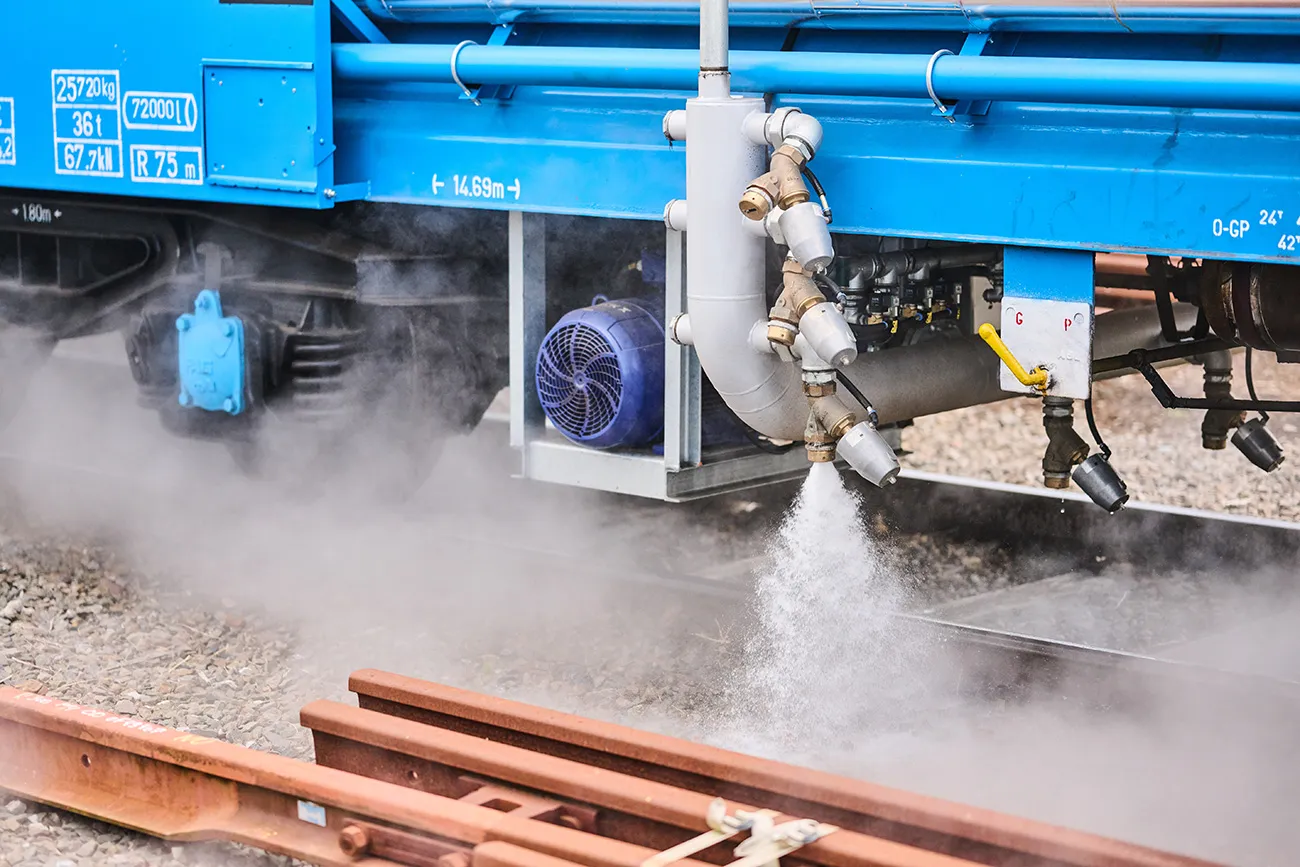
In the small world of European rail infrastructure managers, where everyone is now looking for alternatives to weedkillers, Switzerland was the first country to test a train designed to tackle vegetation with hot water. Infrabel took inspiration from that prototype and developed its own technology, which is innovative in many respects. The made-in-Belgium hot-water train is undergoing a new series of tests. Trials were also carried out in autumn 2021. This innovative train is 180 m long and consists of two locomotives and five wagons. Three of the wagons are well-insulated tanks holding 3 x 50,000 litres of water, heated to 90° C. The other two wagons house the heating equipment, a generator and computers that control the spraying systems. On either side of the tanks are two pipes for treating the service paths alongside the tracks. Four more pipes are located beneath the tanks to treat the ballast specifically. In its current configuration, this ‘H2O train’ travels at 20 km/h, fast enough not to disrupt rail traffic. Spraying three to six m³/km of hot water enables the train to treat several dozen kilometres a day. In areas where the surrounding environment is particularly rich in biodiversity, the train sprays only the ballast. Three to four treatments a year, compared with two using herbicides, could allow the hot water to slow vegetation growth sufficiently.
Georges Gilkinet, Federal Minister for Mobility: “Biodiversity is our most precious heritage, and we must preserve it by every possible means if we want to leave our children a planet fit to live on. The sooner we can maintain our rail network without pesticides, the better! I realise this is a complex challenge, but it is essential. In any case, it has been a priority of mine since I took office as minister. An additional two million euros has been allocated to Infrabel to accelerate the search for sustainable and innovative solutions in this area. With this weedkilling hot-water train, Infrabel is testing a first that could be groundbreaking for Europe. Together, we are working towards a rail network that is not only more efficient, but also greener and healthier!”
These initial tests are encouraging and will continue until early 2023 on part of the rail corridor from Antwerp to the German border. But this prototype train will become even more environmentally friendly. In future, the water will be heated before the train departs, using pellets or a heat pump. A vegetation detection system powered by artificial intelligence will control the pumps autonomously, further reducing the amount of water used.
Zuhal Demir, Flemish Minister for the Environment: “Pesticides often do more harm than good. They do kill weeds, but they also have a negative impact on the environment. Infrabel is currently responsible for the bulk of pesticide use in the public services sector. So if we want to put an end to pesticide use, that figure has to come down. It is therefore positive to see that they are taking concrete initiatives to achieve this. Hopefully, this initiative will put Infrabel on the right track to reducing its pesticide use as much as possible.”
Combining alternatives
Since 2019, Infrabel has been following an action plan to reduce pesticide use. The aim is to keep main and secondary tracks free of weeds using alternative or preventive methods.
For secondary tracks, such as those in marshalling yards, the action plan aims to halve the treated surface area by the end of 2023. This will be achieved using techniques such as mowing, weeding and grubbing out plants. Unfortunately, these mechanical techniques cannot be used across the entire rail network because, in addition to their considerable budgetary impact, they would also take up a great deal of time. This would adversely affect the smooth flow and regularity of rail traffic. To prevent weeds from growing on service paths over the long term, Infrabel also makes preventive changes during renewal works, using concrete, asphalt and slag sand.
The aim, then, is to make extensive use of a combination of more environmentally friendly alternatives, such as pelargonic acid and the hot-water train. In future, biological weedkillers, which are still under development, and electrical systems could also be added. Over time, this mix will make it possible to phase out the most harmful products used to control weeds on the railway.
Benoît Gilson, CEO of Infrabel: “Infrabel is making major efforts to limit the environmental impact of its activities. The reduction in herbicide use in recent years is a concrete example of this. But it is our duty to go further and find alternatives to these chemicals. The ‘hot-water train’ offers promising prospects. I am proud of this innovation and will do everything in my power to ensure that this prototype becomes one of the tools we use to tackle weeds on our railway estate in an increasingly environmentally friendly way.”
Question about this story? Ask your question
Keep following this
Get an email when a new story is published. No account needed.
- ThemeFuture-proofing roads and railways
- SubjectRail engineering