First: expertise and experience combined for Belgium’s first tram project using a ladder track system
Text Niels Rouvrois Beeld De Bonte Group
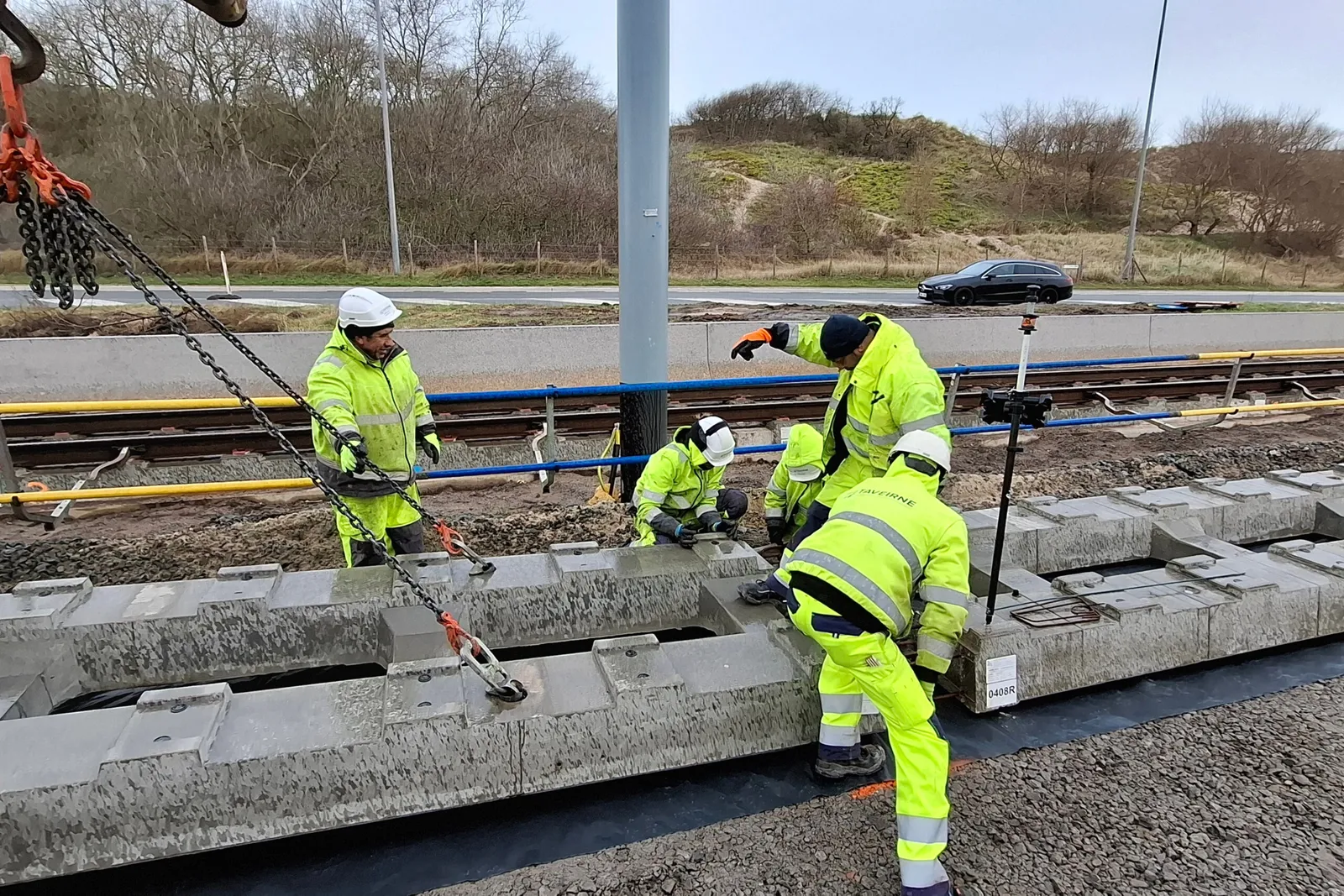
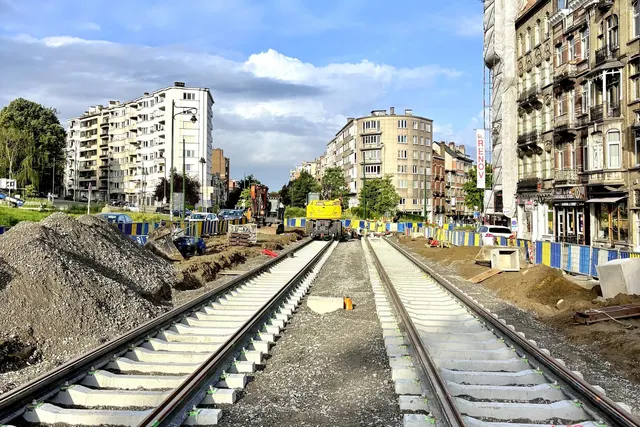
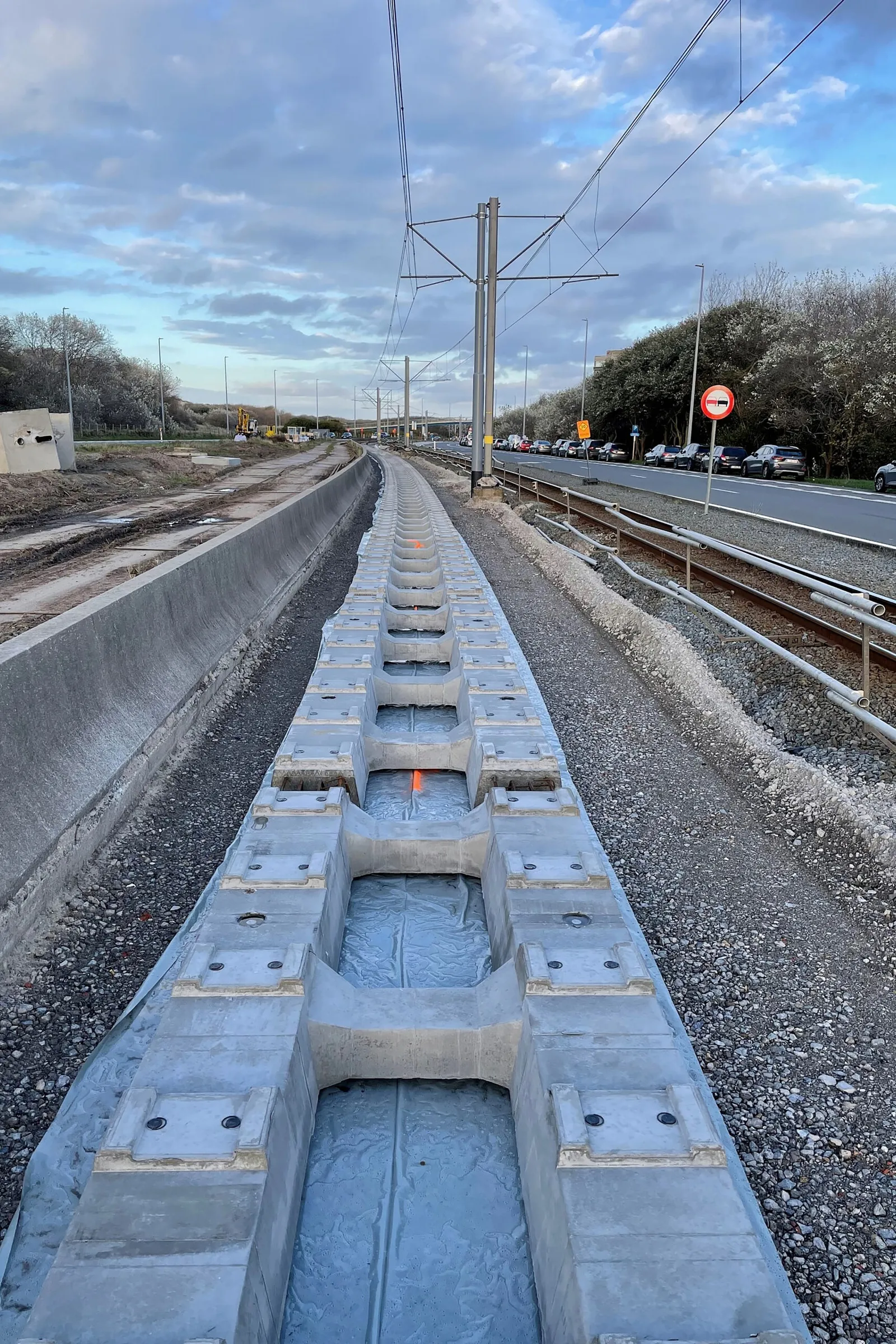
In September 2024, Taveirne began renewing the tram track in Bredene and Oostende on behalf of De Lijn. The project is a first: Belgium’s innovative prefabricated ladder track system is being used on a curved alignment for the first time. Taveirne called on De Bonte Group to manufacture the unique system. The two experienced companies joined forces, pooling their expertise to deliver an impressive reference project. “From both a production and a construction-methods perspective, this was a very challenging project,” they say in unison.
Urban space is under pressure. Growing demand for mobility, the impact of climate change and the need for liveable public spaces make integrated solutions essential. Today, unexpected opportunities lie at the intersection of infrastructure and ecology. Areas alongside tram and railway lines are particularly well suited to creating new connections, not only physical ones, but also in terms of sustainability, biodiversity and climate adaptation. Green track, and in particular construction using prefabricated ladder elements, offers an innovative and robust solution.
Infrastructure and nature
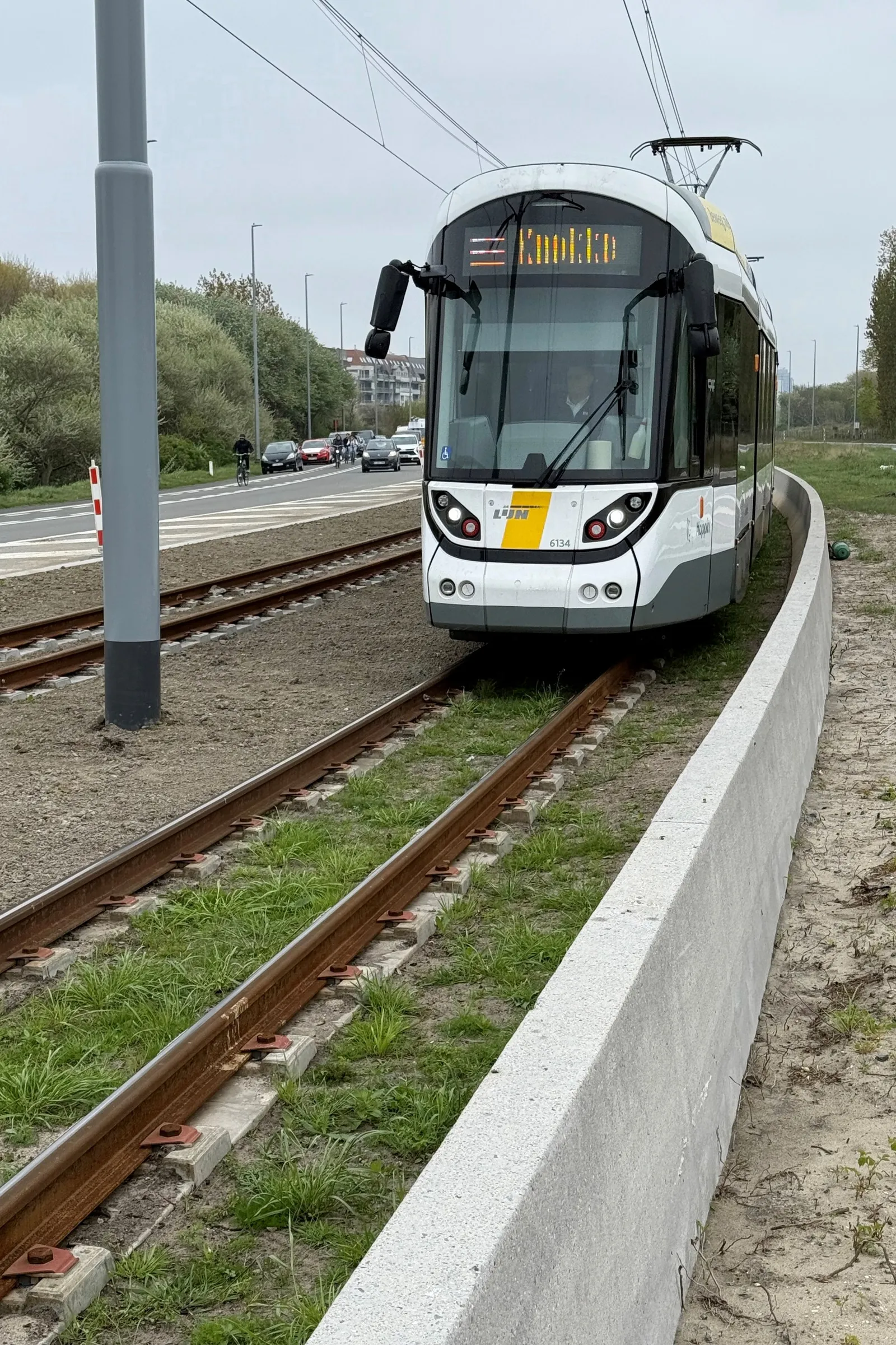
Combining technical transport infrastructure with natural elements is essential. Green track is a tangible example, bringing life to the streets. Grass, sedum or other low-growing plants between tram rails not only make streets more attractive, but also serve a range of functions: noise reduction, water infiltration, air purification and cooling. The result is infrastructure that softens the visual landscape, delivers ecological benefits and has a positive effect on the urban microclimate. “You hear the term ‘infrastructure and nature’ increasingly often,” says Filip De Bonte, CEO of De Bonte Group. “Infrastructure runs through cities and municipalities, and concrete and greenery have to find common ground. You either embrace that and look for solutions, or resist it, but that is not sustainable in the long run. With this project, both we and Taveirne are showing that we can be a reliable partner for De Lijn in this area in the future.”
Efficient on site
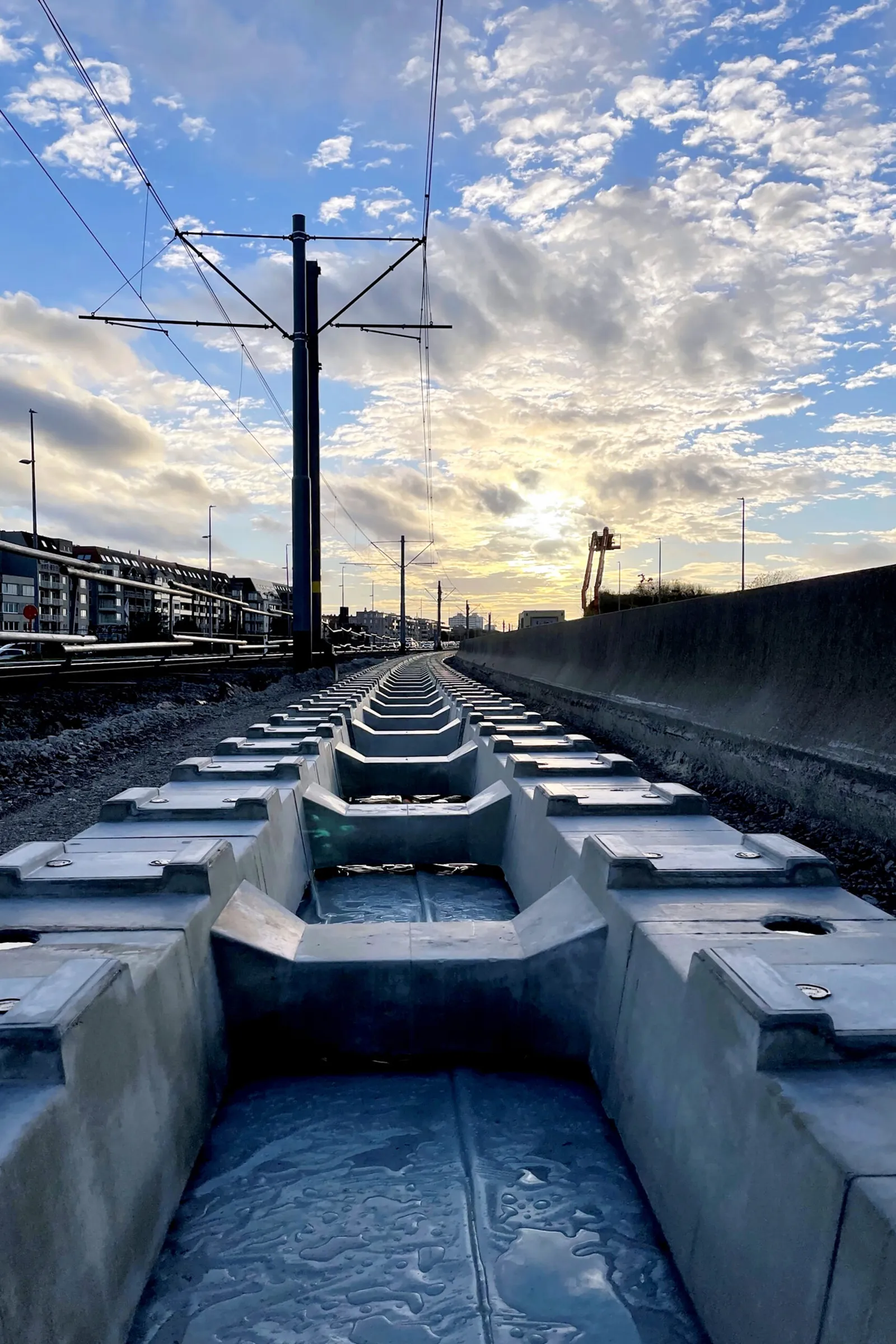
Up to 220 metres of ladder track modules can be installed each day, significantly shortening the project’s delivery time. Once installed, the open spaces are filled with topsoil to maximise water permeability.
The whole area is then sown with grass. This not only creates a green appearance and a more attractive streetscape, but also helps prevent sand from accumulating between the tracks. Green track built with prefabricated ladder elements combines ecological benefits with technical robustness. Its load-bearing substructure ensures track stability without the need for conventional maintenance such as tamping. Loads are distributed evenly, extending service life and reducing maintenance costs. The green track construction is also fully compliant with rainwater regulations, greatly facilitating planning integration. “The theory is very sound,” says Lode Van Iseghem, technical director at Taveirne. “We have great confidence in the system’s potential, both technically and in terms of sustainability. The initial results are promising. And no one doubts that it is a high-quality product, thanks in part to De Bonte’s craftsmanship.”
Bredene project
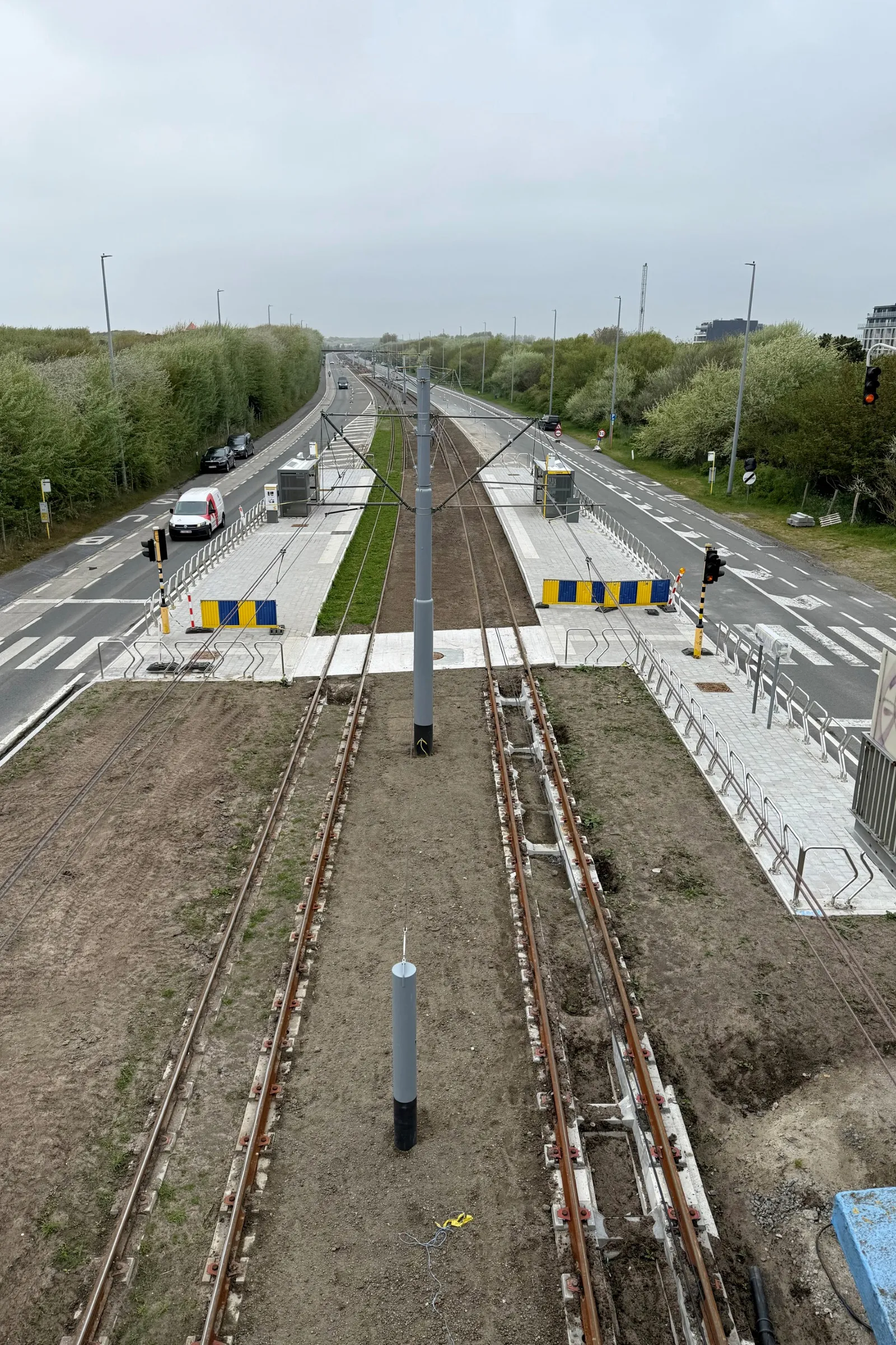
From laying new track sections to renewing and maintaining existing track and overhead lines, Taveirne delivers a safe, stable and reliable railway network. Kristof Vonck, project manager at Taveirne: “The Bredene project involved renewing the tracks and overhead line. We also renewed one junction, at Zeelaan. The remaining work involved laying 2,200 m of ladder track. The works are being carried out in several phases because the route needs to remain in service during certain periods, especially the holidays.”
De Lijn had already used the ladder track system on a pilot project. “But that was a straightforward project, whereas in Bredene we laid a curved section more than two kilometres long,” explains Kristof Vonck. “This project therefore presented quite a few logistical and technical challenges, including extremely precise planning, preliminary studies, and the accurate positioning and adjustment of the tracks. The margin for error was exceptionally small, even smaller than when laying conventional ballasted track.”
Very tight tolerances
The required precision came into play long before work began on site. Filip De Bonte: “Given the complex 3D shape of the prefabricated concrete ladder element and the extremely tight installation tolerance of ±1 mm in every direction, Taveirne rightly set very high design requirements from the outset. The elements leave little room for error during installation and alignment, so the manufacturer had to implement rigorous quality control and measurement in the factory, to an accuracy of 0.1 mm. The coplanarity of the sixteen bearing surfaces within each rigid element required particular precision. All 16 bearing surfaces on every element were measured in 3D and validated daily to ensure a perfect fit. Each element was given a unique set of dimensions and a position code, preventing any mix-ups on site.”
Before construction began, a trial installation was developed, combining traditional construction techniques with advanced digital applications. A key tool was a digital total station. Every site team was equipped with one, allowing them to position the prefabricated elements entirely independently, without relying on an external surveying service. Combining experience with technology raised craftsmanship to a higher level. This was not an exception, but standard practice for every team on site.
No first-timer
The result? Smooth, methodical installation with no remedial breaking-out work. The combination of clearly defined technical requirements, a carefully developed production process and a meticulously planned installation led to flawless execution. Kristof Vonck: “We established two fixed points for each ladder using a total station, which helped us position the ladders very accurately from the outset.
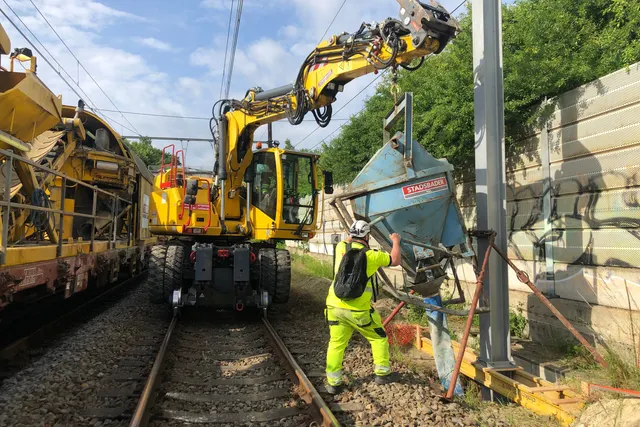
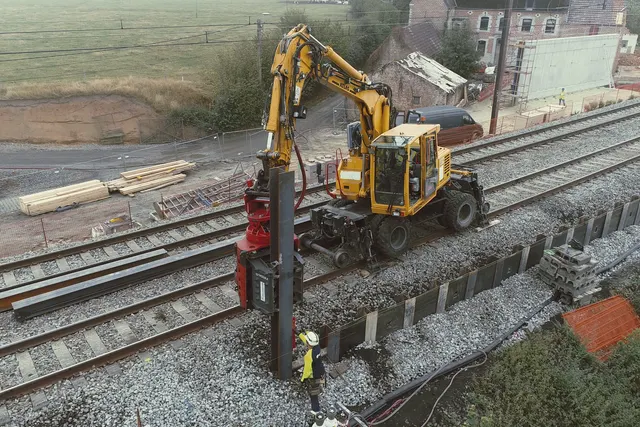
These elements are 6 m long and weigh 4 tonnes. They were lifted and positioned by crane. The rails were then laid. Marking out those reference points on the prefabricated elements was absolutely crucial. When that is done accurately, installation itself goes very smoothly.” Lode Van Iseghem adds: “We are no strangers to innovative systems and techniques either. For example, we previously installed the first concrete switches and p-switches for Infrabel and carried out the first direct fixings. We firmly believe in the innovation needed to move forward.
Filip De Bonte was impressed by Taveirne’s craftsmanship: “I have known them for some time and am familiar with their capabilities, but the team working here was truly impressive. This project is undoubtedly a reference for the whole sector. What I admire most is that it was not just about old, proven techniques, but also about new, clever ideas. For example, when it came to equipment, they did not bring out the newest machine, but chose one that seemed perfectly suited to the job. We made good use of the freedom allowed in the specification, both in production and execution, and delivered a highly professional solution.”
Pioneering work
For public transport operators and cities, green track is more than a technical solution. It is a way to make sustainability tangible in the streetscape. The system brings mobility, climate adaptation, biodiversity and comfort together in a single integrated whole, making it an ideal fit for today’s policy objectives. Contractor Taveirne and prefabrication manufacturer De Bonte Group responded with a carefully developed concept, made possible by intensive consultation. Custom moulds for curves, cant and even clothoid shapes can accommodate any route configuration. “Thanks to their extensive technical expertise, attention to detail and close consultation with the client, they have delivered pioneering work that not only meets the highest quality standards, but can also serve as a reference for future projects. This collaboration demonstrates innovation, trust and a shared ambition to push boundaries and deliver sustainable results,” concludes Benny De Bruyn, senior official at De Lijn, enthusiastically.
Question about this story? Ask your question
Keep following this
Get an email when a new story is published. No account needed.
- SubjectRail engineering