









Prefabrication shortens construction time for new Vopak berth
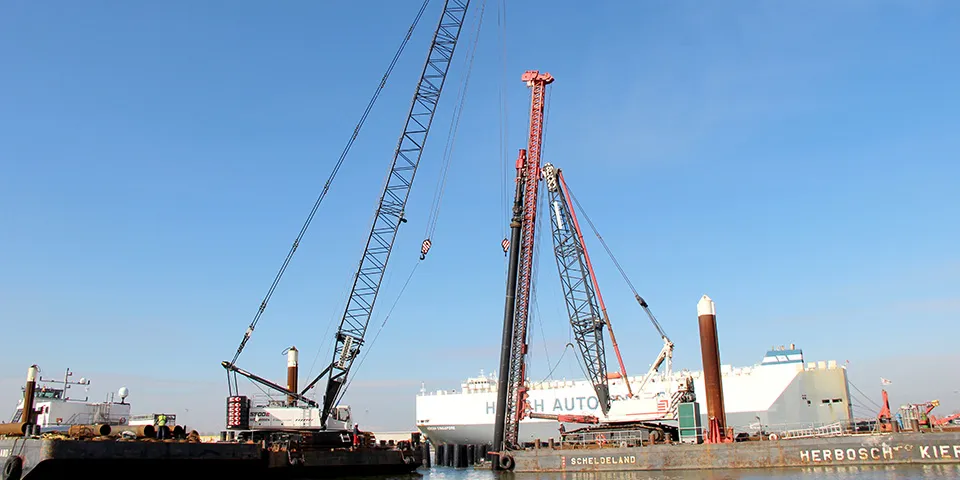
Last month, the first pile was driven for the new berth at Vopak Terminal Linkeroever in the Verrebroekdok. The terminal opened in 2008 and has 76 tanks with a capacity of 140,000 cubic metres. The experienced marine construction specialist Herbosch-Kiere has been brought in to build the L-shaped berth.
Berths, quay walls, bridges, locks… Herbosch-Kiere works across every aspect of marine construction and specialises in projects that require floating plant. “Marine construction is our core business. There aren’t many contractors that do this. We mainly work for public-sector clients, including De Vlaamse Waterweg and the ports of Antwerp, Ghent and Zeebrugge, but naturally also for private companies such as Vopak,” says Landerik Van Eynde, project manager at Herbosch-Kiere.
Complete construction
The new L-shaped berth will provide additional berthing facilities for the terminal, which stores liquid chemicals often delivered by ship. Tankers of up to 80,000 DWT will be able to berth there, after which the products will be transferred to the tanks via a piping system running along the offshore and onshore pipe racks.
As main contractor, Herbosch-Kiere is responsible for the complete construction of the L-shaped berth at Vopak Terminal Linkeroever. Landerik Van Eynde says: “Our work includes driving the piles, all the concrete work for the access bridges and platforms, and the pipe racks installed on the access bridges. We are also responsible for the marine structures, including all the fendering, standalone mooring piles and dolphins, and the access walkways to those structures. For this project, the piping is installed in modules in the pipe racks on the access bridges. The piping itself is not in our scope, but we are responsible for coordinating with the piping contractor.”
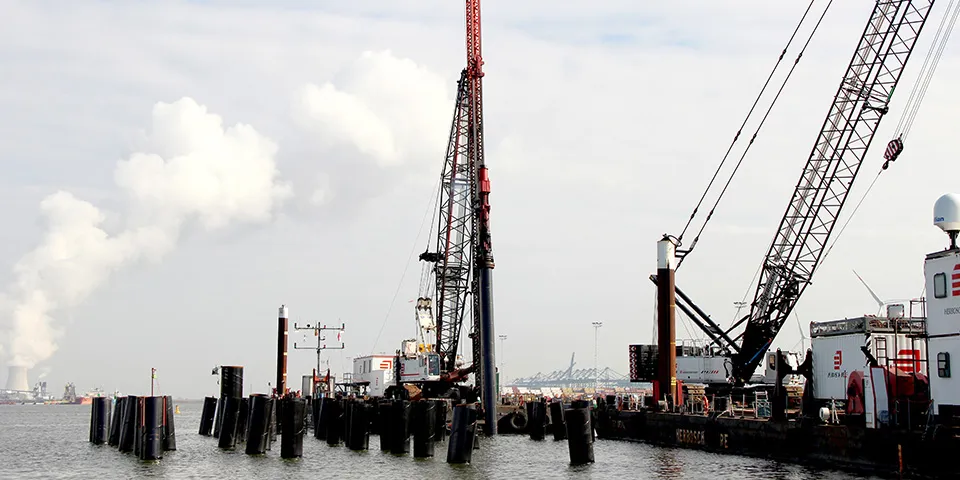
From January to March, as many components as possible were prefabricated, so that only assembly and installation would be needed on site.
Prefabrication keeps construction time short
Herbosch-Kiere places great importance on keeping the time spent on site to a minimum. “That’s why we prefabricate as much as possible,” says Landerik Van Eynde. “We assemble the concrete elements, marine structures and pipe racks at our own site in the largest sections possible. We have the plant and expertise to install large prefabricated components precisely, leaving only assembly work to be done on site. This also simplifies work over water, where safety is always a challenge.”
For example, the prefabricated concrete access bridges are around 14 metres long and weigh up to 80 tonnes each. Landerik van Eynde says: “We lift them with our crane pontoon and transport them by water to Vopak, where they are placed on the crossbeams anchored to the foundation piles. The only work left on site to complete the bridges is to pour concrete into the wet joints. We use the same approach for the concrete platforms, for which we produce prefabricated elements weighing up to 150 tonnes. The pipe rack modules, including the piping, are 28 metres long, and the hose tower is also prefabricated as a single, fully equipped unit. Only the connections between these prefabricated components need to be made on site.”
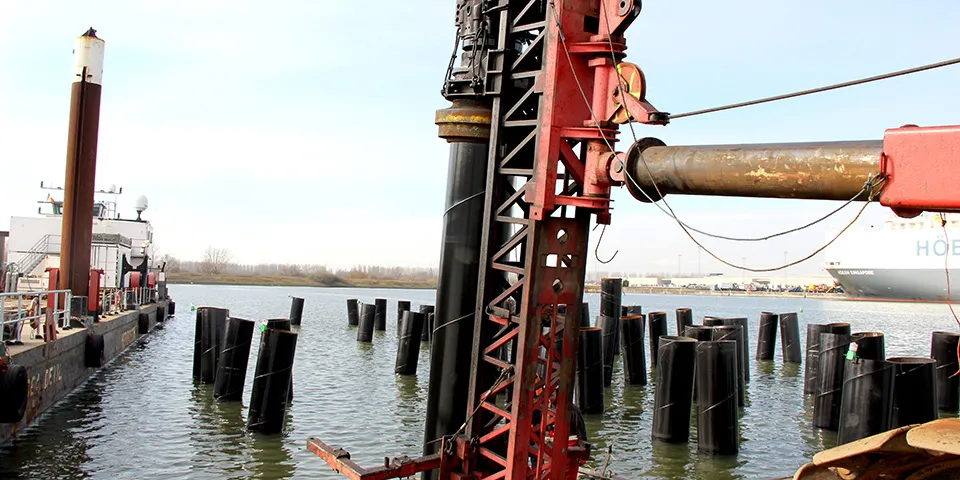
Disruption to the terminal is minimised by carrying out as much work as possible in the intervals between ships.
Extensive experience
Herbosch-Kiere can draw on extensive experience in building this type of berth. “We have developed a system that allows us to work very quickly. Once we start on site, the operation gets into its stride and doesn’t stop,” says Landerik Van Eynde. “Eight years ago, we built phase 1 of this type of berth at ITC Rubis. It is almost identical to this L-shaped berth. For Seatank, we built a T-shaped berth with six berths in the sixth harbour dock, followed by ITC Rubis phase 2, which extended the L into a T. Most recently, we completed a project for Oiltanking AGT. The team working there moved straight on to Vopak Linkeroever.”
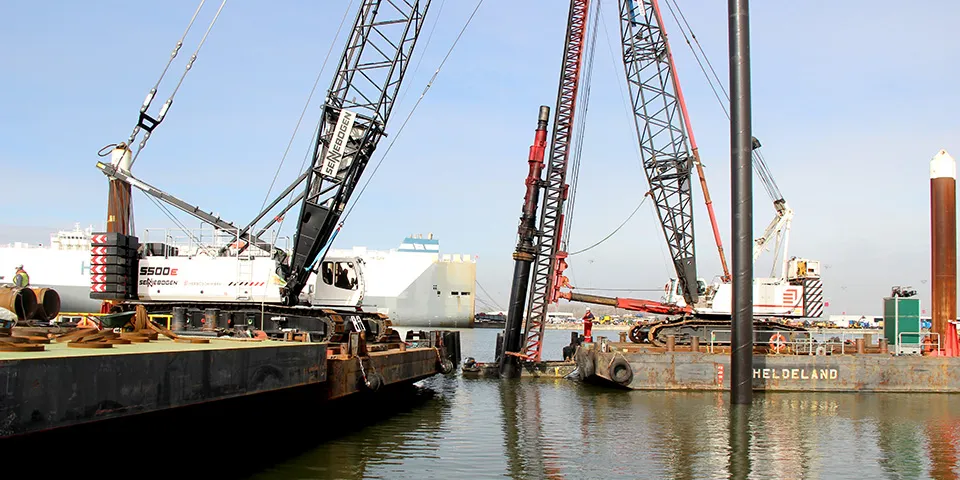
Piling began in March.
At the end of February, Herbosch-Kiere began assembling the first prefabricated bridges at its own site. Meanwhile, site set-up began on site. “The project was prepared in every detail through to March, and piling has now started. We drive an average of five piles a day, which means the work will take around thirty working days. We will then prepare the foundation piles so that the concrete work can begin. The work is carried out in consultation with Vopak and the Port to minimise disruption to shipping for Vopak and the surrounding businesses,” concludes Landerik Van Eynde.
Een zakelijke vraag aan Herbosch-Kiere? Get in touch
Companies in this story
Keep following this
Get an email when a new story is published. No account needed.
- ThemeStrengthening waterways and coastlines
- SubjectGeneral
- CompanyHerbosch-Kiere







