









Ostend, De Halve Maan | Ground anchoring works on Halve Maandijk successfully completed
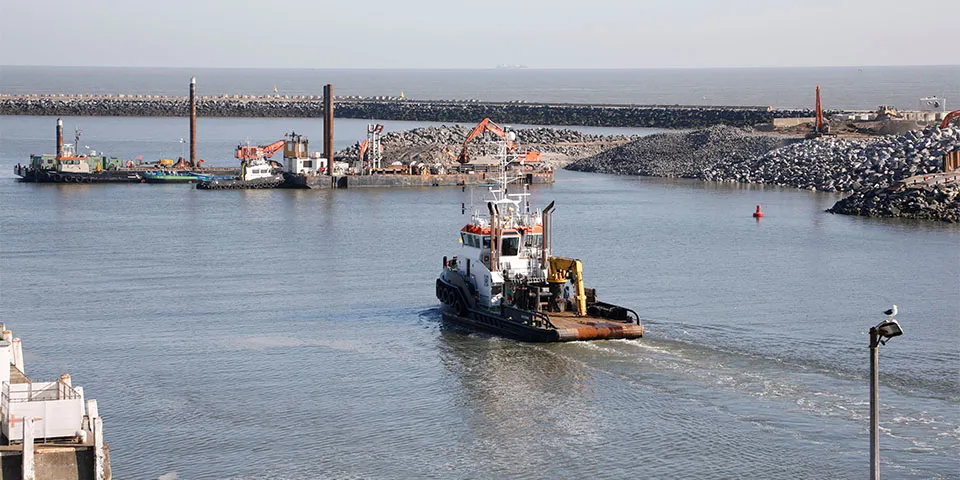
Despite the coronavirus crisis, work on Halve Maandijk in Ostend has progressed well over the past few months. The harbour channel is being widened to allow larger vessels to access the Port of Ostend. In a temporary joint venture (TM) with Jan De Nul-Soetaert, SMET F&C is responsible for the ground anchoring works. “The final anchors were successfully stressed and completed at the end of May,” says Koen Van der Eecken, project manager at SMET F&C.
Since May 2019, work has been under way on Halve Maandijk in Ostend on behalf of the Maritime Access division of the Department of Mobility and Public Works. To allow larger vessels to access the Port of Ostend, the access channel is being widened from 85 m to 125 m at the front of the Halve Maan site. At the rear, near the entrance to Visserijsluis, the channel is being widened to 145 m. Once the widening is complete, the harbour will be accessible to vessels up to 200 m long, including larger jumbo ferries, cruise ships, cargo ships and installation vessels for wind turbines.
The coronavirus crisis did not stop the TM from continuing the work. “We are grateful to the contractor for keeping the work going in these difficult times while respecting the strict safety rules,” said Flemish Minister for Mobility and Public Works Lydia Peeters proudly. “Flanders is investing more than 22 million euros to protect Ostend against flooding and to strengthen the harbour’s economic position.”
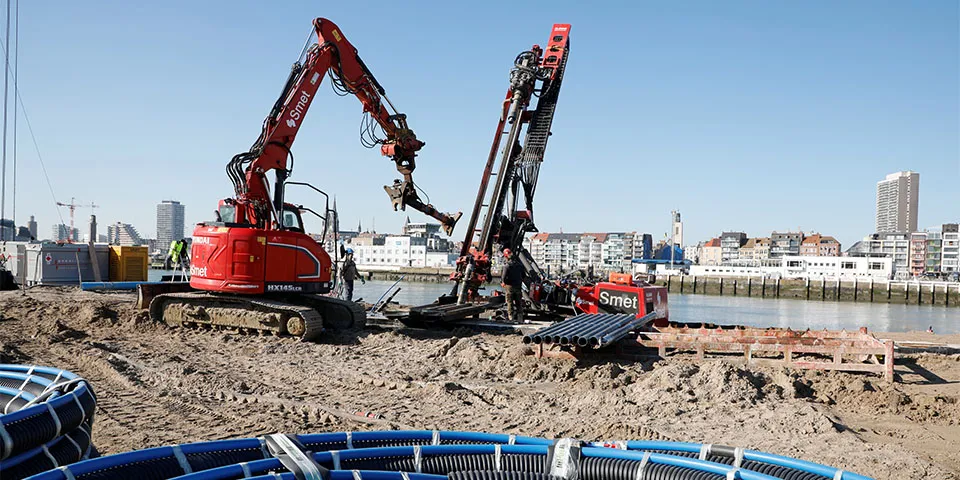
In a temporary joint venture (TM) with Jan De Nul-Soetaert, Smet Smet F&C is responsible for the ground anchoring works.
Overview of the works
A vertical wall with an underwater berm is being built in the southern section. In the northern section, a new slope will be constructed, similar to the existing sloping structure. Its surface layer will consist largely of concrete HARO blocks. The existing slope on the northern side will also be reinforced with a layer of HARO blocks. The area to the east of the new slope will in turn be redeveloped as a nature reserve. Work was already carried out last autumn on the slope to be built on the northern side. The contractor placed HARO blocks on the existing dyke.
New combi-wall
Construction of a new combi-wall in the southern section was completed at the end of May this year. Jan De Nul-Soetaert managed the works and installed the tubular piles, sheet piles and concrete. “Within the TM, Jan De Nul and Soetaert are responsible for the hydraulic engineering and civil engineering works,” says Koen van der Eecken. “SMET F&C carried out the ground anchoring works. In the original tender specifications, a significant number of points could be scored for specialisation in ground anchors. These anchors have a capacity of up to 165 tonnes, an area in which Maritime Access had little experience. A specialist contractor with strong references on similar projects was therefore a major asset.”
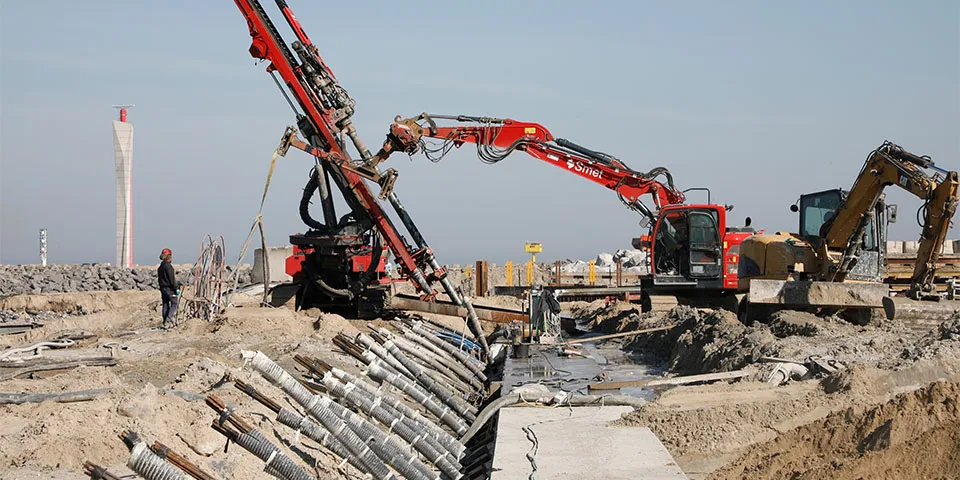
The ground anchors secure the combi-wall, a quay wall made up of tubular piles and sheet piles, topped with a concrete capping beam.
Test anchors
The permanent ground anchors secure the combi-wall. This quay wall is made up of tubular piles and sheet piles, topped with a concrete capping beam. Koen van der Eecken says: “One notable feature of this project is that we had to install a relatively large number of test anchors before we could install the permanent anchors. The test anchors demonstrated that our proposed anchor type, materials and working method met the requirements. This provided sufficient assurance in advance that the outcome would be as expected. As the test anchors were installed at the start of the works, the planned schedule for installing the permanent anchors was not put at risk.”
The test anchors were installed in June and July last year. Testing continued until the end of September. Koen van der Eecken says: “Based on the test results, we received official approval and the go-ahead for the permanent anchors. We began drilling and installing them in March this year, and the final anchors were stressed and completed at the end of May. There are eight sections in total, each with between 10 and 13 anchors. Our work is now complete, and for a certain period we will continue to monitor the installed anchor load cells. We will take weekly measurements until the construction holiday, followed by monthly monitoring for a while to see how the loads develop.”
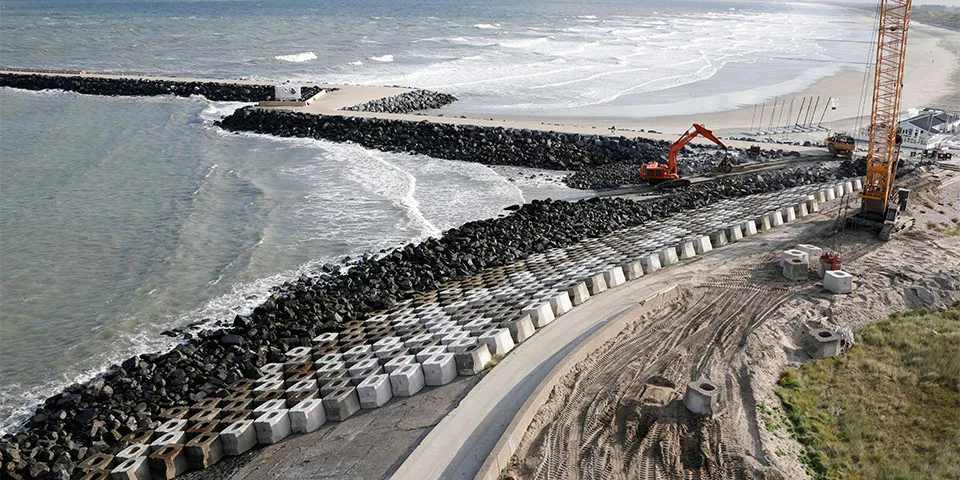
Despite the coronavirus crisis, work on Halve Maandijk in Ostend has progressed well over the past few months.
Quality, safety and planning
This project was a perfect fit for SMET F&C. Koen van der Eecken says: “We are well known for this type of work. We have also worked with higher-capacity anchors. What was different from usual on this project was that the anchors had to be drilled at a very steep angle, but that was simply a technical consideration. SMET F&C’s strengths lie in quality, safety and planning. We were able to carry out this project properly and safely, on time and in accordance with the agreements. And, of course, with great attention to the coronavirus measures. We acted very quickly in early March in this respect, allowing us to get the anchors shipped from Italy just in time.”
New shoreline protection
Work is also progressing at pace on the new shoreline protection in the northern section. The contractor is working both from land and from the water. The new revetment along the navigation channel is already clearly visible. All the soil between the new slope and the existing harbour channel is being removed in stages, including below low-water level. Several mattress units have now been installed. The berm and surface layer of the new slope will be installed next. Once the area running parallel to the navigation channel has been completed, the corner of the new Halve Maan will be built in a similar way.
The widening of the harbour channel is part of the integrated coastal protection and maritime access plan for Ostend, also known as the ‘public works’ or OW plan. The plan aims to protect Ostend against flooding while also strengthening the harbour’s economic position. Work began in May 2019 and is expected to take just under two years. The total cost is 22,670,000 euros (including VAT). The impact on shipping is limited, as the contractor is working alongside the existing navigation channel wherever possible.
Question about this story? Ask your question
Wie aan Verbreding havengeul ter hoogte van Halve Maan werkte
- grondankeractiviteitenSMET F&CIn this story
- waterbouwkundige en civiele werkenJan De Nul-SoetaertIn this story
- contractorTijdelijke Vereniging Jan De Nul: Soetaert: SmetMentioned in Works on Ostend harbour entrance channel completed
Keep following this
Get an email when a new story is published. No account needed.
- ProjectVerbreding havengeul ter hoogte van Halve Maan
- SubjectGeneral
- CompanySMET F&C
- CompanyJan De Nul-Soetaert







