Smart water management on the rise
Driven by Aquafin, smart sewers are on the rise. By installing additional meters and sensors, the sewer system can be controlled in real time, resulting in a clear ecological improvement in the watercourse. ESEP, which specialises in water treatment & water management, is on board too and has developed a number of technologies. “From a simple flow limiter with no moving parts to a fully automated, real-time flow management system,” says managing director Emile Bruschinski.
At overflows in combined sewer systems, water that would otherwise cause flooding can be discharged into nearby watercourses. Despite being diluted with rainwater, this water is still highly polluted and can often have a major environmental impact. To limit these adverse effects, Aquafin developed a control strategy for sewer systems. Sensors, controllers and control devices trigger actions in real time, allowing the entire sewer system to fill as evenly as possible. This dynamic control turns underground ‘dumb’ sewers into smart infrastructure that can be monitored remotely.
“Linking the data collected can be a very powerful tool for managing water,” says Emile Bruschinski of the Dutch company ESEP, which specialises in water treatment & water management. “Smart sewers make optimum use of their capacity and volume by enabling proactive interventions at strategic locations, based on data gathered through smart water management. Sewer capacity is more often proving insufficient as a result of the increase in connected impermeable surfaces. Climate change also has an impact, of course.”
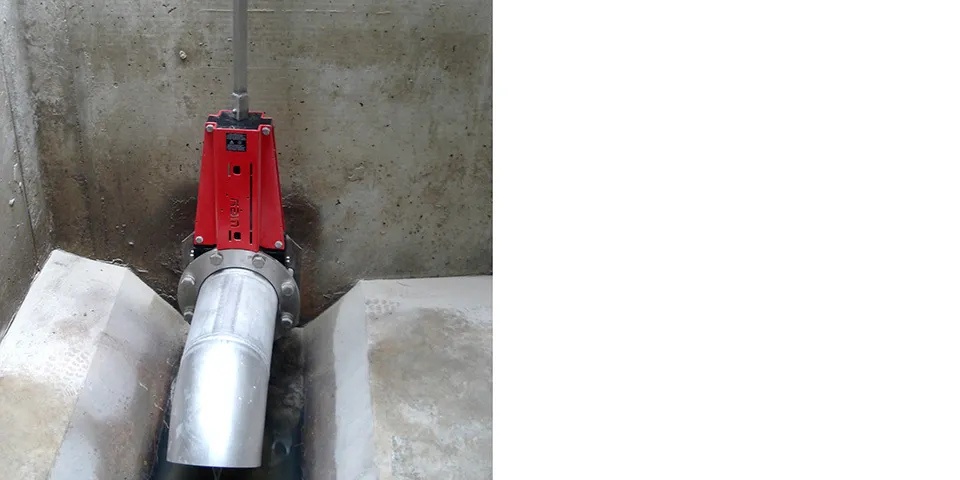
Penstock on the outlet pipe (the actuator for this penstock is shown below).
Untapped potential
In Belgium and the Netherlands, smart sewer systems are still a story of untapped potential. Emile Bruschinski says: “But the potential is enormous. Processing all the data available is a major challenge, though. New techniques for analysing big data and extracting actionable information from it, such as machine learning (ML) and artificial intelligence (AI), are on the rise. Pilot projects in this field are under way in both the Netherlands (Water Boards) and Belgium (Aquafin). The lessons learned from these projects will undoubtedly lead to these techniques being adopted increasingly in day-to-day practice.”
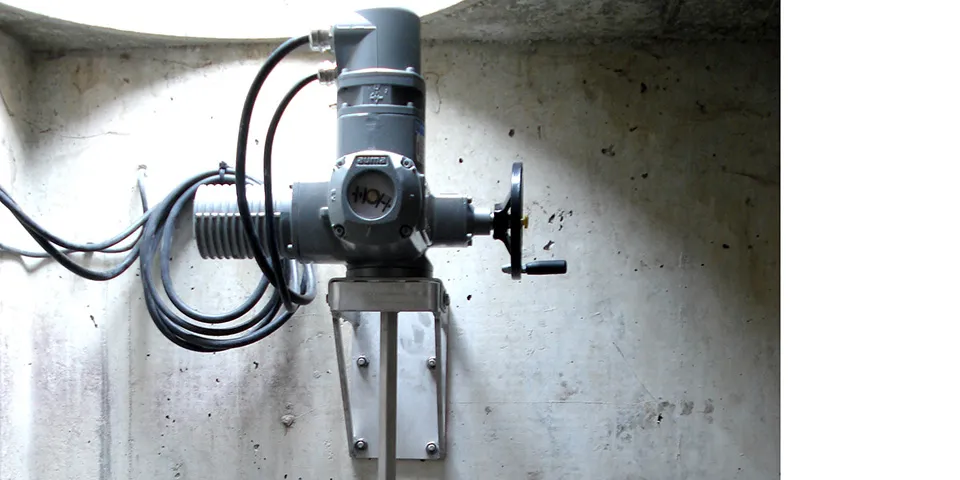
Automated actuator that operates the penstock in real time.
ESEP has developed a number of technologies for water management. “From a simple flow limiter with no moving parts, such as the well-known ESEP vortex flow regulator, to a fully automated, real-time flow management system of the EGAR type. ESEP has solutions that can be seamlessly integrated into smart water management,” explains Emile Bruschinski. “Ultimately, water flows in the sewer system will need to be physically controlled based on the information gathered. Knowing when to take which action is one thing, but putting it into practice is still necessary. The difference is that this will no longer be done on site as it was in the past, but remotely.”
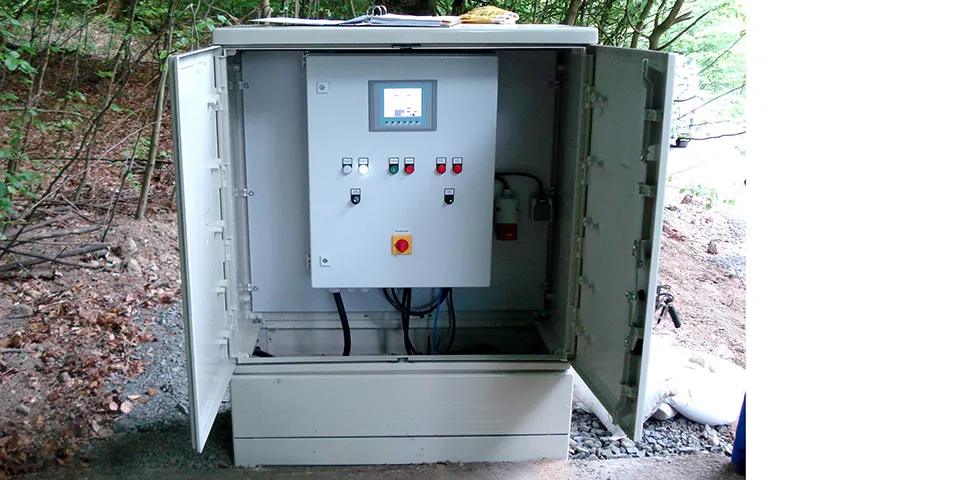
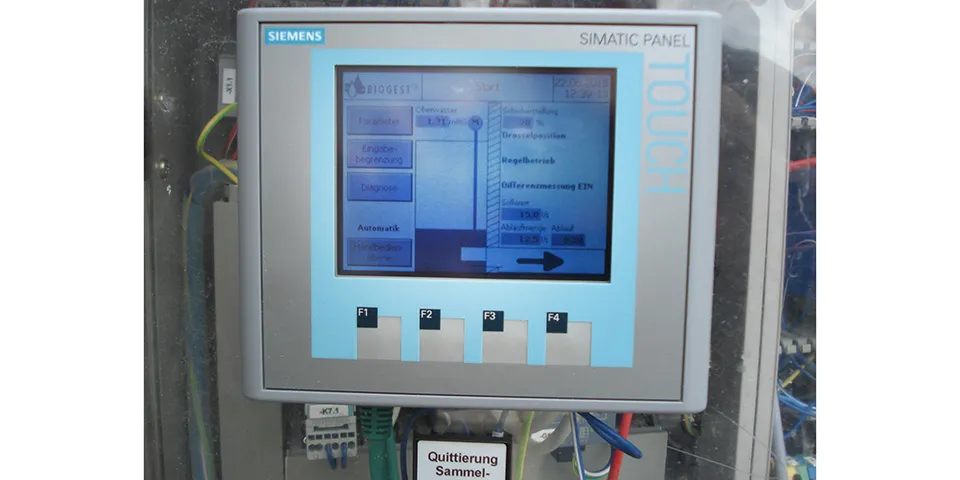
Above-ground control cabinet.
Turning pilot projects into practice
ESEP has its own testing and development facilities and works closely with knowledge institutes to keep developing and improving its solutions. Emile Bruschinski says: “For example, we use CFD (Computational Fluid Dynamics) software to develop models that support and improve our designs. We are also involved in a project using PIV techniques (Particle Image Velocity) to map the internal water flows in our water treatment and water management products.”
The challenge facing the sector now is to turn the experience gained in pilot projects into successful applications in day-to-day practice. “The potential is enormous, but success will ultimately depend on good collaboration between the various parties, such as water managers, providers of information technology, water management technologies and sensors. In the near future, I expect to see the first tangible steps taken in locations where the situation is acute and traditional solutions are undesirable or unsuitable. Over the longer term, smart sewers will become increasingly widespread,” concludes Emile Bruschinski.
Question about this story? Ask your question
Keep following this
Get an email when a new story is published. No account needed.
- ThemeRenewing pipelines and sewers
- SubjectMachines & equipment