RTC: from dumb sewers to smart sewers
Real Time Control, or RTC for short, is a cost-effective measure that gives Aquafin better control over how the sewer system’s overflows operate during wet weather. Using controllers and control structures in the system, the sewer operator can intervene immediately with RTC, manage water flows through the system more effectively and thus prevent overflows. Put simply, it turns a dumb sewer into a smart one. The principle also impressed the jury of the Belfius Smart Awards. They nominated Aquafin’s RTC for both the public award and the Smart Company Award.
Underground traffic lights
Geert Dirckx, study manager at Aquafin’s R&D department, explains what RTC involves: “Aquafin takes various online measurements in and around the sewer system, including rainfall and water levels. By correctly interpreting all the data using an algorithm, RTC control kicks in and can influence the load on the sewer network so that its capacity is used to the full. Think of it as underground traffic lights for wastewater.”

“RTC cannot prevent every discharge of untreated wastewater, but it is a cost-effective way of significantly reducing the number of overflows.” Geert Dirckx, study manager, Aquafin. (Image: Marco Mertens)
“This control is carried out in 2 ways,” explains Geert Dirckx. “First, we use our existing pumping stations more efficiently by making a simple adjustment to the PLC (Programmable Logic Controller) control programmes. This allows us to control when the pumps switch on and off. The second method is to install control structures, such as gates. We can easily open or close these to control water flows. With RTC, we aim to prevent untreated wastewater from entering watercourses during heavy rainfall. This can cause serious damage to the flora and fauna, particularly in sensitive natural areas. Our system reduces that damage to a minimum.”
Investment?
Depending on the chosen approach, whether to make optimum use of pumping stations or install control gates, investment is of course required. This can range from simple reprogramming of a pumping station’s PLC to laying cables and communications infrastructure and installing control gates. Geert Dirckx says: “Even the most extensive scenario remains a relatively cost-effective measure. Comparative studies show that RTC can often prevent overflows almost as effectively as much more expensive solutions, such as converting a combined sewer system into a separate system or building stormwater storage tanks. Yet its cost is up to seventy-five times lower.”
Several areas in Flanders are already equipped with RTC. Aquafin has drawn up a ten-year plan for its further roll-out. Since last year, we have started equipping an additional five to ten areas with RTC each year.
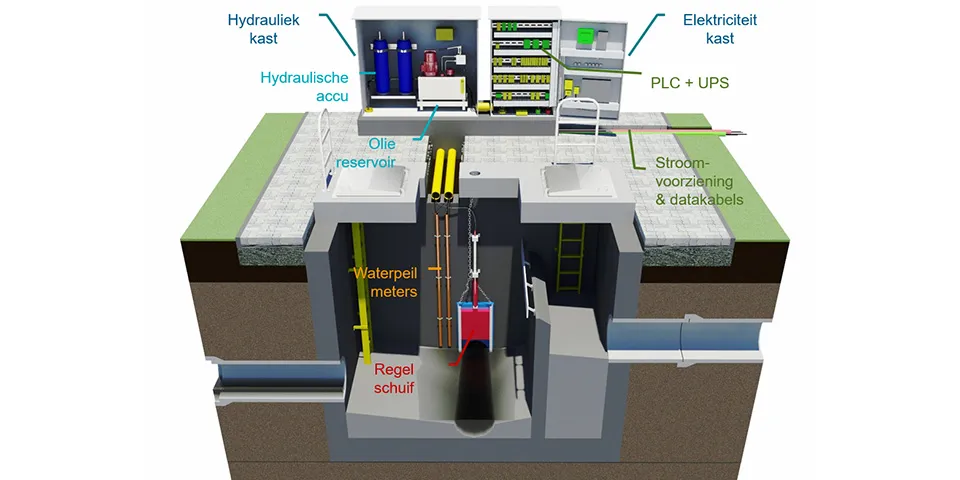
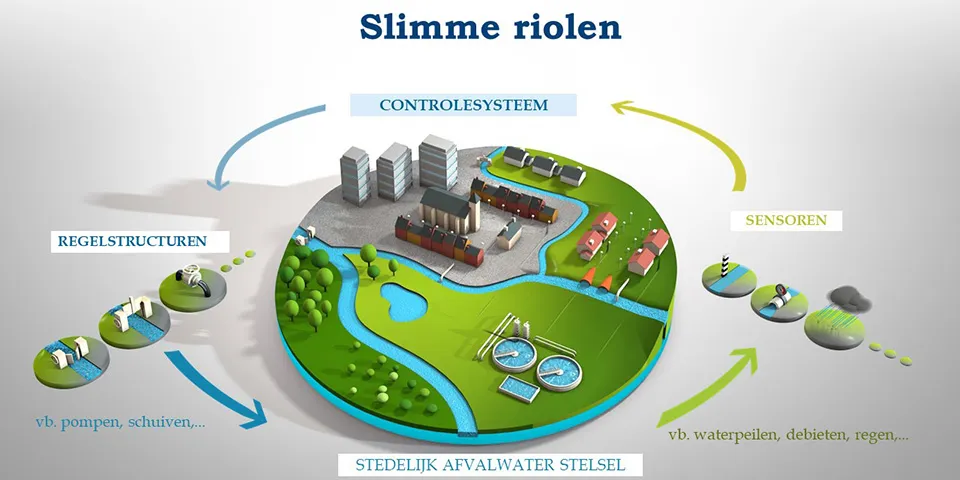
Infographic showing how RTC works.
Further possibilities
Research is also continuing. “The areas where RTC has been installed are still relatively small, but we expect the benefits to grow proportionately when we implement the technology across larger areas. That will certainly be a focus for us over the next few years,” explains Dirckx. “For now, we can only open or close the gates fully. We will also investigate the possibility of partially opening or closing them, to control the flow of wastewater more effectively.”
Aquafin will also focus on the capacity and resilience of the watercourse receiving overflow discharges. A large watercourse such as the Schelde, for example, has a greater capacity to receive water than a stream. One option could therefore be to use RTC to discharge into the Schelde to spare the stream. This too will be explored in greater depth.
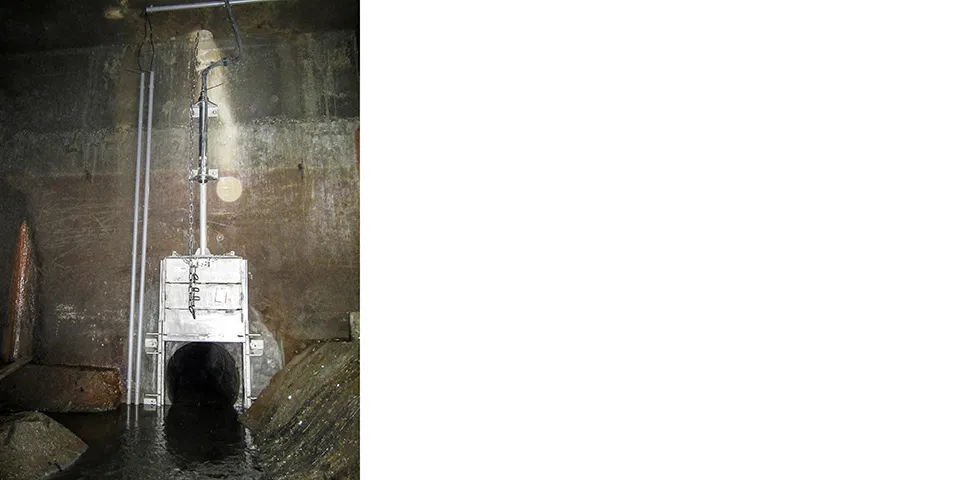
Control structures in the system reduce the operation of overflows.
The ultimate solution?
Because RTC is an adaptive system, it can be adjusted at any time to accommodate future planned disconnections or connections to the sewer network. RTC can be adapted to the new situation with relatively little investment. Does that make RTC the ultimate solution for preventing overflows? “No,” says Dirckx. “It does not have the potential to solve the problem of every overflow. But given its relatively low investment cost, its impact on reducing overflows and its adaptive nature, it has quickly become a powerful tool. Aquafin intends to continue focusing on it in the future. The nomination for the Belfius Smart Awards confirms that this can be a viable solution for dealing with overflows. We are rightly proud of it.”
Question about this story? Ask your question
Keep following this
Get an email when a new story is published. No account needed.
- ThemeRenewing pipelines and sewers
- SubjectMachines & equipment