









Experimenting with lime treatment of dike cover layers
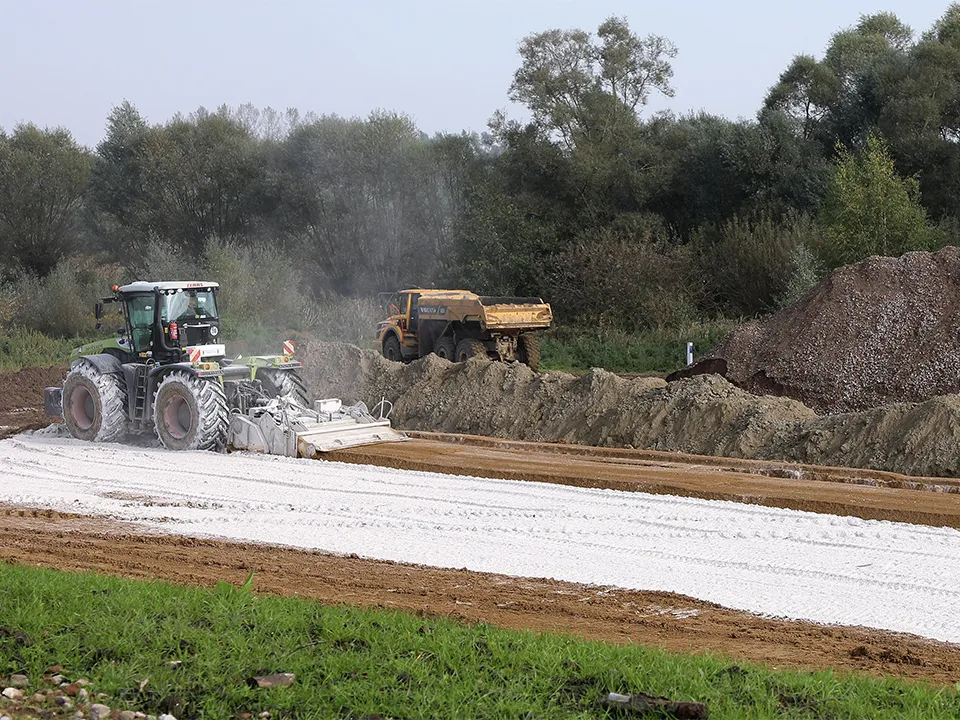
De Vlaamse Waterweg nv and Lhoist nv have constructed a test section with a lime-treated cover layer on the ring dike of the Vlassenbroek controlled flood area.
Soil that would not normally be suitable for use as a dike cover layer was mixed with a lime blend. “We are investigating whether mixing this soil with lime could make it suitable for use as a cover layer,” say Kristof Verelst, researcher at the Flanders Hydraulics Research department of the Department of Mobility and Public Works, and Gontran Herrier (Lhoist nv). Improving the hydraulic properties, particularly erosion resistance, to make soil suitable for use as a cover layer has never been done before in Flanders.
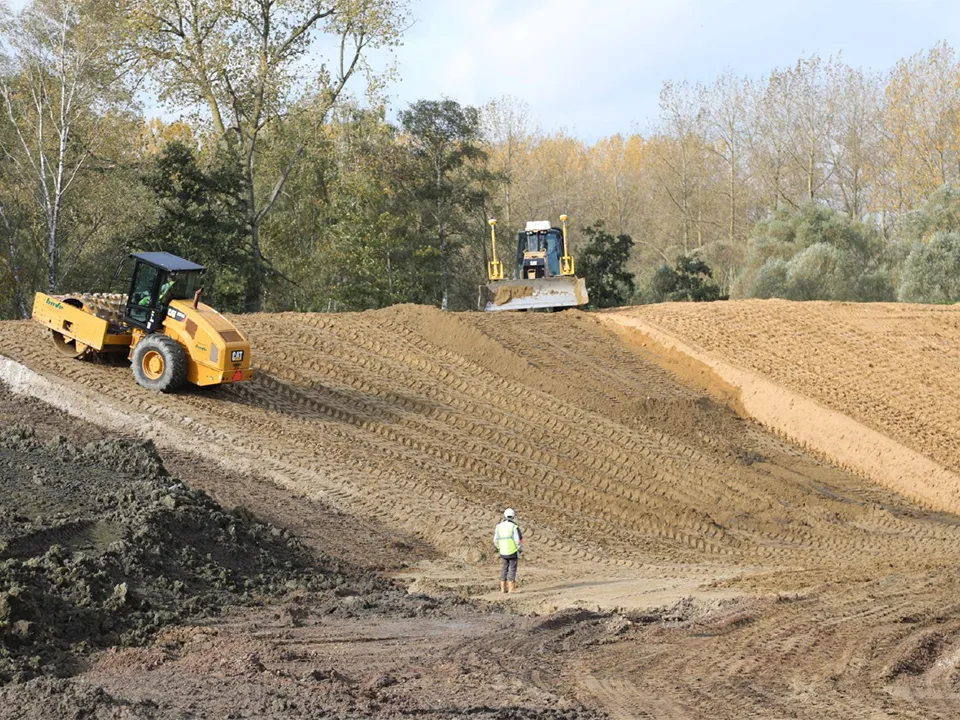
Scheldt dikes in Flanders consist of a sandy core, which provides stability, surrounded by a cover layer that makes the dike watertight, or impermeable to water. This cover layer, including vegetation, must meet a number of specific requirements regarding permeability and erosion resistance. These are often expressed as a required plasticity index (Ip) of more than 15. De Vlaamse Waterweg nv (DVW) and Lhoist nv have constructed a test section on the ring dike of the Vlassenbroek controlled flood area, where the cover layer has been treated with lime. Soil that does not meet the specific requirements for a dike cover layer was mixed with lime to bring it up to the required standard. Adding lime to soil, typically 2 to 4% by mass, is a technique widely used in the construction of civil engineering infrastructure (roads, railways, motorways, platforms, etc.). “This technique offers the opportunity to reuse soil found on site and, after compaction, improve its mechanical properties (bearing capacity, stability),” says Kristof Verelst. “Lime treatment is often used for core material. Improving hydraulic properties, particularly erosion resistance, to make soil suitable for use as a cover layer has never been done before in Flanders.”
110 cm cover layer
The 46 m-long test section was constructed at the end of October 2019. Two 21 m-long sections of the ring dike were given a lime-treated cover layer. In the northern part of the test section, the cover layer consists of imported loamy soil (Jette loam), treated with 2% quicklime (Proviacal® DD). In the southern part, the cover layer consists of sandy soil from the site itself, treated with 3% formulated lime. The lime-treated cover layer was constructed on the controlled flood area side of the ring dike and comprises four layers, each 30 cm thick. “An additional innovation in the experimental test sections was compaction along the transverse profile (slopes). This gives the cover layer a total thickness of 110 cm after trimming,” says Gontran Herrier.
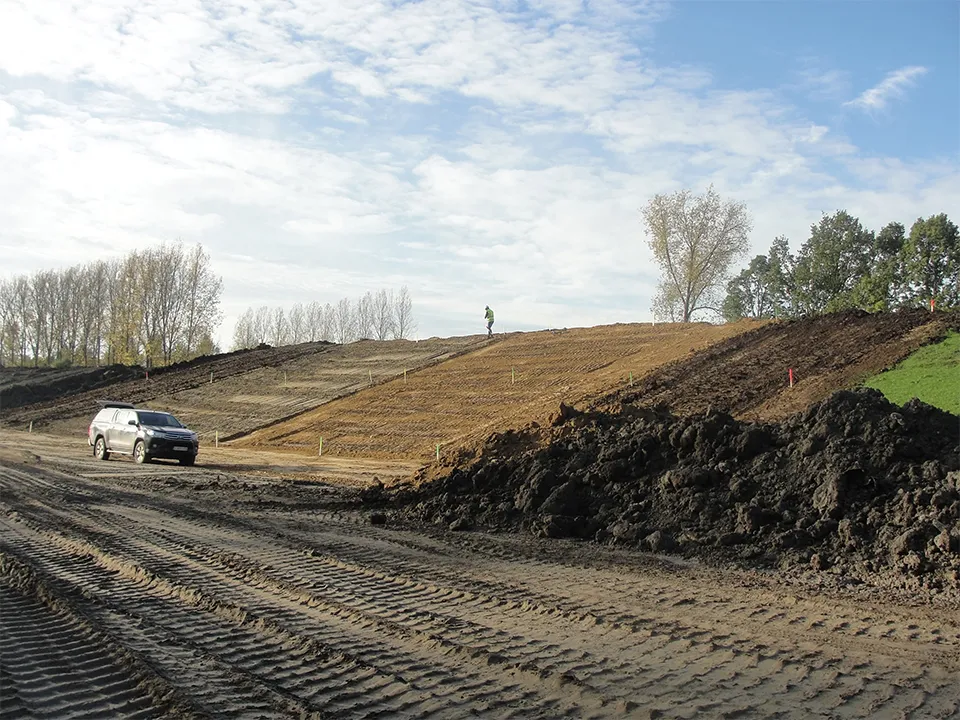
Grass sown in spring 2020
The test section was sown with grass in May 2020. “We sowed several types of grass,” says Kristof Verelst. “For five years, we will investigate how adding the two types of lime affects the growth of the different grass species, as well as the differences between the grass mixtures tested.” In each of the two sections of the test area, one zone was sown with a fertile topsoil layer and Italian ryegrass/rough meadow-grass, one with Italian ryegrass/rough meadow-grass directly on the lime-treated cover layer, and one with grass mixture B1, as used on Dutch dikes, also directly on the lime-treated cover layer. For comparison, the same grass species were also sown on a section of the dike with a conventional cover layer next to the test section.
Five years of extensive monitoring
Extensive monitoring will be carried out on the test section over the coming years. It began immediately after construction and will be repeated every six months to a year for approximately 5 years after construction. The Geotechnics department (GEO) and the General Technical Support department (ATO) of the Department of Mobility and Public Works (DMOW) will respectively measure the permeability of the cover layer and determine dike settlement using topographical surveys.
Commissioned by Lhoist, INRAE in France will carry out JET erosion tests to assess the erosion resistance of the cover layer, while the Belgian Road Research Centre (OCW) will conduct PANDA tests to determine its compaction. Vegetation (cover, rooting, species diversity, etc.) will be monitored by the Research Institute for Nature and Forest (INBO). Once the grass is fully grown and has sufficient strength, the erosion resistance of the grass cover will be determined by means of in situ overflow tests conducted by Flanders Hydraulics Research. Flanders Hydraulics Research and De Vlaamse Waterweg nv are responsible for coordinating the project. The ultimate aim is to determine the potential of the lime treatment technique.
Question about this story? Ask your question
Keep following this
Get an email when a new story is published. No account needed.
- ThemeStrengthening waterways and coastlines
- SubjectGeneral







