









Why concrete cracks
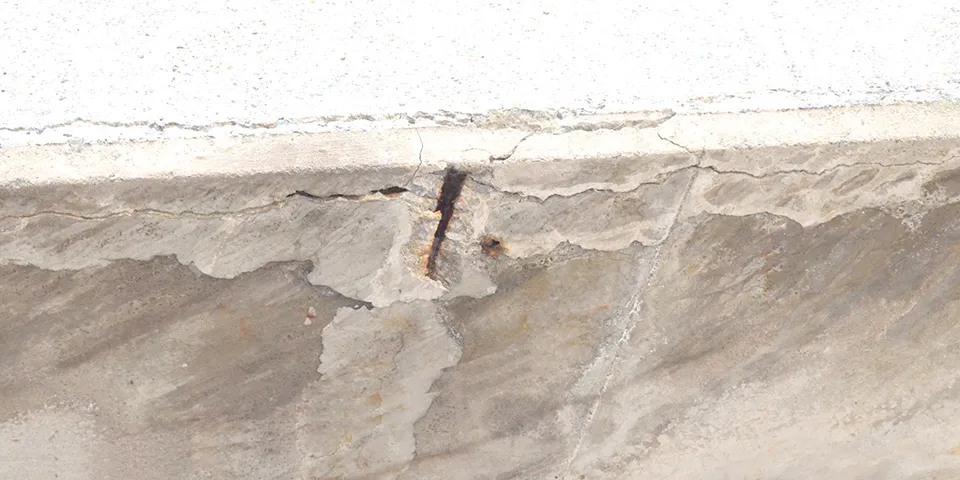
Concrete is the most widely used building material in the world. Since Louis Vicat invented cement in 1817, research and development have optimised its properties. This has led to improved applications, greater mechanical strength and chemical resistance, and new materials such as prestressed concrete. Has concrete achieved perfection over the years? If we look closely at the many concrete structures around us, we can see that none has remained perfectly intact, not even those in the newest buildings.
Concrete’s inevitable weak point is its tendency to crack. Cracking is accentuated by the very factor that accounts for concrete’s popularity: its compatibility with steel, and the fact that reinforced concrete meets the requirements of an advanced construction material. Are all cracks the same? Certainly not. Cracks can be caused by various factors, such as deformation, hydraulic shrinkage, thermal shrinkage or swelling. BASF Master Builders Solutions explains the main differences below.
Cracks caused by deformation
Concrete structures are subjected to tensile, compressive and shear forces. These forces deform the material and can cause cracks. The location and shape of a crack in a structure are often characteristic. Its cause can therefore be identified by looking closely at the cracks. Cracks caused by compression run parallel to the applied force, cracks caused by tensile force form at right angles to it, and cracks caused by shear forces run at right angles to the tensile stress.
The tensile strength of concrete is only about one tenth of its compressive strength. Concrete is therefore rarely used without reinforcement. The most common reinforcement method is to embed steel reinforcing bars in areas exposed to tensile stress. This type of concrete is generally known as reinforced concrete. Synthetic fibres can also be used as reinforcement.
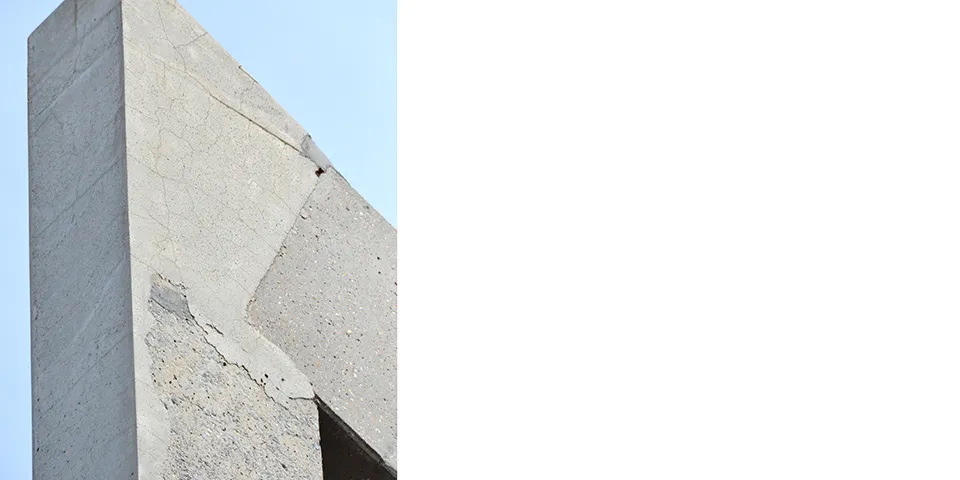
Concrete structures are subjected to tensile, compressive and shear forces. These forces deform the material and can cause cracks.
Cracks caused by hydraulic shrinkage
Concrete exposed to the open air generally shrinks as it hardens. This is because some of the water in the concrete evaporates. Cracks form when shrinkage forces exceed the strength of the concrete. This can be seen as a race against time between two processes: the evaporation of water and the increase in the strength of the concrete. The same applies to concrete elements that cannot deform. When concrete shrinks, deformation is impossible. Under these conditions, internal stress builds up, leading to cracking when the stress exceeds the strength of the concrete.
Cracks can also form before the concrete has hardened. This phenomenon is not caused solely by hydraulic shrinkage, but is rather due to some of the water evaporating or being absorbed by the substrate. It mainly affects pavements poured in hot, dry weather, or concrete poured in heated spaces or on a porous substrate in cold weather. Cracks appear at specific locations, such as at concrete joints and near reinforcement.
Cracks caused by thermal shrinkage
This problem occurs mainly in large structures. Cement hydration is an exothermic reaction that releases heat, which dissipates over time. The temperature does not change uniformly throughout the structure, causing differential deformation that can lead to cracking.
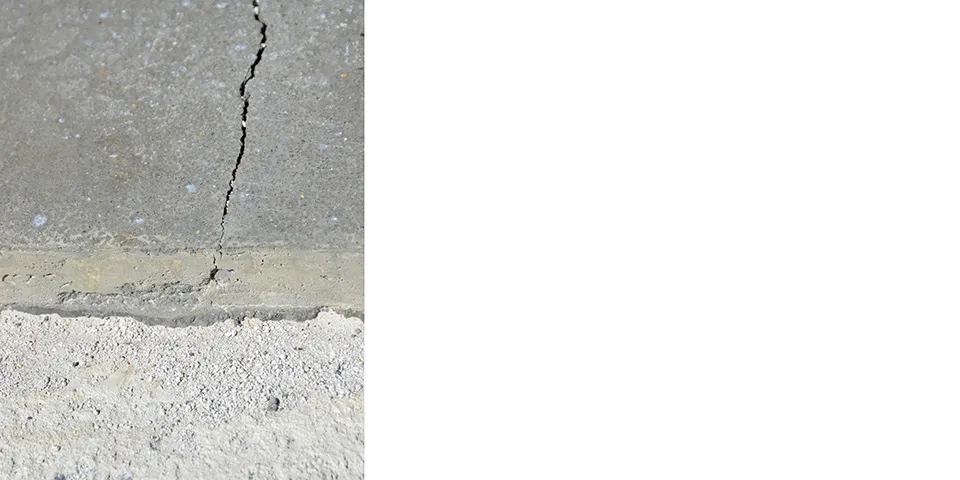
Concrete’s inevitable weak point is its tendency to crack.
Cracks caused by swelling
Concrete can swell as a result of the action of salts such as sulphates, which are often found in soil in direct contact with the concrete. This leads to a chemical reaction with the aluminate in the cement itself, forming an expansive substance. Swelling can also occur when free water in the concrete freezes and expands as it turns to ice. Finally, swelling can be caused by oxidation of the reinforcement embedded in the concrete, a process that is itself accelerated by the presence of cracks.
Cracks caused by steel reinforcement
Concrete is highly alkaline and therefore protects steel reinforcement. This makes reinforced concrete an almost indestructible material. However, under certain conditions, the reinforcing bars can corrode, forming rust. When the volume of the corrosion products is greater than the volume of the original reinforcing bar, they exert tensile stress on the concrete. In advanced stages of corrosion, the concrete can crack and delaminate. The main causes of steel corrosion in concrete are carbonation of the concrete and the presence of sea salt or de-icing salt in the concrete and around the reinforcing bars.
Question about this story? Ask your question
Keep following this
Get an email when a new story is published. No account needed.
- ThemeMaterials with a lower environmental impact
- SubjectConcrete







