









The long service life of concrete roads results in a low ‘life-cycle impact’
Roads are essential for transporting goods and people, and therefore play an important role in a country’s economic and social development. We therefore need roads that keep traffic flowing smoothly by offering high levels of availability. This, in turn, means that the number of sites for repairs, maintenance or reconstruction must be kept to a minimum.
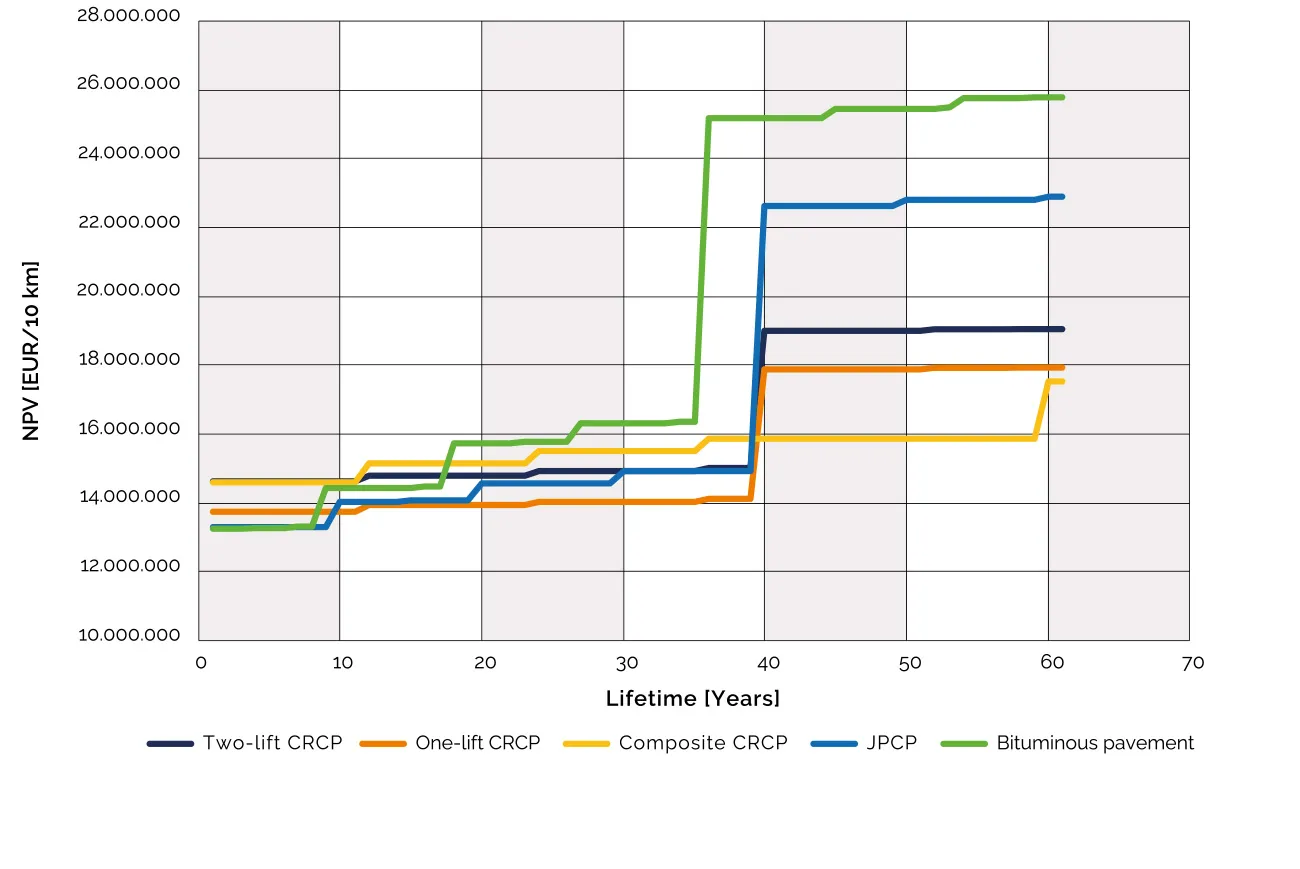
A service life of 30 to 40 years or more without structural damage is readily achievable with concrete pavements. Thanks to their long service life and low maintenance costs, the total life-cycle costs of concrete roads are low. The small number of road closures required for maintenance means less disruption to traffic, bringing significant environmental and economic benefits.
Service life and durability
A road’s service life is the period from its construction until it is no longer in use. In technical terms, this is also referred to as the durability of a structure. Keeping a road in service requires different maintenance measures for the two main road construction materials, concrete and asphalt. Throughout their theoretical service life, which is usually 30 years, concrete roads require virtually no planned maintenance, apart from renewing the joint sealant. In practice, moreover, concrete roads usually remain in service for much longer, sometimes for up to 50 years on motorways and even 100 years on roads carrying light traffic.
The long service life of concrete pavements is an advantage when carrying out life-cycle analyses. This applies both to economic analyses (life-cycle cost analysis, LCCA) and environmental impact studies (life-cycle assessment, LCA). This holistic approach is the right way to compare different alternatives, such as the choice of pavement type or rehabilitation method, by taking a long-term view. Given the comparable initial costs of asphalt and concrete structures, but significantly lower maintenance costs for concrete, the overall life-cycle cost consistently favours concrete.
Service life and circularity
A long service life with little maintenance also extends the time before construction materials are needed for new infrastructure. After demolition, the concrete is crushed and screened, then reused as recycled aggregate in the construction of the new road, either in the sub-base or as a replacement for aggregate in a new concrete mix for the road surface or linear elements. A long service life and recycling are both examples of circular construction. They conserve natural resources and reduce the unavoidable emissions generated in the production of construction materials.
Finally, modern design and construction concepts make it possible to significantly reduce tyre noise emissions, rolling resistance and fuel consumption with concrete pavements. They also provide a skid-resistant, deformation-resistant and light-coloured surface, in other words, a safe road surface.
Question about this story? Ask your question
Keep following this
Get an email when a new story is published. No account needed.
- ThemeMaterials with a lower environmental impact
- SubjectConcrete







