









Removing concrete more efficiently and easily with hydrodemolition
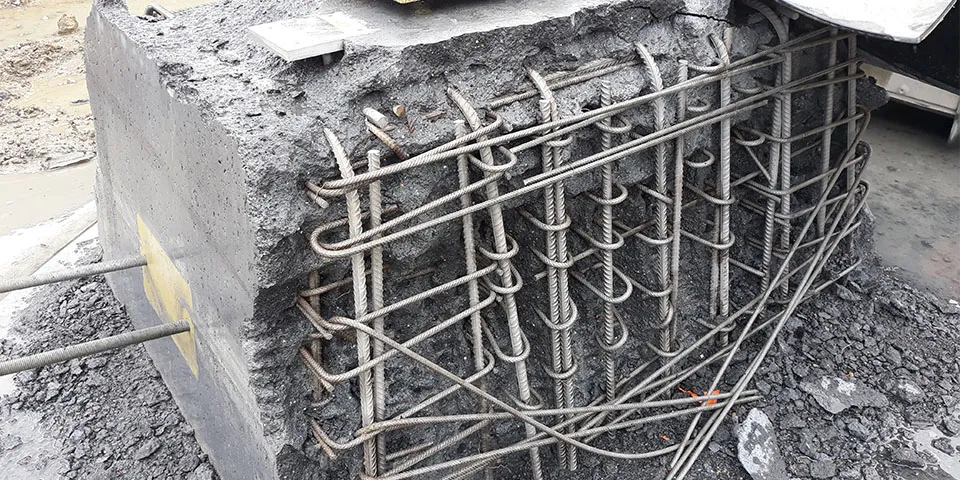
Demolishing concrete structures using water. The technique is called hydrodemolition, and JACOBS of Olen has made it a speciality. “Powerful water jets cause little or no damage to sections of concrete that are not to be removed, which is often what happens when breakers are used. But the technique offers further benefits,” says manager Bart Boone.
JACOBS has been a specialist in industrial cleaning for more than 35 years. The company, based in Olen, has been part of HCI Group since 2007. HCI Group was in turn acquired by VEOLIA in 2018. JACOBS has a modern, extensive fleet that meets all current safety standards. “In total, we have 52 truck-mounted vehicles, ranging from high-pressure units and vacuum tankers to sewer-cleaning vehicles, road sweepers and road-surface cleaners,” says manager Bart Boone.
This is more than enough to meet the needs of its customers, who are mainly in industry but also work in the construction and road-building sectors. The construction industry can call on JACOBS for road sweeping, sewer works, grout-slurry removal and the cleaning of, among other things, sumps, pipes and diaphragm walls. JACOBS also offers hydrodemolition. This innovative technique uses high-pressure water to break up or roughen concrete and other materials while preserving the reinforcement.
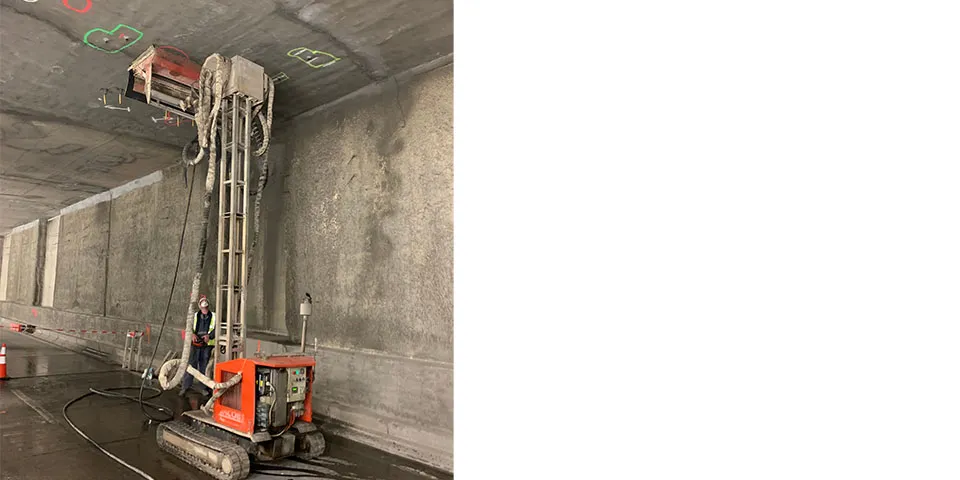
JACOBS has already used the technique, among other projects, to renovate the ceilings in several Brussels tunnels.
Up to 3,000 bar
“Ageing concrete is still often removed using heavy pneumatic breakers, and this way of working has a number of disadvantages,” Boone explains. “Hydrodemolition eliminates those disadvantages. Powerful water jets break up the old concrete while causing little or no damage to sound sections, which is often what happens when breakers are used. Unlike pneumatic breakers, the technique is vibration-free. It therefore does not cause cracks in the concrete that is to remain, and the reinforcement also comes through undamaged. Hydrodemolition also puts an end to the fine dust inevitably generated by conventional demolition work, as the water washes it away.”
“The pressure used ranges from 800 to 3,000 bar,” Boone explains, “depending on the required depth, the quality of the concrete and the method of spraying. Hydrodemolition is therefore most often carried out automatically using robots, but it can also be done manually with a high-pressure lance. It is an ideal solution for renovating bridges, tunnels and buildings. It is also often used after concrete has been incorrectly poured or when additional reinforcement needs to be added. JACOBS can also supply the water required and take care of cleaning up and removing the material.”
Ghent Book Tower
JACOBS has already used the technique, among other projects, to renovate the Boekentoren in Ghent, the Temsebrug in Temse, and to carry out various repairs to ceilings in Brussels tunnels, including the Stefania, Montgomery and Rogier tunnels. “The technique can also be used to prepare concrete underground,” Boone adds.
Question about this story? Ask your question
Keep following this
Get an email when a new story is published. No account needed.
- ThemeMaterials with a lower environmental impact
- SubjectConcrete







