









Moving towards sustainable concrete repair
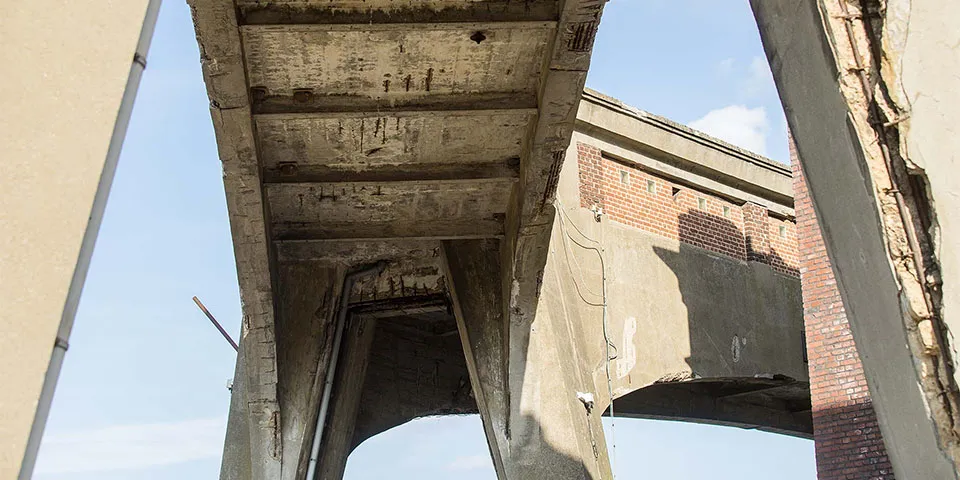
Research shows that 50% of repaired concrete shows signs of damage again within 5 to 10 years of the repair.
The reasons are varied: insufficient diagnosis of the initial damage, an inadequate repair solution, poor implementation, the wrong choice of materials … Premature failure of a repaired structure creates considerable uncertainty about its expected service life, as well as recurring and rising costs. That is why it is important to make progress in sustainable concrete repair.
Words and images | Master Builders Solutions Belgium nv
The focus is still too often limited to repairing visible damage. We repair just the broken section with a repair mortar and call it a day. Although high-quality repair mortars are often selected, so-called patch-and-paint strategies are certainly not enough to achieve an optimal extension of service life.
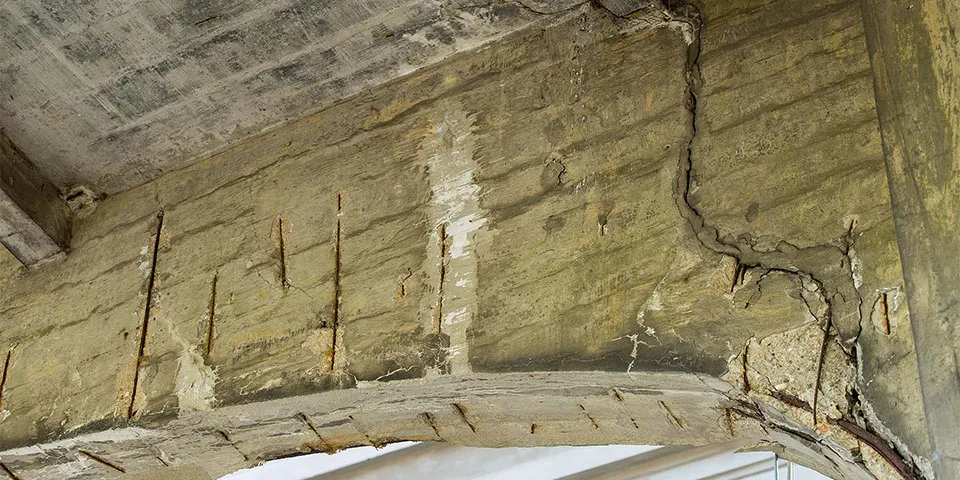
Concrete deterioration, here at the old coal mines in Waterschei, can pose a risk to a building’s stability.
Sustainable concrete repair
A well-designed repair solution will not only address visible damage, but also provide additional protection for the concrete and reinforcement. Protection must first and foremost be tailored to the environmental conditions. It must also take account of the structural loading (a concrete surface subject to traffic loading requires a different approach from a vertical wall in a building) and, of course, the owner’s wishes and expectations.
Under the Master Builders Solutions brand, a Life Cycle Cost model was developed to compare the cost of repair plus protection with repair alone, based on project information and product properties. The report states that every euro invested in protection saves 3 to 5 euros in recurring repair costs, and that appropriate protection eliminates an average of three repair cycles over the structure’s service life.
The EN 1504 standard, which has been in force for more than ten years, covers all aspects of concrete repair and material selection. It sets out guidelines for sustainable repair design. These guidelines must be applied more widely and more effectively.
Extended service life
Exposed reinforcement must be treated with a corrosion-protection product, after which the concrete is repaired using repair mortars. An appropriate protection system is then applied. Special techniques such as crack injection, anchoring of reinforcing bars, bonded reinforcement and cathodic protection are beyond the scope of this article.
Corrosion protection for reinforcement
Corrosion protection for reinforcement is usually carried out using method 11.1, with active primers: cement-based materials containing special corrosion-inhibiting additives. These materials are applied by hand to the exposed reinforcement. The key properties are adhesion to steel and concrete, and the treated steel’s resistance to corrosion.
Repair mortars
European standard EN 1504-3 defines 4 classes of repair mortar. These are divided into structural (R3 and R4) and non-structural (R1 and R2) repair mortars, and must be used differently depending on their consistency and application method: hand-applied (small and medium-sized repair areas), poured or pumped (large repair volumes) or sprayed (large surface areas).
Protection
Protection must meet the environmental conditions set out in EN 206-1, and the products to be used are specified by EN 1504-2. Protection can take several forms.
In environments where there is a risk of corrosion caused by CO2, carbonation-inhibiting coatings should be used. Examples include buildings and bridge piers. These are usually water-based acrylic emulsions. The key properties of a carbonation-inhibiting coating are high resistance to CO2 penetration, impermeability to water, water vapour permeability and high crack-bridging capacity.
Hydrophobic impregnation should be used in environments where concrete is exposed to freeze-thaw cycles, with or without contact with de-icing salts. Polymers sprayed directly onto the concrete penetrate its pores, making it water-repellent. The key properties are penetration depth, freeze-thaw resistance, reduced algae growth and little to no change in the appearance of the concrete.
Corrosion inhibitors are molecules that prevent and slow down corrosion reactions in reinforcement. They are particularly useful on jetties, bridges and industrial structures in contact with seawater and chlorides … The inhibitors must reach the reinforcement to be effective. These molecules are therefore dissolved in a carrier that penetrates the concrete by impregnation. Under EN 1504, the key properties of these systems are the same as those for hydrophobic impregnation.
Protection against chemical attack is often needed in industry, for bunds, containment basins and tanks, as well as for protection against biogenic sulphuric acid in wastewater treatment plants and sewers …
The choice of technology depends on the application and environmental conditions, such as temperature, humidity, and whether the environment is open or enclosed. It also depends on the chemicals involved and whether contact is temporary or permanent. In general, the main differences between these technologies are their chemical resistance and their crack-bridging capacity. Other important properties include adhesion, impermeability to water, abrasion resistance and thermal compatibility.
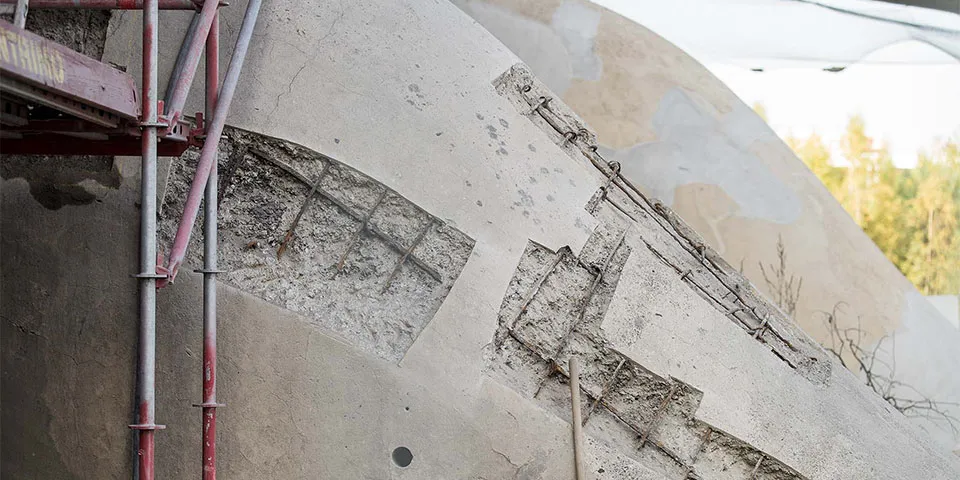
It is essential to consider sustainable, well-planned concrete repair at every stage.
Certification, safety and support
Three elements are crucial: certification, safety and support. CE marking in accordance with EN 1504 should be the starting point when selecting materials. However, not all CE markings are the same. The product-specific parts of the standard set out the minimum requirements products must meet in each situation. There are also additional requirements depending on the environment and loading, known as extended uses. Check the minimum requirements products must meet in each situation and whether there are any additional requirements. It is also worth consulting the products’ declarations of performance (DoPs), as they may need to meet quality and additional requirements (BENOR, BELGAQUA labels …).
A second point to consider when selecting materials is not to get caught up in a battle for the numbers. We tend to compare materials and look for the one with the highest compressive strength, the best adhesion, the best water resistance … If the materials meet the certification requirements for the application, that is usually sufficient. It may be better to consider other factors, which in many cases also have a significant impact on durability and investment costs, such as ease of use and how efficiently applicators can apply the material. Safety for people and the environment is also becoming increasingly important. Are any harmful substances released during application or afterwards? Are special safety measures required? What about waste disposal? These are important factors to consider, especially for homes and public buildings.
A third and final point to consider when selecting materials, and certainly not the least important, is the supplier. What level of support can you expect from them? Can the supplier provide technical support during the design phase and to contractors? What guarantees can they offer, and what support can you expect if something does go wrong? These are also factors that can make a significant difference to whether or not a durable concrete repair is achieved.
Een zakelijke vraag aan Master Builders Solutions Belgium nv? Get in touch
Companies in this story
Keep following this
Get an email when a new story is published. No account needed.
- ThemeExtending the life of bridges and tunnels
- SubjectConcrete
- CompanyMaster Builders Solutions Belgium nv







