









More than 600 concrete enthusiasts gather for Concrete Day
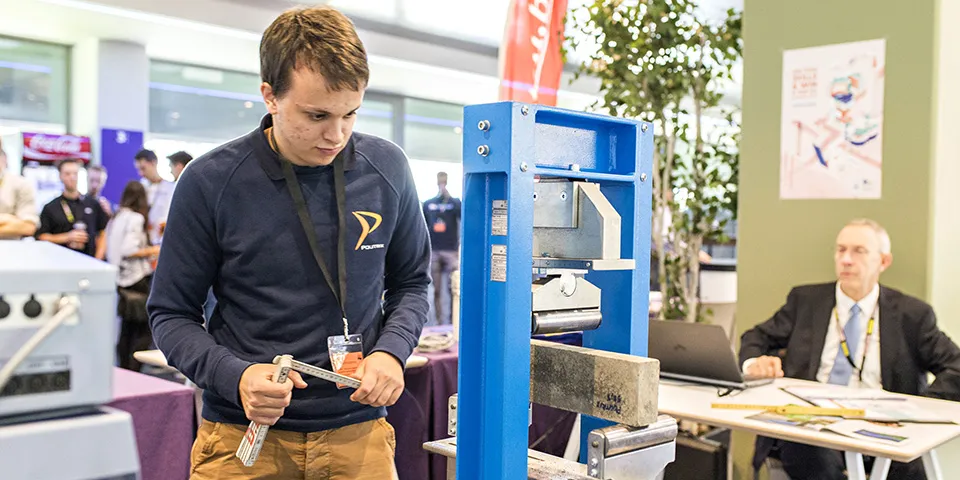
The leading lights of the concrete sector gathered at the Constantin Van Den Stock stadium in Anderlecht on 18 October for the annual Concrete Day, organised by the Belgian Concrete Group (BBG). Safety and infrastructure, Concrete 4.0 and circular construction were among the topics covered in the almost thirty talks on the programme. More than 600 concrete enthusiasts attended Concrete Day.
As is traditional, Concrete Day was preceded by Febelcem’s press conference. There, chairman and director Eddy Fostier and André Jasienski highlighted the importance of the cement sector, both in Belgium and worldwide. “Global cement production stood at 4.56 billion tonnes in 2016, half of which was produced in China,” Eddy Fostier began. “With consumption of 6.25 million tonnes and 547 kg per inhabitant, Belgium is among Europe’s top performers.” He also emphasised the sector’s efforts to limit its environmental impact. André Jasienski, meanwhile, drew attention to the decline in investment in concrete pavements, which is a source of concern for the sector.
Safety and infrastructure
Concrete has come in for regular criticism over the past year. Think of the Morandi Bridge, the failure of the nuclear power stations, the Brussels tunnels… This has not gone unnoticed by the BBG. Safety and infrastructure was therefore a key theme at Concrete Day. In his opening remarks, chairman Luc Taerwe stressed that concrete structures remain the most durable and economical construction solution. “Robustness is a hot issue in concrete construction today,” he said. “There are always risks when you build, but you can reduce them by investing more in monitoring, inspection and maintenance. When it comes to tenders, the lowest price is still the key criterion. Quality, however, should come first.”
Paul Meekels, head of the Concrete and Steel Expertise Division at the Mobility and Public Works Department of the Flemish Government, explained at Concrete Day the condition of bridge infrastructure in Flanders and how it is inspected. The previous issue of Grond/Weg/Waterbouw provided an in-depth look at how the Flemish Government prioritises robust design.
Also focusing on safety, Benoit Parmentier of WTCB presented a new test method for measuring concrete’s susceptibility to cracking. Dorothée De Pauw presented Diamonds, software that quickly and efficiently calculates the fire resistance of T-beams and cast-in concrete sections. Tom Michiels, HSE Manager at CRH Europe Materials, discussed the safe transport of concrete.
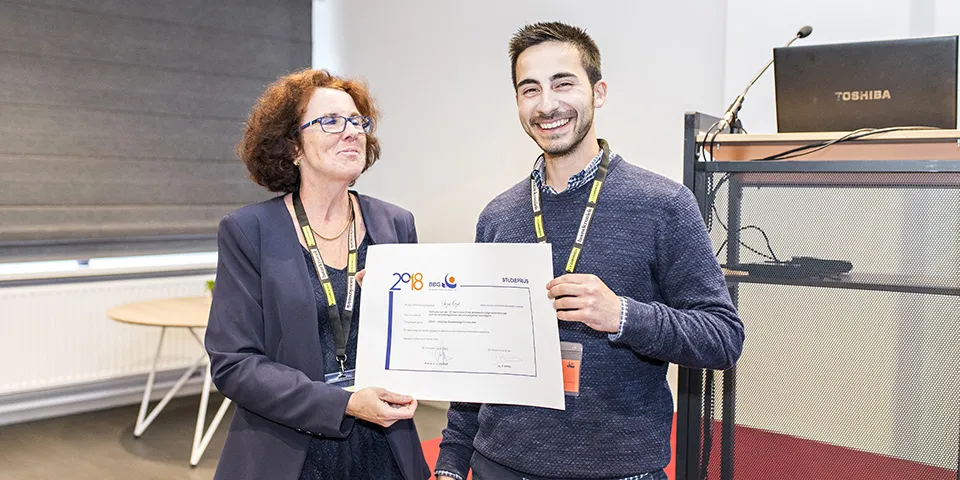
Pascale Hardy, Training Manager at the BBG, with Study Prize winner Sezan Özel.
Concrete 4.0
How digitalisation can also add value to infrastructure works became clear during Jan De Bièvre of Arkance Systems’ presentation of SiteVision. SiteVision is an augmented reality solution that makes it possible to visualise a BIM model on site. “You simply connect a smartphone to a Trimble GNSS receiver and, via Trimble Connect, see all the data contained in the 3D model projected onto the real world,” he explained. “This allows you, for example, to visualise underground cables and pipes or structures yet to be built on site.”
Rob Piosik of Command Alkon presented a digital application that measures concrete properties in real time during transport.
Workshop for architects
The Belgian Concrete Group also organised a workshop for architects in partnership with FEBE, the Flemish Architects Network (NAV) and Infobeton. The session covered ‘The 10 Commandments of Precast Concrete’, ten basic rules to be followed during design, construction and aftercare to achieve good architectural concrete.
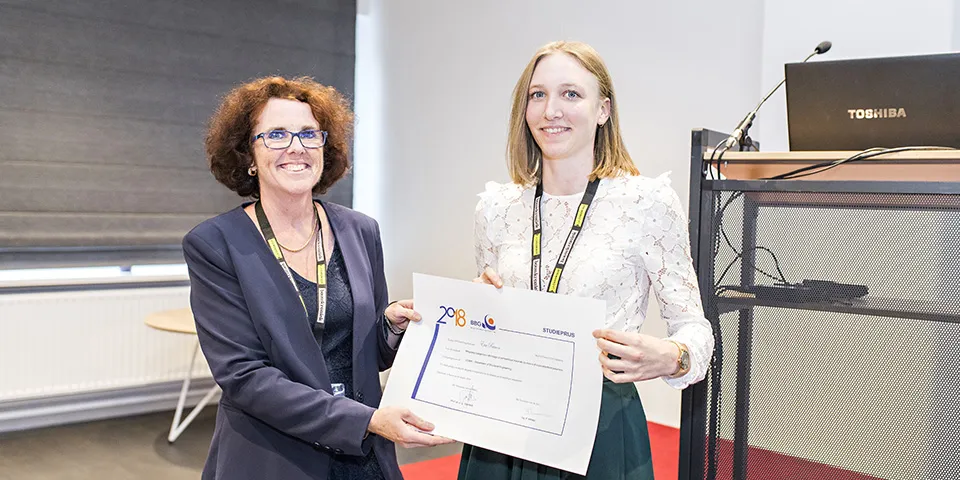
Pascale Hardy, Training Manager at the BBG, with Study Prize winner Eva Ramon.
Student prizes
This year, too, the BBG awarded a Study Prize for the most outstanding final-year project in the field of concrete. The prize recognises a project submitted in 2018 at a Belgian educational institution in the disciplines of civil engineering, civil engineering and architecture, or industrial civil engineering. The two Study Prize winners were Eva Ramon and Sezan Özel, both from Ghent University.
For the eleventh time, the Belgian Concrete Group and Infobeton organised the Infobeton Student Contest. Under the theme ‘Double Impact’, students were challenged to produce concrete that best met the specified requirements. The task was to make two test specimens, with the second having twice the strength of the first. Ghent University took the top prize here too, with team Schoonmeersen. Second and third place went to Team Concreet from UAntwerpen and the Poutrix team from UGent.
Een zakelijke vraag aan BBG | Belgische Betongroepering? Get in touch
Companies in this story
Keep following this
Get an email when a new story is published. No account needed.
- ThemeMaterials with a lower environmental impact
- SubjectConcrete
- CompanyBBG | Belgische Betongroepering







