Grond/Weg/Waterbouw Vlaanderen is part of Louwers Mediagroep: 45+ trade platforms in the Netherlands, Flanders and Wallonia. Trade magazines, websites, newsletters, video and podcasts, since 1987.
Renewing almost 1 km of track while replacing 4 sets of points at the same time would usually disrupt rail services for several weeks. To limit the impact on our customers, Infrabel engineers are testing a new, innovative technique this weekend. Rails, ballast and sleepers were pre-assembled on a mobile concrete slab alongside an operational railway line. This Saturday, the gigantic “Tetris block”, weighing as much as 18 long-haul aircraft, will be pushed into its final position. This technique will allow rail services to resume much sooner.
A gigantic 6,100-tonne “track block” inches into place at 1 metre per hour between Namur and Charleroi
As heavy as 18 long-haul aircraft
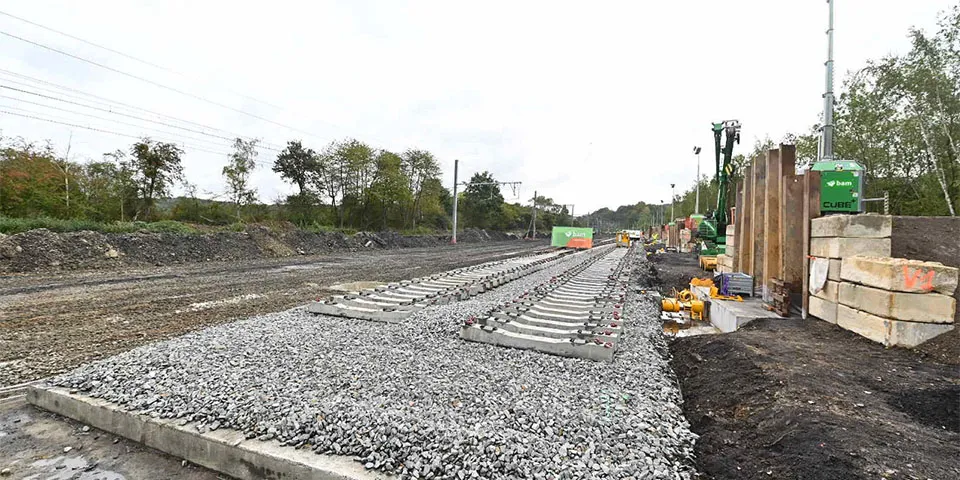
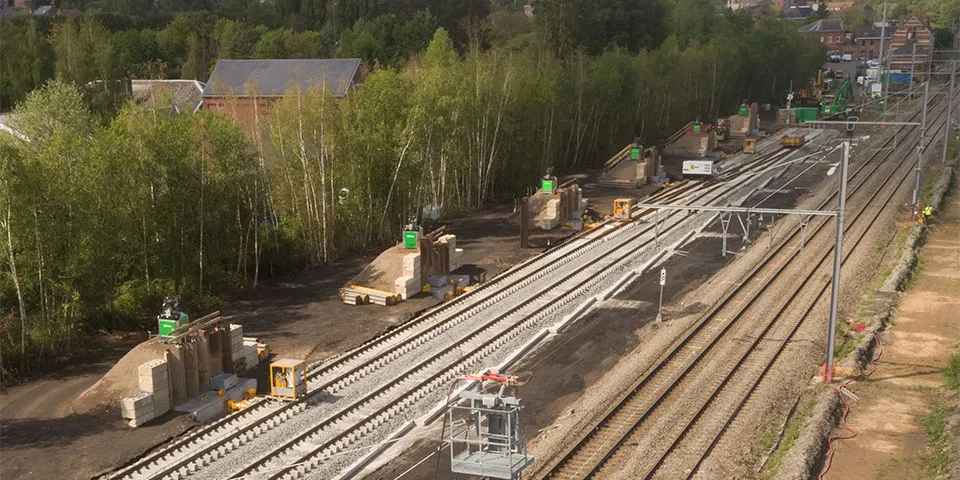
Work began in early May near Franière stop, right beside the Namur-Charleroi line (L130), one of the main railway lines in Wallonia. The first task for the Infrabel teams was to produce a slab using 1,300m³ of concrete and 300 tonnes of steel reinforcement, on the site of a former goods yard. The structure is “XXL” in size: 480m long, 8m wide and around 30 cm thick. In a second phase, this slab, like a gigantic Tetris block, was fitted with 2x480m of track, ballast (the layer of stone) and 4 sets of points. The result? A complete, “ready-to-install” section of the railway network.
The second part of the work is taking place on 5 and 6 September: this “giant” must be pushed into its final position, a distance of around 16 metres. It is a challenge when you consider that the structure weighs no less than 6,100 tonnes, equivalent to 18 fully loaded long-haul aircraft.
An unprecedented operation in Europe!
This technique, developed by Infrabel engineers, is a first: never before has a section of railway infrastructure been installed this way in Europe, not in terms of its size, weight or the distance moved.
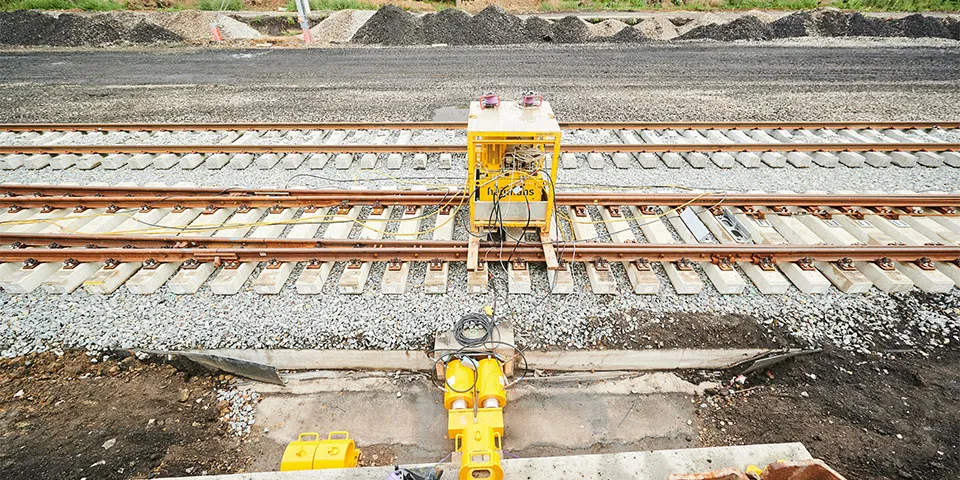
Since Friday evening, around a hundred people, assisted by a dozen cranes and machines, have been carrying out the work. As a special measure for this delicate operation, train services between Namur and Tamines have been suspended. First, the existing railway infrastructure, which is nearing the end of its service life, was dismantled. Removing the rails, ballast and sleepers made the space needed to install the new infrastructure. To move this colossal structure, the technicians first built massive blocks, with foundations 3 metres deep, and positioned 16 hydraulic cylinders against them. The cylinders are spread along the entire length of the concrete slab. It will take around ten hours to push the whole structure into place. Maximum speed: 1 m/hour!
Once the slab is in place, the new infrastructure must be connected to the existing tracks on both sides. Services can resume on Tuesday morning, after around seventy hours. This section of track previously ran through a sharp curve. The new infrastructure has partly removed the curve. Trains will eventually be able to travel at 120 km/h, instead of the 100 km/h permitted by the previous configuration.
A major benefit for our customers
When Infrabel renews its track infrastructure using the “traditional” method, work is often carried out at night, or sometimes under a so-called single-track operation. One track is then taken out of service, and trains run in both directions in turn over the only track still available. This can cause disruption and potentially significant delays. On a major railway line such as the one between Namur and Charleroi, the potential impact of a project like this is considerable, with 135 passenger trains and around 40 freight trains per day.
The innovation at Franière is primarily a way of limiting the impact of the work on services. For Infrabel, this investment, of around 4 million euros, is no greater than what we would spend on a traditional track renewal. The benefit for our customers, however, is significant. What is more, our staff did not have to work near the tracks while the new infrastructure was being built. This makes the work much safer. Another real advantage!
In concrete terms, this innovation allows us to:
limit the work to 18 days (and 3 weekends) of single-track operation, compared with 49 days of single-track operation (and 8 weekends) using a traditional method;
limit the number of weekends with a complete line closure to 3 (instead of 5);
reduce by a factor of 4 the period during which a temporary speed restriction applies after the work.
De video laadt pas als je op afspelen klikt.
An innovation that cannot be used everywhere
This European first must be evaluated, but given its benefits, it is already clear that the method will be used on other railway projects. Infrabel is already studying whether it could be used for two infrastructure renewal projects on the “Athus-Meuse” freight line, which links Antwerp to the Luxembourg border.
However, this type of innovation cannot simply be used everywhere. There needs to be enough space alongside the railway, and the site must also be easily accessible to ensure materials can be delivered quickly and efficiently.
Find the right company in the sectorSearch by product, area of expertise, region or project in the company directory and across all articles from Grond/Weg/Waterbouw Vlaanderen.
We use cookies to keep the site working properly. With your consent, we also use cookies for statistics and third-party banners. Read more in our privacy and cookie statement.