









Concrete steps out of the shadows
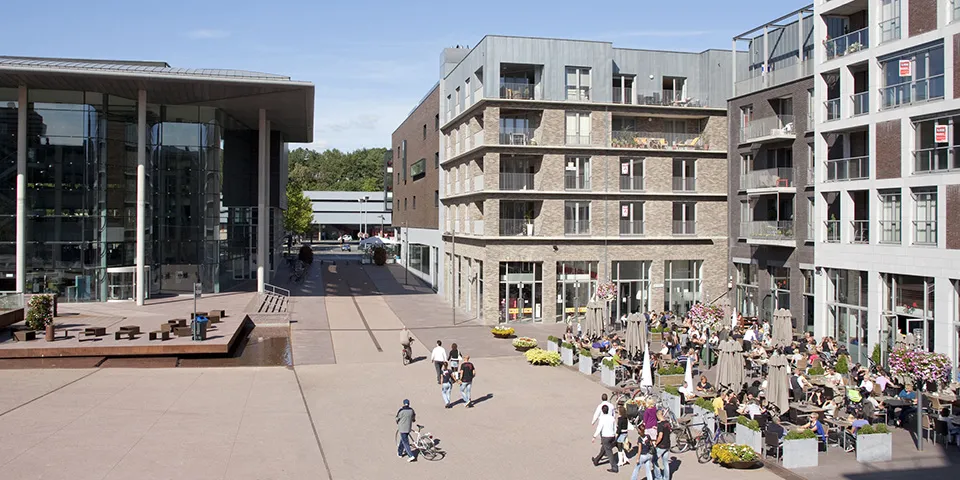
Exponential population growth is pushing us towards the mass construction of large numbers of urban homes. Buildings will also continue to reach ever greater heights. At present, there is no alternative to concrete that can meet this enormous challenge, particularly for the many applications that are essential to the proper functioning of our society: hydraulic engineering works, civil engineering structures, buildings, and so on.
It is therefore unrealistic to stop building with concrete, both in Europe and in the rest of the world, where the most significant demographic growth is taking place. Efforts should focus on producing the material itself, particularly its most energy-intensive component: cement. Innovation in the cement industry is a source of pride for the sector. As part of its ongoing efforts to reduce its carbon footprint, the cement industry took a further step towards energy efficiency and lower CO2 emissions in 2016, with a Roadmap 2050 built around three main levers.
Three levers
As the circular economy gradually expands into every sector, the cement industry has long been one of its advocates. The specific characteristics of the cement production process, as well as the non-renewable nature of its basic raw materials, such as limestone, have led the industry to develop secondary materials and alternative fuels. Improving the energy efficiency of processes and production equipment is a second key lever for the cement industry in reducing its environmental footprint. The sector is making sustained investments to equip cement plants with the best available technologies required by Europe and the relevant authorities.
The cement industry is also carrying out important research into CO2 capture technologies tailored to its industrial processes. The potential of CO2 capture and storage is promising in terms of drastically reducing the carbon footprint. In this regard, the research and innovation project “LEILAC” (Low Emissions Intensity Lime And Cement), funded by the EU, was developed for completion by 2020. This pilot project, carried out at the CBR-HeidelbergCement-group cement plant in Lixhe (Visé), will enable the cement and lime industries to significantly reduce carbon dioxide emissions.
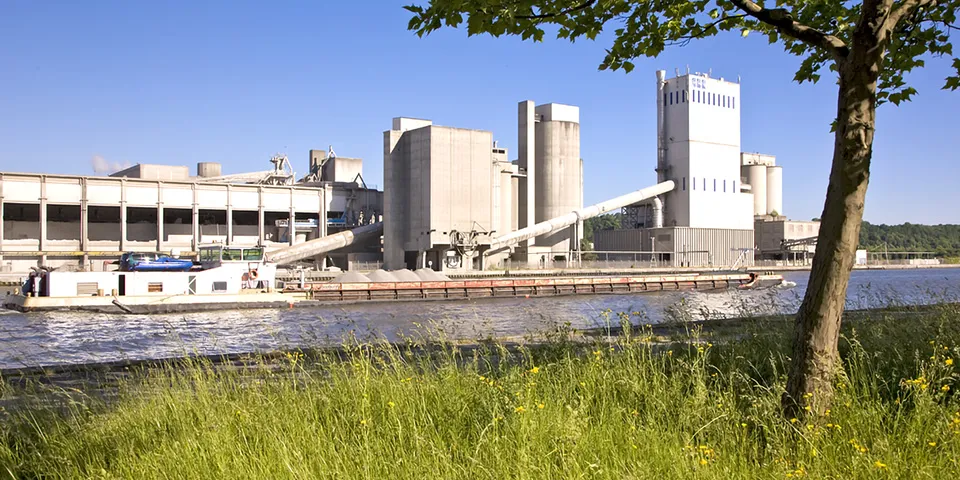
The CBR plant in Lixhe, Visé. (Image: CBR)
TOTEM tool
At the request of FEBELCEM, the University of Leuven (KUL) used the TOTEM tool to assess a terraced house and an apartment building. The assessment drew on the TOTEM library, which contains various combinations of materials for floors, roofs, façades (including windows) and internal walls. Three construction methods were compared for the terraced house: brick, concrete and timber frame. The difference in environmental cost between the three options proved insignificant, at less than 5%. Concrete occupies the middle ground between brick and timber frame. On average, 85% of the environmental cost is attributable to materials, and 15% to energy use during the use phase.
Three structural options were also compared for the apartment building: steel, concrete and CLT (cross laminated timber). On average, materials account for around 90% of the environmental impact here, with energy use during the use phase accounting for 10%. However, clear differences emerge between the various options, particularly in terms of environmental cost during the production phase. For concrete, this is almost half that of steel, and almost 30% lower than for CLT.
The TOTEM study objectively confirms the sustainability and excellent performance of concrete compared with competing construction materials. With this tool, Belgium is among the European frontrunners in promoting the use of life cycle assessment (LCA) in the construction sector, and in objectively assessing and reducing environmental impacts.
At the beginning of 2018, the three Regions launched TOTEM, the ‘Tool to Optimise the Total Environmental impact of Materials in buildings’. This online software enables designers to objectively estimate the environmental impact of entire building projects. Total environmental impact is analysed using the established CEN indicators (see European standard 15804), supplemented by a series of so-called CEN+ indicators (ILCD/PEF). The assessment covers the entire life cycle, from the production phase of materials through to the treatment of demolition waste. The result is expressed as a cost in euros per m² of gross floor area. Energy use during the use phase (EPB requirements or Passive standard) is also taken into account.
Question about this story? Ask your question
Keep following this
Get an email when a new story is published. No account needed.
- ThemeMaterials with a lower environmental impact
- SubjectConcrete







