









Concrete is not so bad after all!
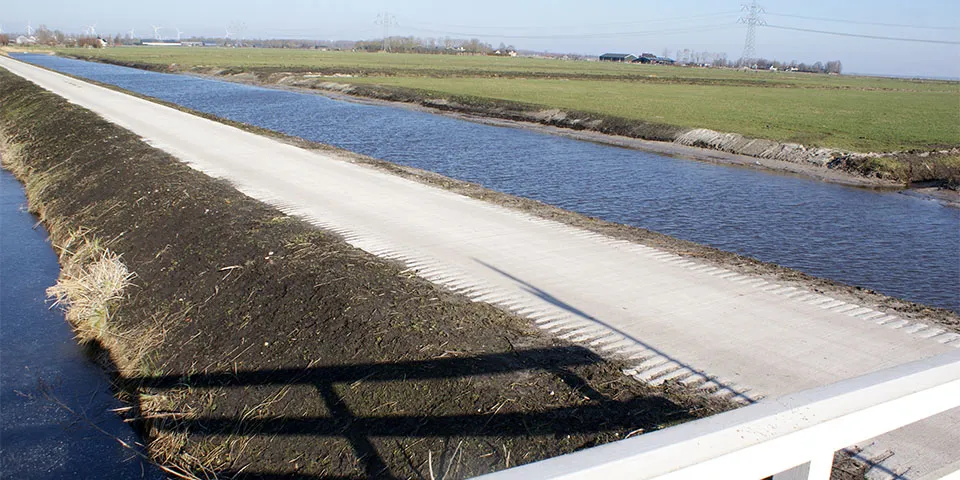
Compared with not building at all, putting up houses, offices, flats, factories and other structures is always bad for the environment, whether you use concrete, brick or timber.
Four questions about concrete answered
1. People say building with concrete is bad for the environment, but is that really true?
Building with concrete is more environmentally friendly than you might think. In the Netherlands, concrete accounts for just 1.6 per cent of CO2 emissions, including emissions from cement and reinforcing steel produced abroad. Cement is the material used in concrete that causes the most CO2 emissions. Around 80 per cent of total carbon dioxide emissions are attributable to cement. The rest of the CO2 emissions come from energy used for transport and production.
The 1.6 per cent share is low, especially considering that three-quarters of the mass of construction materials used in residential and non-residential buildings in our country consists of concrete. Its contribution to carbon dioxide emissions in our country is relatively low, but it must still be reduced to zero. The European cement industry has committed to reaching zero emissions by 2050.
Worldwide, concrete accounts for seven per cent of total CO2 emissions. This is due to enormous demand, and there is good reason for that: concrete is strong, safe, long-lasting and can be used to make almost anything. Towering skyscrapers, homes, sewer systems, bridges, industrial floors, you name it.
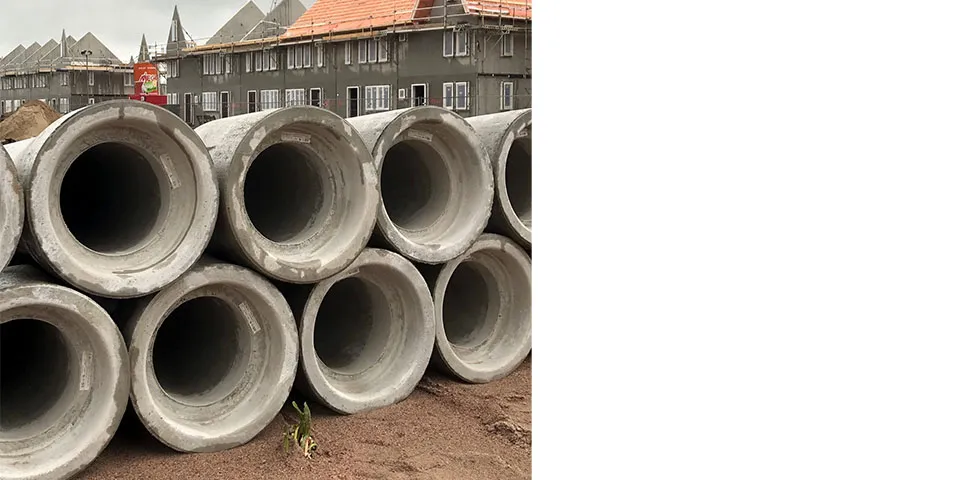
We are building the future with concrete: it is strong, safe and long-lasting. It can be used to make almost anything. Towering skyscrapers, prefabricated homes, sewer systems, bridges, roundabouts, you name it.
2. Building with concrete is more environmentally friendly than building with timber. How can that be?
At first glance, building with timber may seem to result in lower CO2 emissions, but closer examination shows that this is not the case. In construction, timber often means CLT, or cross-laminated timber.
This is glued laminated timber made from timber grown in plantations. Its manufacture requires adhesives and resins containing substances such as polyurethane and melamine formaldehyde. Protective coatings are also used in its application. To improve its fire resistance, it needs to be clad or made from thicker timber. CLT is therefore quite different from a freshly sawn, sweet-smelling beam straight from the forest.
For a fair comparison, it is best to look at the building level. Figures per kilogram or tonne are less meaningful. In practice, they are difficult to compare because a building requires a greater volume of CLT than concrete. On the other hand, a cubic metre of concrete is much heavier than glued timber.
Studies show that, at building level, concrete performs better than or comparably to CLT in terms of CO2 impact. But that is not the whole story. Heating and cooling a timber building requires more energy than its concrete equivalent. In a timber home, the additional heating and cooling alone over a period of fifteen years produce as much CO2 as the concrete used to build a comparable home.
3. What research is this based on?
These are independent studies conducted in Belgium, Sweden and Norway. The study in neighbouring Belgium found no environmental difference between a concrete house and one built using conventional structural timber. For an eight-storey apartment building, concrete performs ten per cent better.
The Norwegian study shows that, in terms of CO2 emissions, concrete performs better than CLT in a 16-storey apartment building. The results are roughly equal for eight storeys, while CLT performs slightly better for four storeys. One small caveat: the Norwegians assumed a clinker content of 70 per cent for concrete, which is higher than in the Netherlands. Here, the clinker content is 50 per cent.
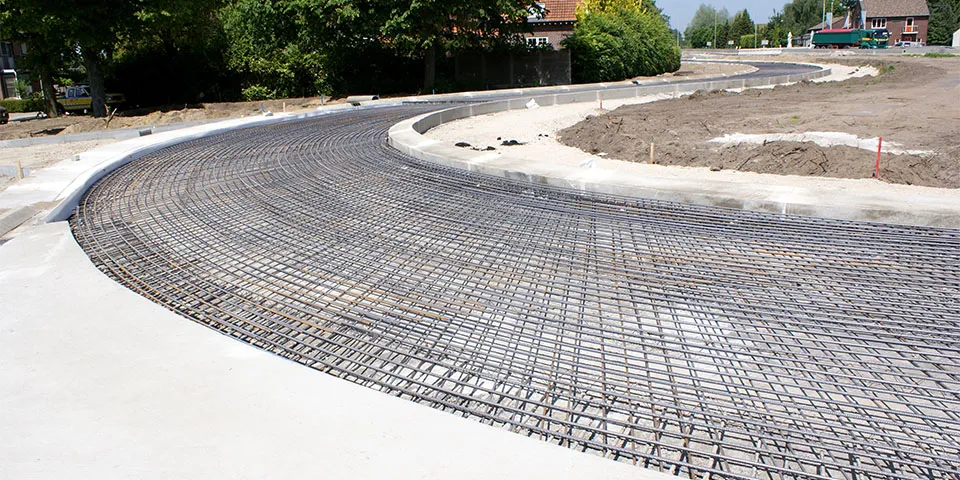
This oval roundabout is located in the centre of Bergen, at the junction of Rijksweg and Siebengewaldseweg, and is built entirely in concrete. The province of Limburg chose concrete because it can withstand the high torsional forces generated by lorry traffic and does not develop rutting. Concrete was chosen for the segregated cycle paths because it does not suffer from root heave. The province expects a service life of forty years with little maintenance.
4. What does the LCA say about concrete?
The LCA, or life cycle assessment, provides considerable insight into environmental impacts and the associated CO2 emissions, but there are caveats. The LCA takes 11 important factors into account to produce a single figure: the environmental cost indicator (MKI). This expresses in euros the cost of offsetting adverse environmental effects. In the Netherlands, the MKI values of all materials used in a building are collated to calculate the so-called MPG, which stands for Environmental Performance of Buildings.
Not everything is measured in a life cycle assessment. For example, it does not account for organic material left behind, such as when trees are felled. In addition, although CO2 absorption and emissions are rightly offset against each other, the tree would have absorbed much more CO2 if it had not been felled.
The increase in biodiversity in river areas resulting from sand and gravel extraction is not taken into account in the LCA. The service life of concrete is also estimated very conservatively for the analysis: 50 years for offices and 75 for homes, even though they can easily last for more than a century.
Question about this story? Ask your question
Keep following this
Get an email when a new story is published. No account needed.
- ThemeMaterials with a lower environmental impact
- SubjectConcrete







