









Cement & Concrete Roadmap 2050

Through the Green Deal, Europe has committed to becoming the first climate-neutral continent by 2050. This also involves the transition to a more circular economy, in which growth is decoupled from the use of raw materials. These objectives are intended to make the European Union a modern, sustainable and inclusive economy.
As is well known, the construction sector is a particularly effective lever for driving action. Buildings have a considerable environmental impact, both during the production of materials and technical equipment and during their use. At European level, they are estimated to account for 40 % of energy consumption and 36 % of the climate footprint.
Against this backdrop, FEBELCEM, the Federation of the Belgian Cement Industry, has developed its ‘Cement & Concrete Roadmap 2050’. At its heart is concrete, an essential material for infrastructure works and buildings in a sustainable society. The Roadmap sets out how cement, through the production and use of concrete, contributes to circular, climate-neutral construction. The image of a roadmap symbolises the path towards the 2050 objectives. It is built around five areas for action, known as the ‘5 Cs’: Clinker (the active ingredient in cement), Cement, Concrete, Construction and (re)Carbonation.
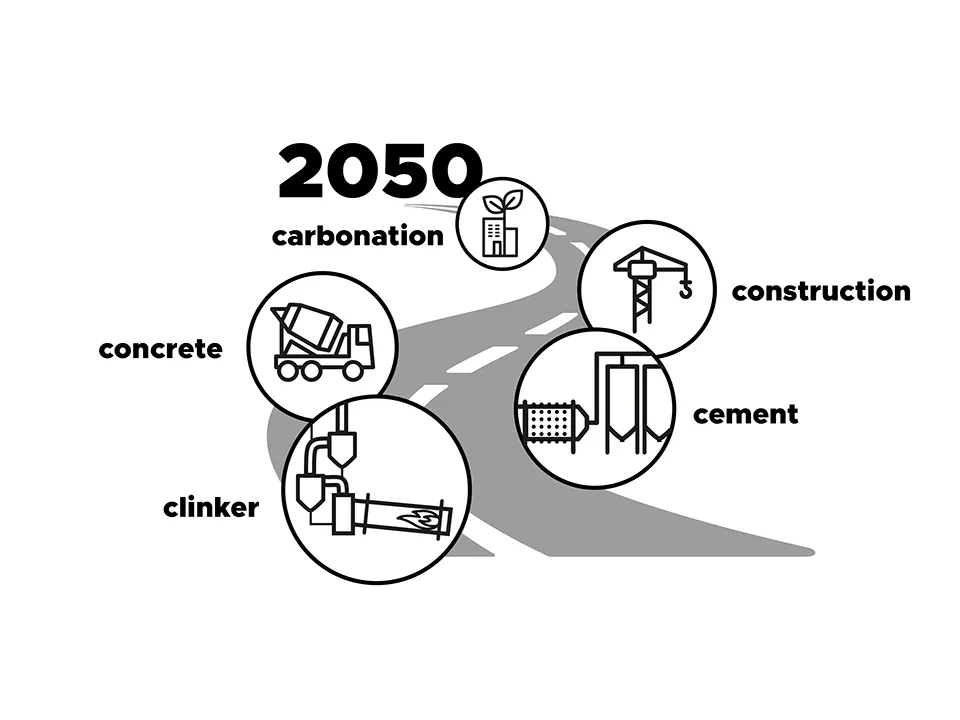
This Roadmap entails a major transformation of the construction value chain and requires commitment from every stakeholder: clients, architects, materials producers, contractors, public authorities and others. Similarly, every project must be assessed at every stage in terms of its environmental footprint and the circular economy, from design through construction and use to recycling or reuse.
The cement industry aims to play a leading role in this transition. The Roadmap therefore proposes benchmarks for reducing the carbon intensity of cement (kg CO2 per tonne of cement) relative to the 1990 baseline, with a view to achieving climate neutrality by 2050. It should be stressed that some progress has already been made, and the climate footprint of cement has already been reduced by almost 30 %. Although many factors remain uncertain, the Roadmap sets out how the ‘remaining 70 %’ will be addressed and how it will contribute to the EU’s interim 2030 target of reducing greenhouse gas emissions by 55 %.
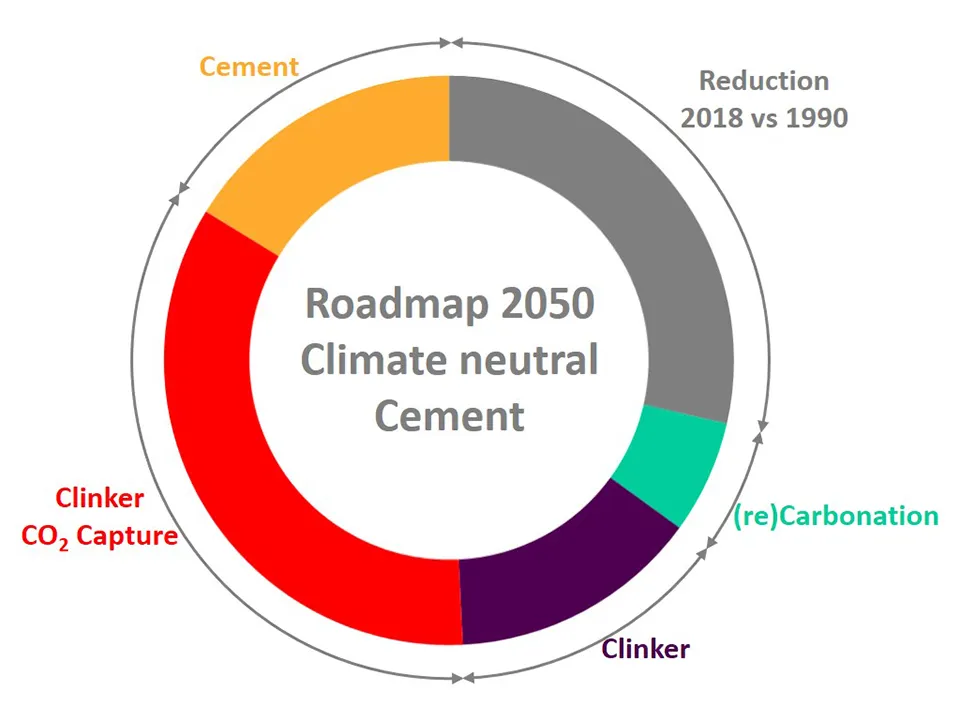
As a central player in industrial symbiosis, the cement industry will need to intensify its cooperation with other sectors, particularly in the areas of carbon-neutral electricity, hydrogen, and CO2 transport and use.
Finally, we must not forget that this far-reaching transformation will require enormous investment. The funding made available by the European Union through various support mechanisms is not enough. If the sector is to invest in new processes and plants, the government has an essential role to play in providing legal certainty and establishing mechanisms to prevent ‘carbon leakage’.
The ‘Cement & Concrete Roadmap 2050’ covers the entire construction value chain and a broad range of topics. Each topic requires more than a brief explanation. FEBELCEM therefore undertakes to develop these topics further over the coming weeks and months and to report on progress towards circular, climate-neutral construction.
Question about this story? Ask your question
Keep following this
Get an email when a new story is published. No account needed.
- ThemeMaterials with a lower environmental impact
- SubjectConcrete







