









Cement and concrete in the new Standard Specifications 250, version 5.0: further steps towards carbon reduction and circularity
Text and images Febelcem
The administrative and technical provisions for road construction contracts are set out in the standard specifications used by Belgium’s 3 regions: Standard Specifications (SB) 250 in Flanders, Type Specifications (TB) 2015 in Brussels and Cahier des Charges Type (CCT) Qualiroutes in Wallonia. These specifications are updated and revised at regular intervals in response to newly published standards, advances in knowledge and insights, or to correct any errors. Wallonia updates its specifications annually, while Flanders publishes a new version every 5 years, with an interim erratum. TB2015 has been completely revised in Brussels, and a new version is expected.
Version 5.0 of SB250 is due to be published by the Agency for Roads and Traffic in mid-2024. There are several notable amendments concerning hydraulically bound mixtures for road bases and concrete pavements, which promote reductions in CO2 emissions and/or greater circularity. The latest cement standards, EN 197-5 and EN 197-6, have been added to section 8 on cement in chapter 13 (previously chapter 3), “Materials”. This means that a number of low-carbon cements with a low clinker content can now also be used. Their use is restricted to mixtures for road bases (sand-cement, continuously graded crushed-stone road base with additives Ia and IIa, and lean concrete), the same applications as those for the previously introduced Hydraulic Road Binders (HBW). One example of a cement that can be used is CEM II/C-M (V-L) 32.5, which is available on the Belgian market and in which 36 to 50% of the clinker is replaced by fly ash and limestone.
Requirements for the composition of road concrete have also been amended. The minimum cement content for construction classes B1-B10 is now 375 kg/m³, a reduction of 25 kg/m³ for the highest construction classes. A combination of Portland cement CEM I and certified ground granulated blast-furnace slag (LMA) is also now permitted for road concrete.
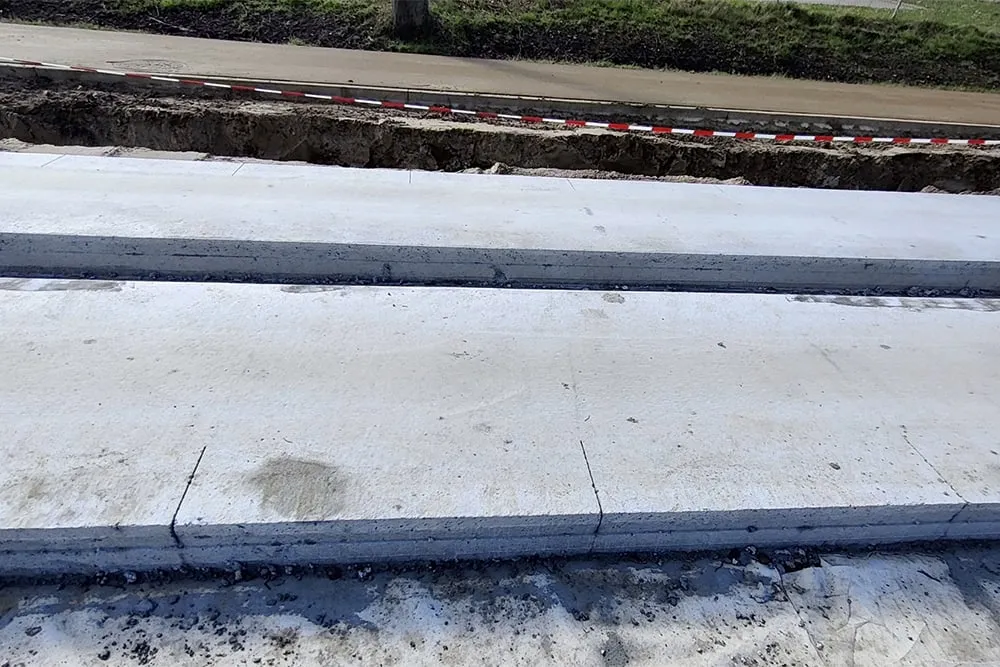
The use of high-quality recycled concrete aggregate as a replacement for coarse aggregate was already permitted (up to 20% by volume) for isolated cycle paths and in the lower layer of two-layer concrete, as well as in linear elements (up to 40%). It is now also permitted for roads in construction classes B9-B10 (up to 20%).
In addition, the use of high-quality recycled concrete sand is now permitted in construction classes B9-B10, BF and linear elements, as a replacement for fine aggregate (up to 20% by volume). This is undoubtedly an important step forward for circularity in the concrete sector.
Here are some further technical amendments:
- Transverse contraction joints have been divided into 3 types: type 1 = dowelled, sealed and with a chamfered rebate, the standard solution for construction classes B1-B7; type 2 = undowelled, with a rebate but no chamfer, and sealed, for construction classes B8-B10; and type 3 = a single saw cut, neither dowelled nor sealed, for BF, that is, isolated cycle paths.
- The induced crack in continuously reinforced concrete has already proved its worth. The specification has been clarified slightly to ensure it works as intended: at least 30 cm of the 40 cm length must have a depth of at least 40 mm.
- ‘Simple’, ‘transverse’ and ‘longitudinal’ brushing as surface treatments have been consolidated into a single specification.
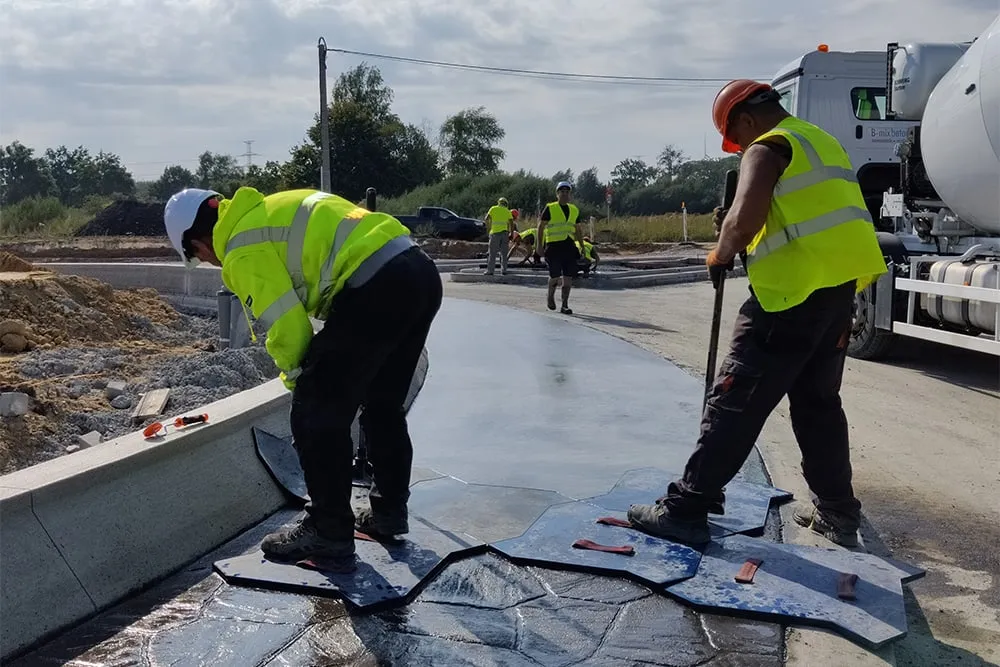
- The specifications for patterned concrete have been completely revised on the basis of the findings of a working group at the Belgian Road Research Centre (OCW). Specific provisions now cover, among other things, manual or mechanical placement, the use of a colour hardener in powder or liquid form, imprinting with moulds or a roller, curing and cleaning. These pavements are all classified under construction classes B6-B10, with the corresponding requirements.
- Unless otherwise specified in the contract specifications, the air content of concrete containing an air-entraining agent is checked on at least 3 truckloads, and 3 consecutive measurements must comply.
- For manually placed concrete surfaces, and where they have been treated with an impregnating agent, which is mandatory in this case, water absorption testing is no longer required.
Requirements for scaling after the freeze-thaw test (slab test) have been amended, both for the preliminary study (maximum 1.500 kg/m² for all applications, a stricter requirement for the lower construction classes, cycle paths and linear elements) and for a posteriori checks (2.000 kg/m² in all cases, making the requirement stricter in some cases but also less strict for B1-B5). These amendments to the technical provisions are intended to improve quality and durability, thereby extending the service life of concrete pavements. In the long term, this means fewer raw materials are needed for reconstruction, environmental impact is reduced, the road remains available for longer and whole-life costs fall. In short, concrete roads meet the 3 pillars of sustainable construction.
Question about this story? Ask your question
Keep following this
Get an email when a new story is published. No account needed.
- ThemeFuture-proofing roads and railways
- SubjectConcrete







