









Belgium’s first ultra-high-performance concrete bridge
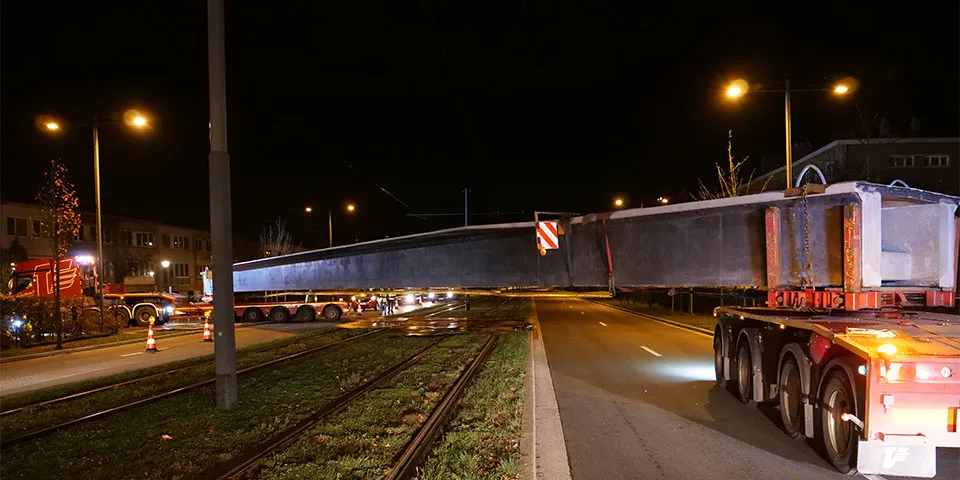
The new Eenboom pedestrian bridge in Evere is Belgium’s first bridge made from ultra-high-performance concrete (UHPC). The bridge, which crosses the Schaerbeek-Halle railway line, was installed in December 2018 for rail infrastructure manager Infrabel, replacing the former, ageing bridge dating from 1956. Infrabel commissioned FEBE member Ergon, part of CRH Structural Concrete Belgium, to carry out the work.
Ergon proposed a new precast concrete element made from UHPC. It is a first for Belgium and also has symbolic significance, as the old bridge was one of the first prestressed concrete bridges in the country. UHPC made it possible to build a more slender bridge, without slab reinforcement, while making it stronger than a conventional prestressed concrete bridge. The structure consists of a 36 m-long, 4 m-wide slab, up to 10 cm thick, supported by two slender ribs that are also just 10 cm thick.
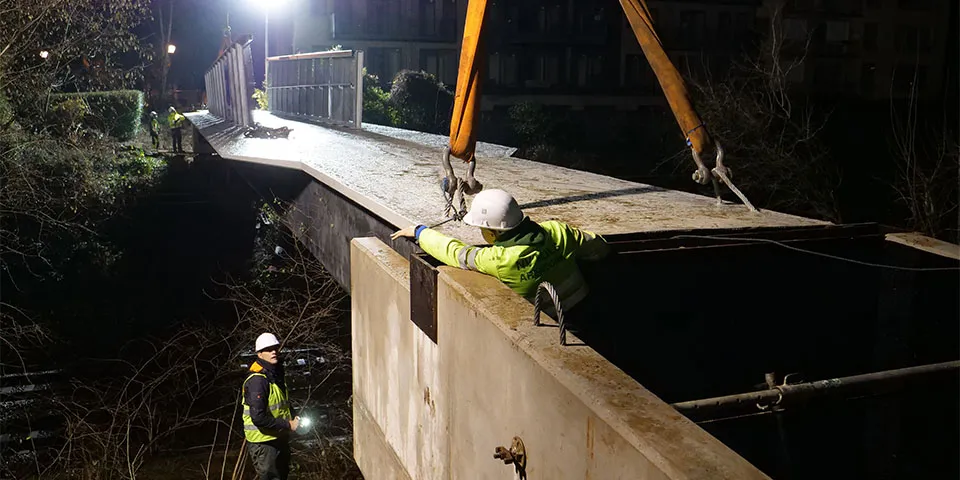
The new Eenboom pedestrian bridge in Evere is Belgium’s first bridge made from ultra-high-performance concrete (UHPC).
The design required preparatory research. Pieter van der Zee, technical director at CRH/Ergon, oversaw the production of the UHPC test elements. “In 2012, the Belgian Building Research Institute (WTCB) issued a call for research into UHPC,” says Pieter van der Zee. “The aim was not to use mixes already familiar in France at the time, but aggregates and admixtures that were readily available in Belgium. The goal was to make UHPC a local product as far as possible. Through FEBE, WTCB approached prestressed concrete manufacturers to produce test elements. At Ergon, we made several 7 m-long I-beams, and produced around forty prisms for WTCB. Samples were sawn from them and analysed.”
Lighter bridge element
WTCB produced a substantial report based on these tests. Pieter van der Zee says: “The tests made us think about what else we could do. From time to time, I floated the idea of a UHPC bridge at meetings. It is always exciting to come up with something that has never been built before. Infrabel was open to incorporating an unusual element into one of its projects. A standard precast concrete bridge at that confined site would have required a huge crane. Alternatively, the railway line would have had to be closed for days, but that was not an option. The challenge, then, was to make the bridge element lighter. But that requires higher-quality concrete.”
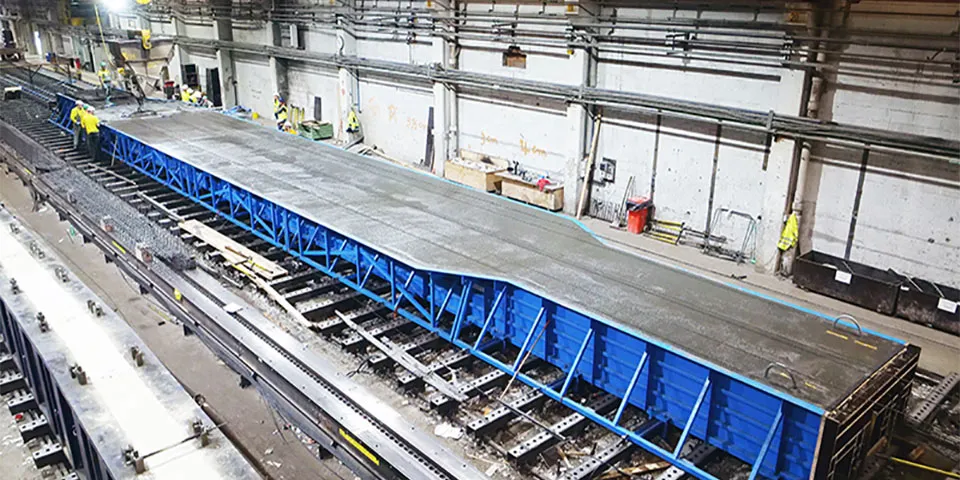
The filled formwork for the bridge elements.
“That is how UHPC came into the picture,” Pieter van der Zee continues. “Technically, the bridge is a remarkable feat. In 2016, after a great deal of consultation and design work, a gently sloping double-T element, 36 m long and 115 cm high, proved to be the right solution. Creating a slope in UHPC is an art in itself. Self-compacting concrete is very fluid (flow spread of 800 mm, ed.). Placing it on a slope is particularly difficult, but not impossible.”
Reference project
Eenboom could be the first UHPC bridge in a long series, but strict European regulations make it difficult to implement this kind of new technology. “For now, there are no prescribed standards to fall back on. UHPC has been discussed in Europe for thirty years, but so far the number of projects can be counted on one hand. It is an exceptionally durable, wear-resistant material. It makes it possible to create remarkably slender designs,” concludes Pieter van der Zee.
Question about this story? Ask your question
Who worked on it
Eenboom in Evere
- spoorwegbeheerderInfrabel
- prefabbetonErgon
Keep following this
Get an email when a new story is published. No account needed.
- ProjectEenboom
- ThemeExtending the life of bridges and tunnels
- SubjectConcrete
- CompanyInfrabel
- CompanyErgon







