









60-metre-high incinerator chimney successfully sawn into sections and brought down
Text Niels RouvroisImage Zabo
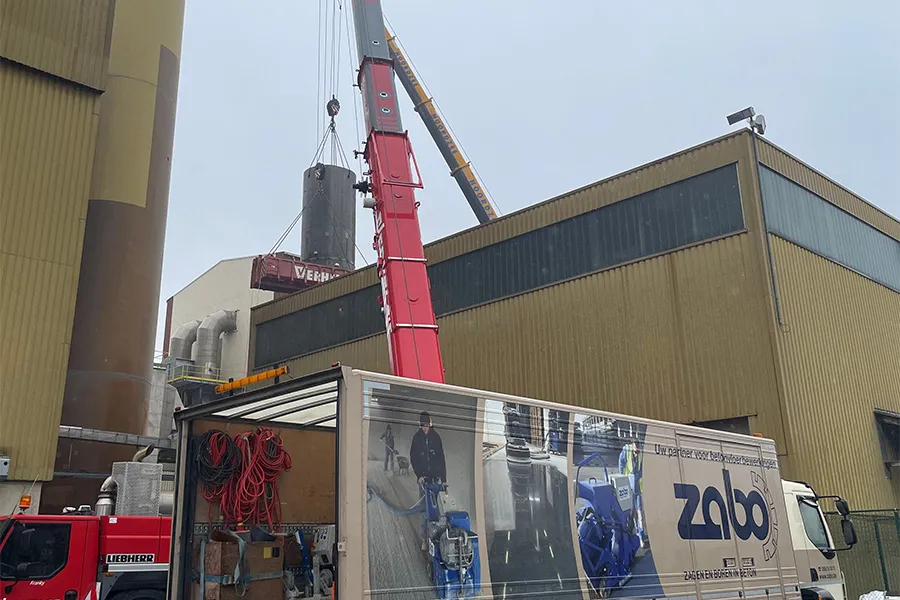
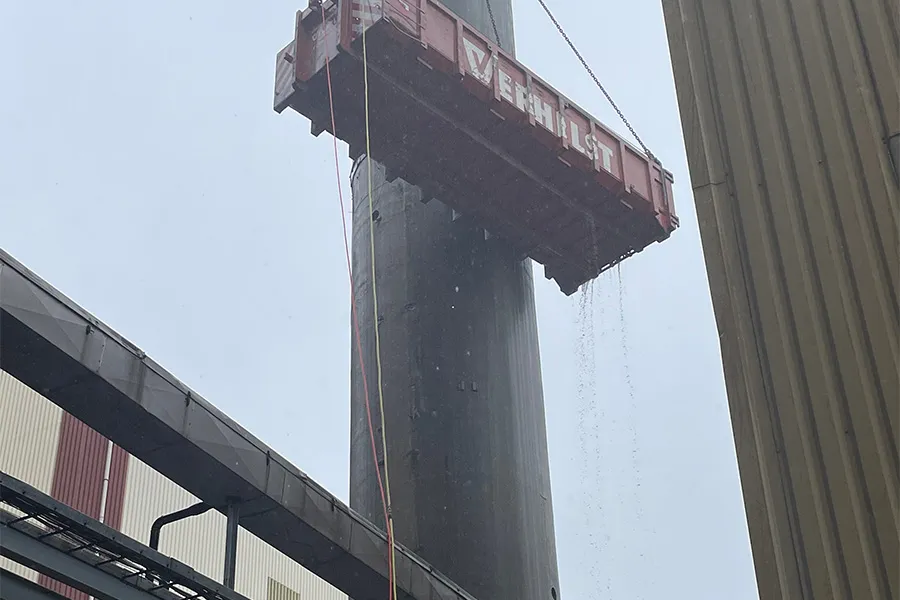
The weathered chimney at the incinerator in Oostende has been demolished. The concrete was showing cracks, and the risk of pieces eventually falling or the chimney toppling had become too great. In just six days, the 60-metre-high tower was sawn into sections, crushed on the ground and removed. Verhelst Aannemingen called on specialist Zabo to carry out the sawing and drilling work. “Given the surrounding buildings, sawing was the option that would cause the least disruption,” says Geert Vanderyse of Zabo.
Zabo has long established itself as a specialist in concrete processing, including sawing, drilling, grinding and milling. “Our aim is for customers to see us as the ideal partner for carrying out this kind of work. We offer a fast, punctual response, clear agreements and high-quality work, always at a fair price,” says the company enthusiastically.
12 sections
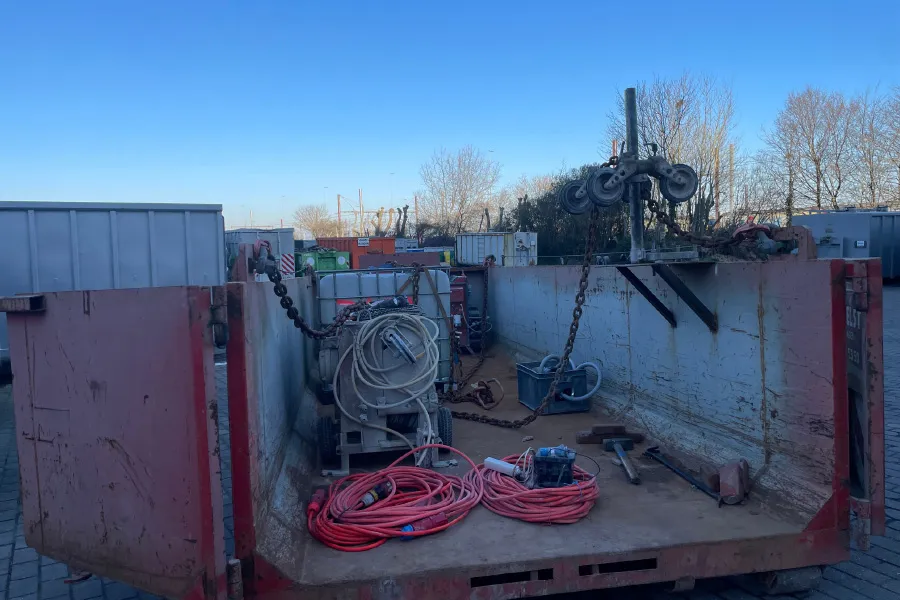
Zabo approaches every project with this mindset, and Oostende was no exception. But how do you demolish an old chimney without damaging the buildings below or alongside it? Geert Vanderyse explains: “There was a lot of careful planning beforehand. In the end, we decided to use a cable saw to cut the 60-metre-high tower into 12 sections. Each section weighed between 12 and as much as 30 tonnes. Beforehand, we drilled holes so the cut sections could be lifted. Our team carried out the work from a container that we had modified. The equipment was secured inside the container, and we fitted safety lines to attach to our team’s harnesses.”
A cable saw was chosen for the sawing work. This technique is used to cut solid, heavily reinforced concrete structures with a steel cable fitted with diamond beads. The cable is driven by a drive wheel and guided along its cutting path by a series of guide wheels. Pneumatic cylinders keep the cable under tension throughout the cutting process. Geert Vanderyse says: “Depending on the reinforcement present, we can saw up to 2 m² per hour. This technique also allows us to cut circular openings up to 3 metres in diameter, and larger if required. The process is, of course, water-cooled, vibration-free and produces minimal noise.”
Two cranes
Two telescopic cranes were positioned on site. Geert Vanderyse explains: “One crane lifted our team to the right height to carry out the sawing work. The second crane supported the section and lowered it safely to the ground. On projects where there is enough room to manoeuvre and no surrounding buildings to consider, a tower like this would be brought down in one piece or demolished using explosives. But that was not an option here. There are buildings around the tower, and refuse trucks come and go to deliver waste. No debris could be allowed to fall. We came up with this system in collaboration with Verhelst Aannemingen.”
Working efficiently
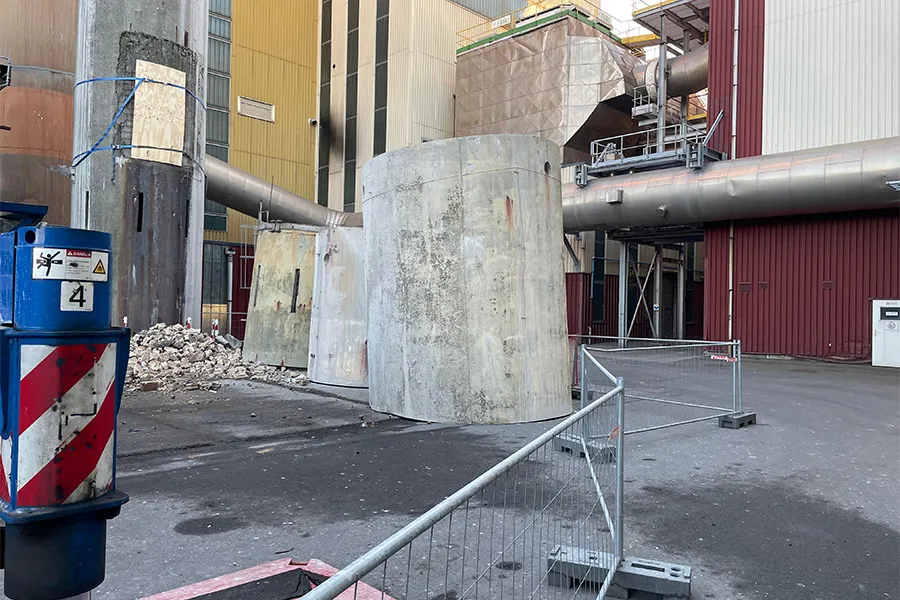
In the first phase, holes were drilled through the tower so the cut sections could be lifted. “This preparatory work took a few days, and the entire tower was sawn into sections six days later. For safety reasons, the top sections were cut smaller. The closer we got to the ground, the larger the sections became. The chimney had a diameter of 3 m. The work could also have been done with a wall saw rather than a cable saw, but that would have required a more challenging set-up logistically and taken considerably longer. Space on site was quite limited, so cable sawing was the best option. No sawing or drilling technique is beyond Zabo, and one of our key strengths is that we always find an efficient, practical solution, even for complex projects like this,” concludes Geert Vanderyse. ■
Question about this story? Ask your question
Keep following this
Get an email when a new story is published. No account needed.
- ThemeMaterials with a lower environmental impact
- SubjectConcrete







