









Commercial transport returns to the Lovaart
Text and images POM West-Vlaanderen
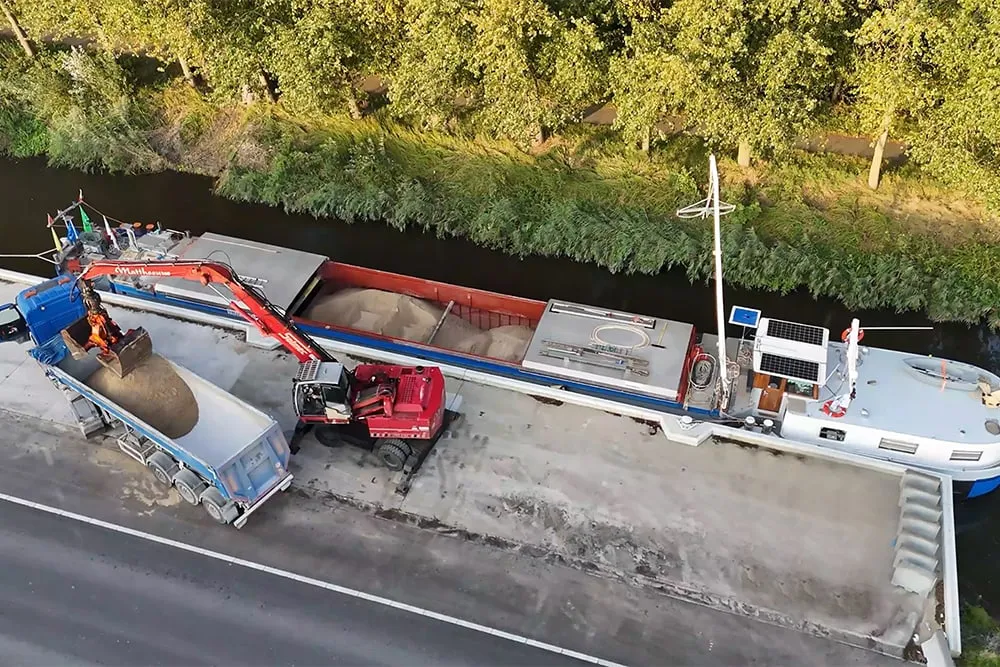
At the end of September, non-tourist traffic travelled along the Lovaart between Veurne and Ostend for the first time in a long while. Concrete producer De Brabandere of Veurne tested the feasibility of transporting sea sand from Ostend by inland waterway for use in concrete production. These trial voyages to the Regional Transhipment Centre (ROC) Veurne are the result of close cooperation between POM West-Vlaanderen, De Vlaamse Waterweg nv, Multimodaal.Vlaanderen (VIL), De Brabandere and Barging Solutions.
The Lovaart was dug in the 12th century to connect the town of Veurne with the Yser. The canal played a crucial role in the region’s development and was deepened several times to support growing commercial activity. Until the 19th century, inland waterway skippers used the Lovaart intensively as a key transport route. With the rise of road haulage, the canal gradually came to be used for tourism and recreation. But that is now changing.
Sustainable transport
In recent weeks, De Brabandere transported sea sand for concrete production from the port of Ostend, via the Plassendale-Nieuwpoort and Nieuwpoort-Dunkirk canals, to the Lovaart and ROC Veurne. “The trial voyages were intended to identify any challenges and accurately calculate the actual cost per cargo”, says Pieter De Brabandere, CEO of De Brabandere. “Our ambition is to switch partly to alternative transport options to ease pressure on the road network. We also want to encourage other companies to take part in sustainable logistics solutions. In time, we hope autonomous electric vessels can also play a role on this route.”
ROC Veurne put into operation for the first time
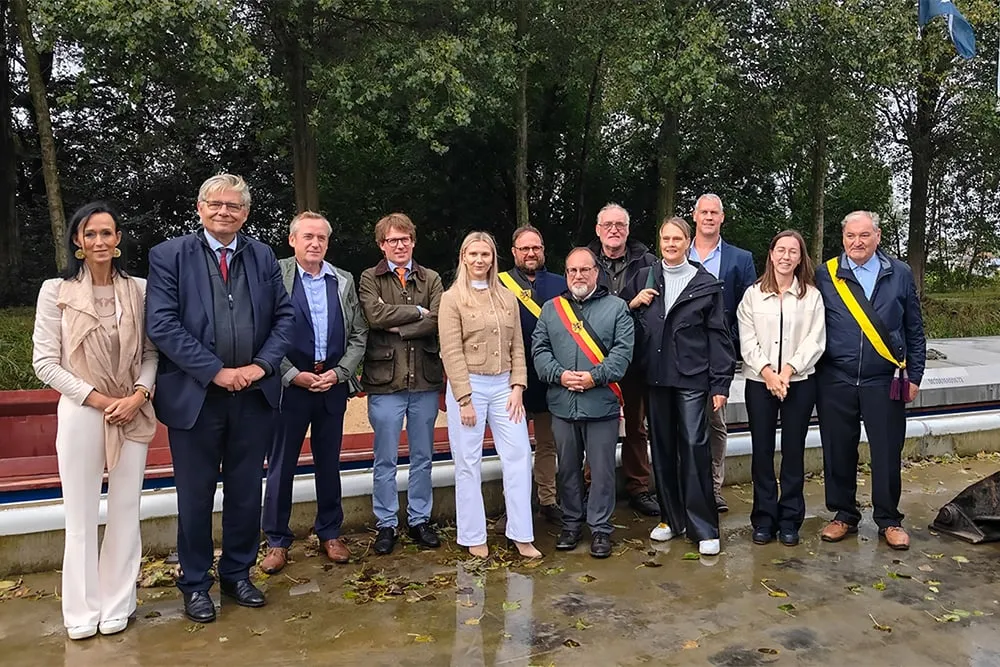
Since the regional transhipment centres in Diksmuide and Veurne were built last year, companies in the region have had new sustainable transport options. ROC Veurne, located on the industrial estate between the Lovaart and Vaartweg in Veurne, has 50-metre quay walls and a 325m² quay platform. “ROC Veurne enables companies to transfer goods efficiently and in an environmentally friendly way from water to road transport, significantly reducing pressure on the road network”, says Jean de Bethune, chair of POM West-Vlaanderen. “ROC Veurne is highly important to securing the region’s economic and logistics future. Its excellent location and facilities allow us to help companies make their supply chains more sustainable.”
Greener logistics
Expanding the logistics network through inland waterway transport offers not only economic benefits, but also contributes to more sustainable mobility in the region. “Our cooperation with POM West-Vlaanderen strengthens the region’s logistics capabilities”, adds Els T’Kindt, account manager at De Vlaamse Waterweg. “Sustainable inland waterway transport options help companies operate more efficiently while also reducing the number of lorries on the road, benefiting mobility and the environment.”
POM West-Vlaanderen has been working with Multimodaal.Vlaanderen (VIL) for years to encourage companies in West Flanders to use multimodal solutions by water or rail. “Pieter De Brabandere contacted us when ROC Veurne was completed. Our role was to provide impartial advice based on a specific business case, taking operational aspects such as a sailing schedule into account. We then put him in touch with various parties, including Barging Solutions”, says Ilse Verdonck of Multimodaal.Vlaanderen (VIL). “Our mission means we can only encourage initiatives like this, and we hope this case will inspire other companies too.”
A pusher barge (CEMT class I) was used for the transport. Its narrow profile, shallow draught and manoeuvrability make this type of vessel ideal for the waterways of the Westhoek. “A vessel like this can carry around 200 tonnes of sand per trip. A lorry carries around 30 tonnes of sand per trip. Each voyage by vessel means seven fewer lorries on the road”, concludes Jean de Bethune.
Essential dredging works
De Vlaamse Waterweg has begun dredging works on the Yser, the Nieuwpoort-Dunkirk Canal and the Lovaart to prevent flooding in the Westhoek. Shallow sections are also being addressed, which will improve navigation. The entire length of the Lovaart is being dredged to a minimum depth of 2.20 metres, with a 6-metre-wide navigable channel”, says Els T’ Kindt. “Deepening the channel is crucial to improving the drainage of rainwater from inland areas. It is also a welcome boost for the logistics potential of this route.”
Question about this story? Ask your question
Keep following this
Get an email when a new story is published. No account needed.
- ThemeStrengthening waterways and coastlines
- SubjectGeneral







