









Belgium’s heaviest quay wall anchored with MV piles
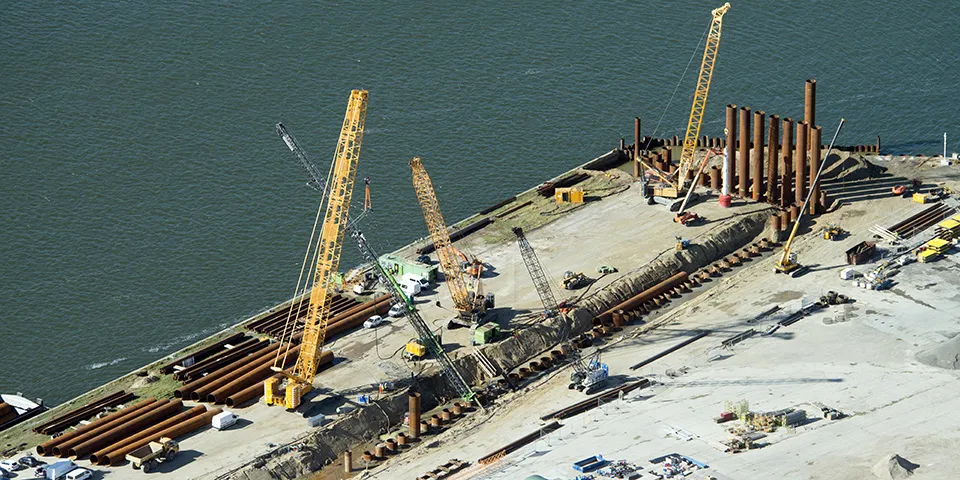
To accommodate the Port of Antwerp’s ever-growing activity, the Soetaert-Jan De Nul joint venture is building a new 800-metre quay wall at Kanaaldok B2, suitable for a water depth of up to 18 metres. As well as being the heaviest quay wall in Belgium, the installation of the MV piles is a notable feature of the project. “We hadn’t done this before, but the MV pile technique combines piling and grout injection, two techniques familiar to Soetaert-Soiltech,” says Ing. Jan Landuyt, Head of Retaining and Foundation Works at Soetaert-Soiltech.
The new quay wall is replacing the existing one, which no longer meets requirements, with its current depth of 6 metres. The upgraded terminal will be able to accommodate larger seagoing vessels in future. Jan De Nul is responsible for the earthworks and concrete works, while Soetaert-Soiltech is handling the foundations. “This means that 100 per cent of the work is being carried out by Jan De Nul Group, which includes Soetaert-Soiltech as a specialist in foundation techniques,” says Jan Landuyt. “We are responsible for all the foundation techniques, including the tubular piles, sheet piles and MV piles. Jan De Nul is doing everything else, namely demolition, earthworks and concrete works. The quay wall we are building here is among the heaviest ever built in Belgium.”
The quay wall comprises a combi-wall built from the land and 280 tubular piles, each with a diameter of 2.0 m, a length of 28 m and a weight of 30 tonnes, driven into the ground. Jan Landuyt: “We installed an equal number of AZ 26 sheet piles between them. But a quay wall of this size also requires a new, robust anchoring system. That is why we invested in installing MV piles.”
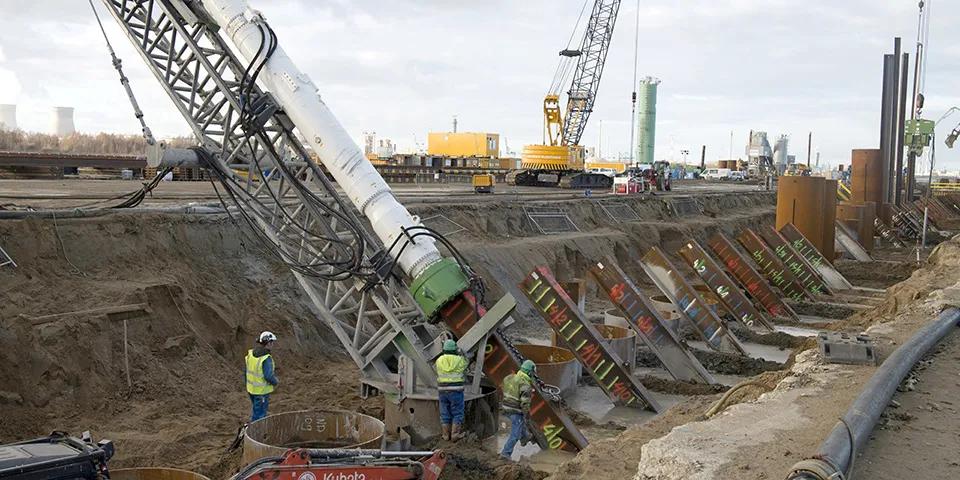
The MV pile technique combines piling and grout injection.
Longest MV pile
What is more, the Soetaert-Jan De Nul joint venture took on the challenge of installing the longest MV pile ever used in Belgium, with the help of a free-hanging leader. The LR1600, Jan De Nul’s heaviest cable crane, was brought in for this one-off operation. “Installing MV piles was relatively new to us,” says Jan Landuyt. “But we are, of course, familiar with the techniques involved, piling and grouting. In other words, for us it is a combination of familiar techniques. A major project like this is therefore a valuable reference, because MV piles certainly add value to projects on this scale. A total of 240 MV piles were installed. They are 43 m-long HEM600 sections, each weighing 12.5 tonnes.”
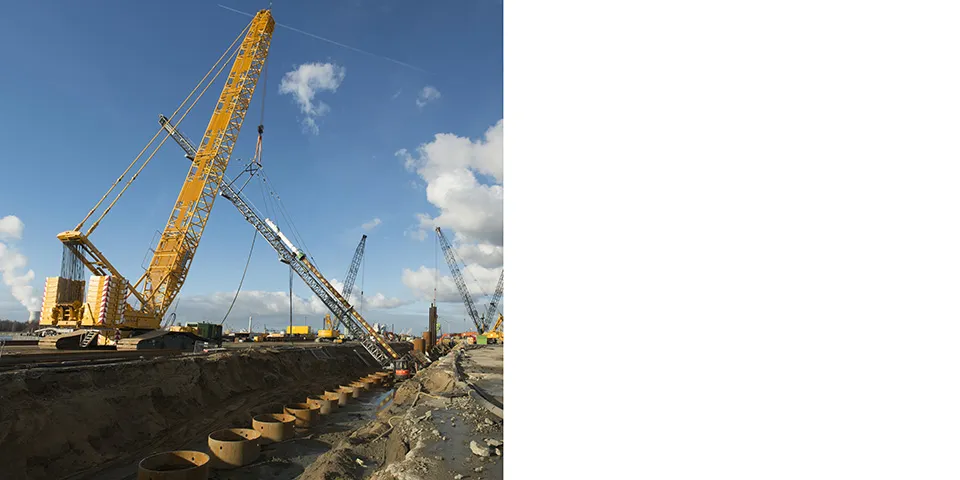
The longest MV pile ever used in Belgium, at 43 m, was installed with the help of a free-hanging leader.
A fine example of synergy
The results and development of the new anchoring technique are a fine example of synergy between Soetaert and the support services of its parent company, Jan De Nul Group. Jan Landuyt: “It was an investment and a valuable learning process, but we are certainly pleased with the results. Especially given the short time available to get everything done. Barely two months passed between receiving the contract and installing the first MV pile. But we achieved high productivity from day one, and there were no delays.”
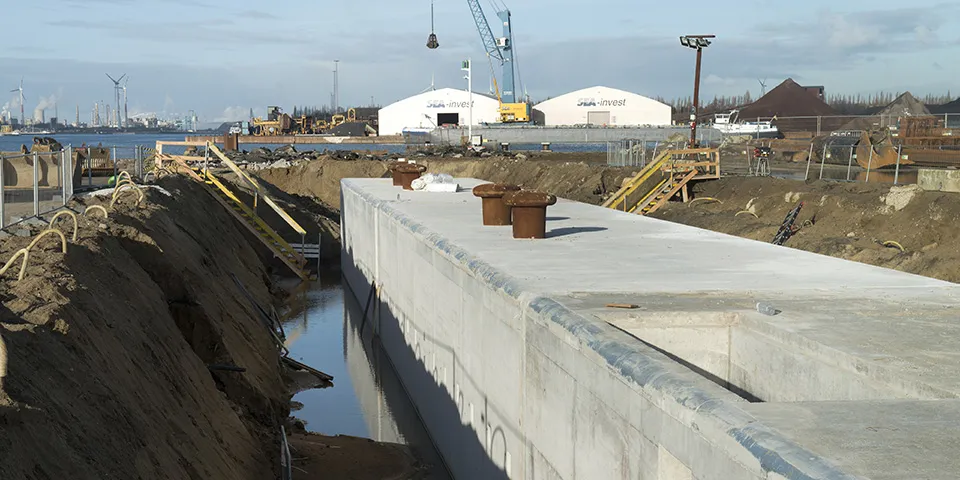
The 800-metre quay wall, suitable for a water depth of up to 18 metres, is among the heaviest in Belgium.
Demolition of old wall
The last MV piles were installed in March, bringing Soetaert-Soiltech’s foundation work to an end. “But we will remain active on site for a little while longer, as we will also be dismantling the old quay wall. It is a completely different type of wall, much lighter and made entirely of sheet piles. These still have to be demolished and removed. At the same time, Jan De Nul will carry out the concrete works on the new quay wall. We expect the work to be completed by the summer,” concludes Jan Landuyt.
Question about this story? Ask your question
Keep following this
Get an email when a new story is published. No account needed.
- ThemeStrengthening waterways and coastlines
- SubjectGeneral







