Innovative wrapping protects the hangers of the Merwedebrug
Text Roel van GilsImage DYWIDAG
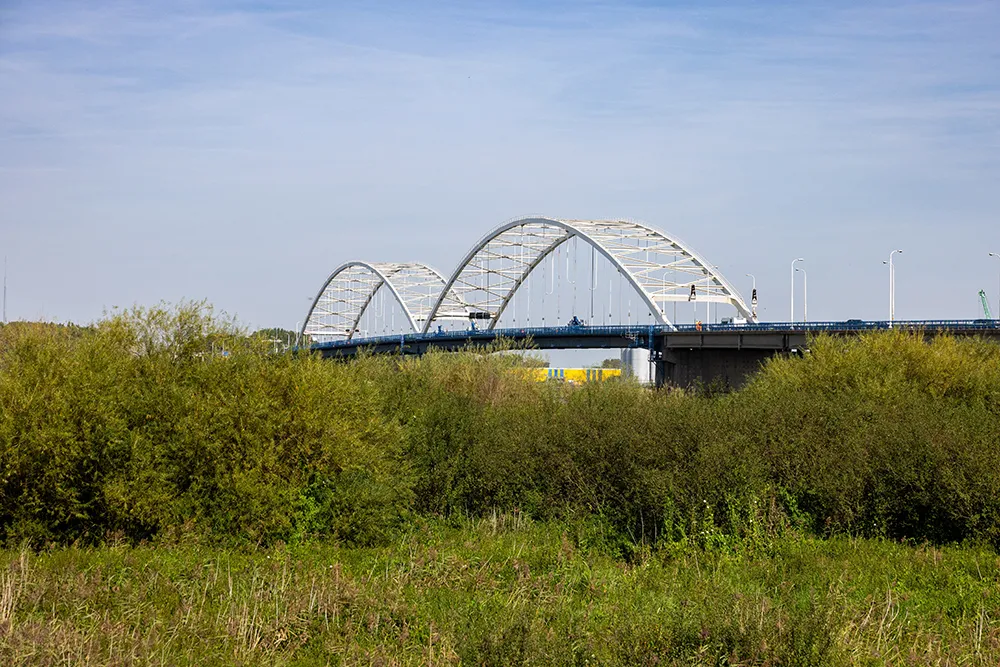
A periodic inspection of the Merwedebrug on the A27 found signs of rust on several hangers connecting the deck to the arch bridge. This was due to wear of the protective coating. Structurally, the hangers were still sound, but it was clearly important to apply a new protective system as soon as possible. Rijkswaterstaat opted for an innovative wrapping system from DYWIDAG, which kept disruption to road traffic to a minimum.
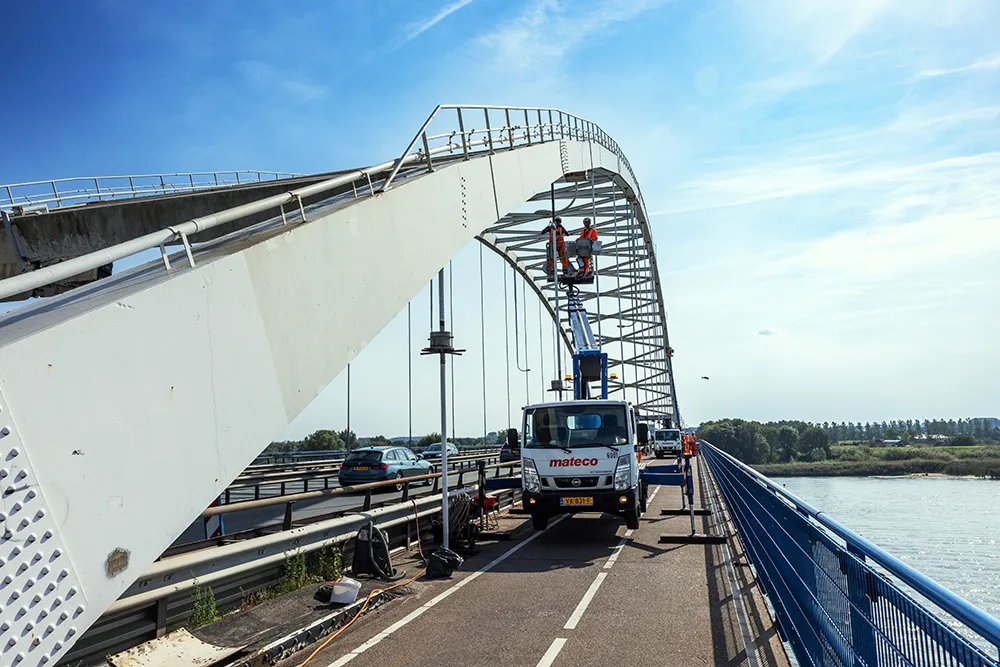
“Rust on components supporting a bridge deck is obviously undesirable,” begins Robert Jansen of DYWIDAG. “The coating on the hangers was in such poor condition that they needed to be protected again to prevent the corrosion from progressing, with all the consequences that could entail. The initial idea was to blast the hangers and apply a new multi-coat paint system, but that would have had a huge impact on traffic flow. Lanes would have to be closed for an extended period while scaffolding was erected around the bridge.” Rijkswaterstaat was therefore looking for an out-of-the-box solution. The engineering firm involved, Schreuder, approached DYWIDAG about its Cableskin technology.
ETA-certified system
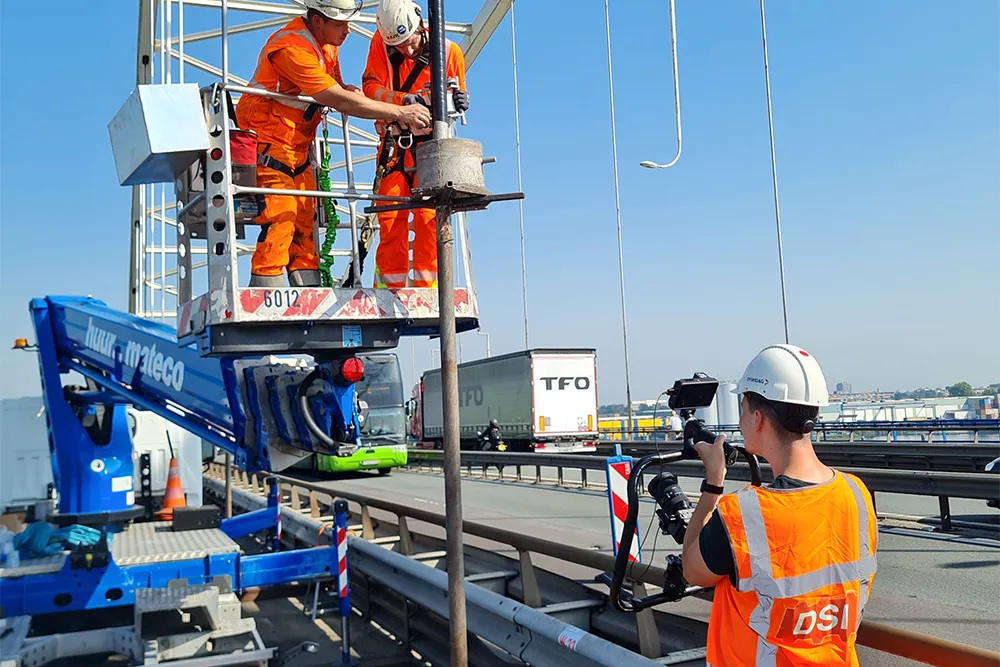
DYWIDAG’s Cableskin has been used successfully for many years abroad to protect steel structures and is an ETA-certified system. “It is a relatively unfamiliar technique in the Netherlands,” says Robert Jansen. “We explained the system to Rijkswaterstaat, and they were immediately enthusiastic, particularly because it causes minimal disruption. To demonstrate this in practice, we successfully installed a test section during the preparatory phase. We were awarded the contract soon afterwards.” How does the technique work? Robert Jansen explains: “First, the larger flakes of paint are removed from the hanger with a scraper. We then apply the wrapping in two layers. The first layer acts as a primer and consists of a tape coated with butyl rubber on both sides. This is covered with a top layer, a tape with butyl rubber on the inside and a PE layer on the outside. The PE layer can be made in any colour, repels water and resists UV radiation. When the butyl rubber is applied with the correct tension and pressure, it vulcanises and bonds into the hanger. You can never get it off again.”
64 hangers
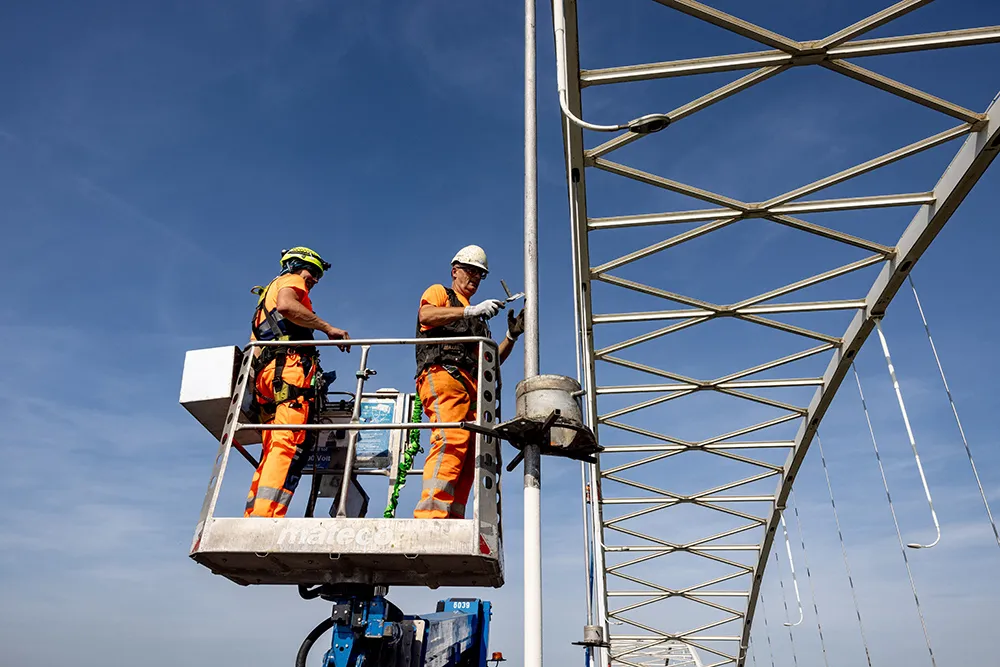
Cableskin can be applied in several ways: manually, semi-automatically or fully robotically. “At the Merwedebrug, we opted for the semi-automatic method because the hangers are relatively short, ranging from 10 to a maximum of 35 metres,” Jansen explains. “We worked from a mobile elevating work platform on the cycle path and used an auxiliary tool to wrap the hangers, ensuring the correct angle, tension and pressure. We worked exclusively during the day, and only one lane had to be closed. That was purely for the safety of our team, as we did not use the lane ourselves. In total, it took us ten weekends to wrap the 64 hangers, 32 on each side. At the same time, Knook Staalkonstrukties repaired and improved the connections between the hangers and the deck, meaning the Merwedebrug is now ready to serve for many years to come. Unlike a coating, our Cableskin system guarantees protection against the elements for at least 50 years.”
Question about this story? Ask your question
Who worked on it
Merwedebrug
- engineering consultancySchreuder
Keep following this
Get an email when a new story is published. No account needed.
- ProjectMerwedebrug
- SubjectBridges & tunnels
- CompanySchreuder