How can we transform social housing estates into sustainable communities?
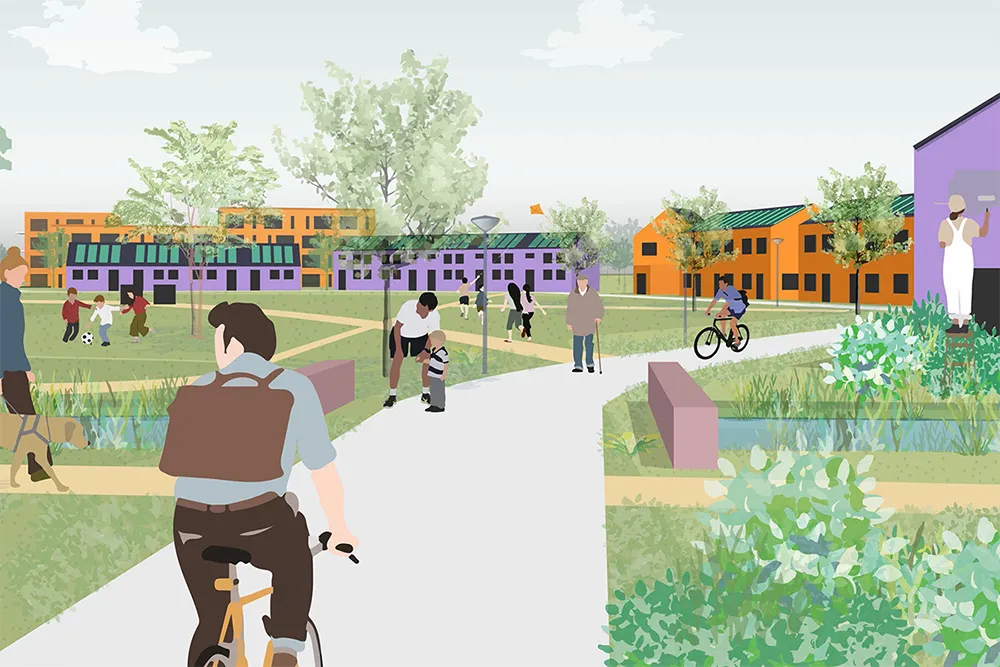
Transition guide sets out a roadmap for close collaboration
Flanders needs a new approach to the climate transition in social housing estates. The ‘Transition Guide to Climate Neighbourhoods: Social Housing Estates’ calls for an integrated, neighbourhood-based approach, with different stakeholders working together to achieve sustainability goals. Research by Sweco, commissioned by the Department of Environment, highlights the importance of coordination and contact between local authorities, social housing companies and other stakeholders.
The climate crisis will not wait, and our social housing estates must not be left behind. The challenges are significant and the issues complex, but we must not be deterred. This transition guide is an invitation to all stakeholders to join forces and actively shape the future of social housing estates, working together towards a future in which everyone has access to affordable and sustainable housing.
Webinar on 24/10
On 24 October, Sweco and the Department of Environment invite you to a free webinar: ‘Transition Guide to Climate Neighbourhoods: Social Housing Estates’. We will present the findings of the research into the challenges and solutions in social housing estates
Successful neighbourhood transformations through an integrated approach
Projects in Sint-Pietersmolenwijk in Brugge and Wilgenpark in Eeklo demonstrate the importance of an integrated approach that combines challenges such as climate adaptation, mitigation, spatial transformation, mobility and social cohesion. The role of the social housing company and its collaboration with local authorities are crucial to this process.
Sint-Pietersmolenwijk in Brugge
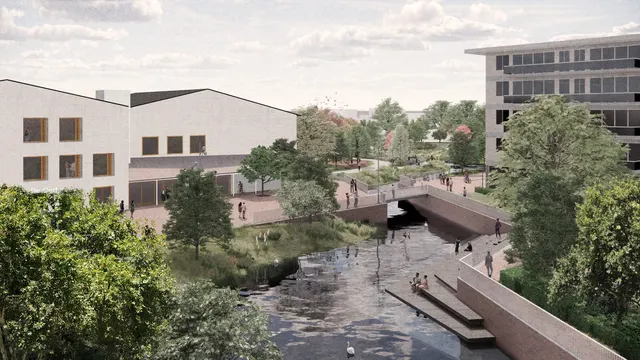
A vision and transition plan were developed for this neighbourhood, addressing several homes at the same time. This is an important lever for achieving climate targets. The approach in Sint-Pietersmolenwijk focuses on resolving water-related problems and considering expansion, renovation and sustainable heating. Scenario exercises helped explore different solutions and strengthened collaboration between the social housing company and the city.
Wilgenpark in Eeklo
In Wilgenpark in Eeklo, existing projects were optimised and better coordinated through scenario exercises. The research concludes that spatial efficiency can be achieved through new-build and replacement housing, with greater potential for higher density without compromising spatial quality or public and private green space. An integrated masterplan must be developed, with a stronger focus on collective solutions. In addition, more attention must be paid to social mix when considering the potential for higher density.
Transition pathway to resilient climate neighbourhoods
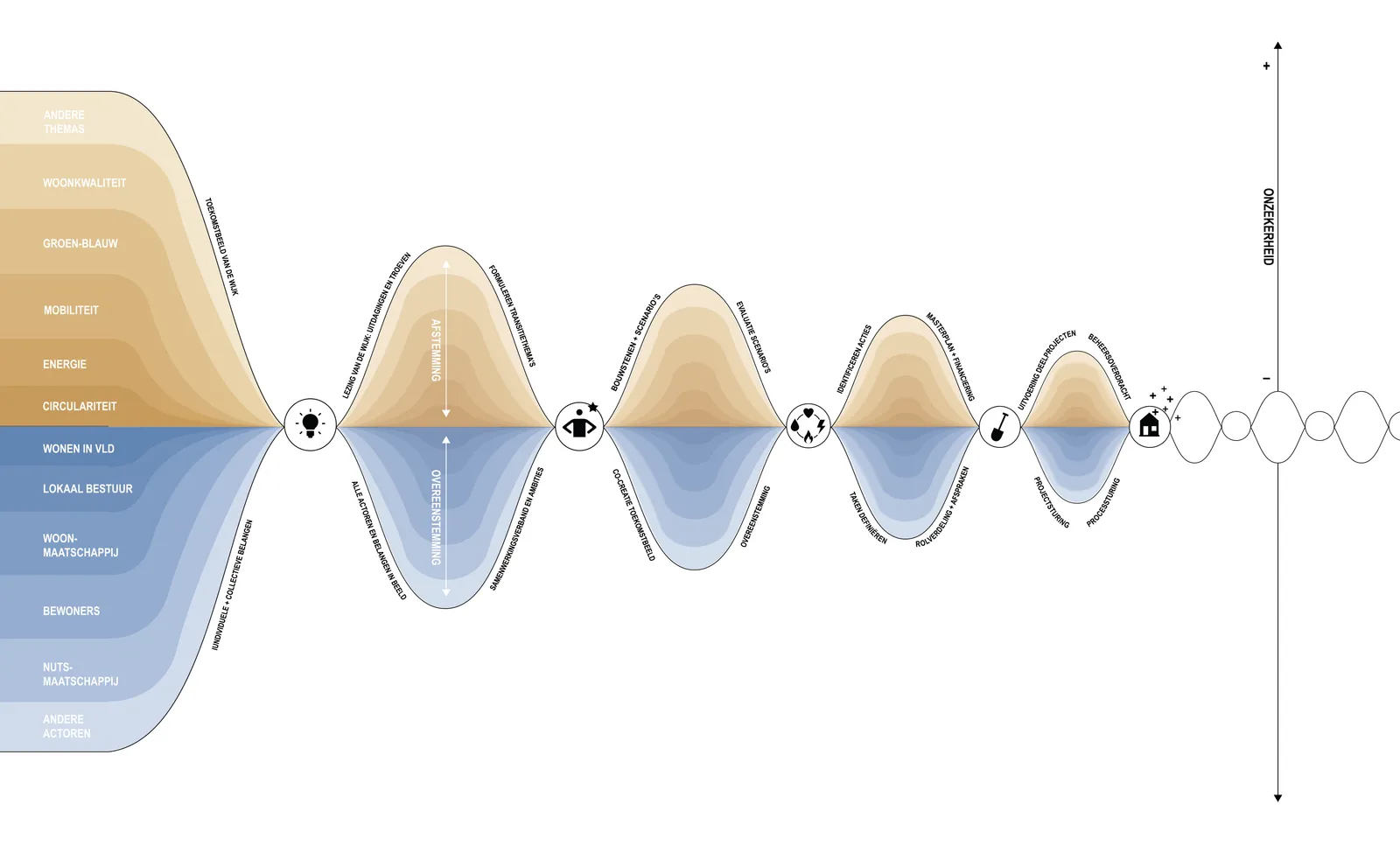
The transition guide presents a strategic framework introducing a four-phase transition pathway. These phases aim to improve the physical environment and strengthen social cohesion and resilience. The guide highlights the power of collaboration and participation, with all stakeholders, including residents, playing an active role in shaping their living environment.
Exploration phase
This phase is about asking questions. It marks the starting point, when the current state of the neighbourhood and initiatives already undertaken are assessed. Stakeholders often work in silos, resulting in a lack of coordination. The aim is to acknowledge these uncertainties and lay the foundations for collaboration.
Visioning phase
The focus here is on reflection and finding solutions. Stakeholders come together to create a shared vision for the neighbourhood’s future. By setting shared ambitions and developing an integrated vision for the future, uncertainties are reduced and a clear direction is established.
Implementation phase
The focus now shifts to taking action. The plans drawn up during the visioning phase are put into practice. This is when the physical transformation of the neighbourhood takes place, through measures such as climate adaptation, heating strategies and home renovation.
Operational phase
Finally, the focus is on maintenance and management. This phase ensures the continuity and evaluation of the transformation. It is a period of stabilisation, during which new forms of collaboration and physical changes in the neighbourhood are maintained and refined.
Recommendations for government
The guide’s recommendations highlight the importance of a coordinated approach, with both the Flemish Government and local authorities playing an active role in the transition to sustainable social housing estates, supported by clear guidelines, long-term planning and financial support.
For Flemish policy the recommendation is to work with local authorities and social housing companies, establish frameworks that encourage joint projects, and provide resources and capacity. Innovation and knowledge-sharing are considered essential. The Flemish Government is also encouraged to review the funding system, particularly in light of new opportunities arising from a European Social Climate Fund.
At local level the emphasis is on the coordinating role of local authorities in housing and climate policy. They must work with social housing companies on integrated transition pathways and take a proactive approach. Drawing up local heat plans and long-term renovation plans is crucial to reducing uncertainty and promoting collaboration.
About the transition guide
The ‘Transition Guide to Climate Neighbourhoods: Social Housing Estates’ is an initiative of the Department of Environment. The full report is available here. It is the result of extensive research and valuable input from experts and practical examples. The transition guide provides a strategic framework and practical guidance for other social housing estates in Flanders to achieve sustainable transitions.
Question about this story? Ask your question
Keep following this
Get an email when a new story is published. No account needed.
- SubjectPublic space