









West Flanders Stevin project takes high-voltage cables underground
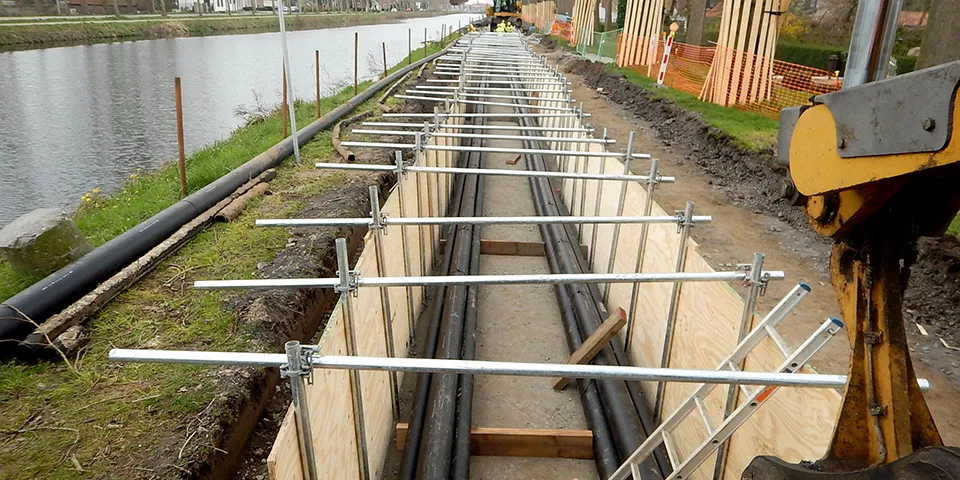
Offshore wind farms off the Belgian coast, rising renewable energy production and the continued growth of the Port of Zeebrugge. These were among the reasons why grid operator Elia started construction of the Stevin project in 2015. The extensive infrastructure works are intended to secure electricity supplies in West Flanders and the rest of Belgium. Alongside the new 380 kV connection, the core of the project, Elia is also carrying out several other infrastructure works. Together with engineering consultancy Antea Group, the grid operator is taking a 150 kV connection between Bruges and Eeklo underground.
The 47 km-long 380 kV Stevin connection between Zeebrugge and Zomergem is vital to energy supply in West Flanders and, by extension, the whole country. Stevin will bring energy from the new offshore wind farms ashore and enable green energy projects to be developed in the region. It will also support the growth of the Port of Zeebrugge and help make energy exchange with the United Kingdom possible via the subsea Nemo cable.
The new connection will be able to carry up to 3,000 megawatts of power, equivalent to 3 large nuclear power stations. “Until recently, we had no ‘electricity motorway’, meaning a 380 kV connection, in the north of West Flanders,” says Arianne Mertens, programme manager at Elia and responsible for the entire Stevin project. “We have one now, which means our grid is better prepared for the future.”
The new underground 150 kV connection comprises two circuits, each with three cables, laid in a trench approximately 1.7 m wide and 1.5 m deep.
Pylons removed, connection taken underground
Elia linked several subsidiary projects to Stevin. The grid operator is taking an existing 150 kV line underground and dismantling another existing 150 kV line. Mertens says: “The new 380 kV Stevin connection meant more high-voltage pylons in West Flanders and the Meetjesland. We therefore decided, together with several city and municipal authorities, to dismantle two existing overhead 150 kV lines in order to preserve the landscape. One of them will, however, be rebuilt underground to secure electricity supplies to the local area. Once the project is complete, there will be fewer high-voltage lines in total than before: 37 km of new overhead line compared with 55 km of existing lines being dismantled.”
The new underground connection runs from the Brugge Waggelwater substation to Eeklo-Noord, across the territory of Brugge, Damme, Maldegem, Sint-Laureins and Eeklo. The overhead line running north of Maldegem will eventually disappear.
30 sections
The new underground 150 kV connection comprises two circuits, each with three cables, laid in a trench approximately 1.7 m wide and 1.5 m deep. Elia is also laying an optical fibre cable for each circuit in the trench, to handle communications between the two substations at either end of the new connection. Elia is using a standard open trench along most of the route, but in some cases other methods are needed, such as ducts or directional drilling at busy junctions or waterways.
The contractors are laying the cables in 30 sections of approximately 1 km, joining them by welding in the joint bays. Above-ground link boxes are installed every three joint bays along the route to limit or eliminate electrical losses in the cable connection. “The easiest option would have been to complete the sections neatly one after another, but that was not possible on this project. We could not carry out some sections during certain periods, for example during the bird-nesting season, so we had to move on to another location,” says Mohamad Amri, project manager at Elia.
“This month, we will finish laying the final cable sections and make the connections. The high-voltage test will follow in December. If it goes well, we expect the connection to be commissioned in January 2020. After that, we will continue restoring the original landscape, including roads, verges and fields.”
“The advantage of working on private land, in fields, is the limited impact on traffic and local residents. Weather conditions do play a greater role, though.”
From city to field
At the outset, the project was divided into three lots. Lot 1 is the approximately 5 km route through the city of Brugge, while Lot 2 covers 15 km of smaller roads and fields between Brugge and Maldegem. Lot 3 comprises the final 10 km, alongside the N49 and mostly through fields. The project partners use different construction methods for each lot. Mohamad Amri says: “The advantage of working on private land, in fields, is the limited impact on traffic and local residents. Weather conditions do play a greater role, though. When heavy rain sets in, parts of the site roads can be difficult to drive along. Lot 1 is entirely in an urban area: the work zone there is simply the public road, but the impact on the surrounding area is much greater. Local residents and businesses must have access to their homes and premises at all times.”
There were, of course, several locations along the route that presented technical challenges. Katty Pouilliart, senior project engineer at Antea Group, the engineering consultancy overseeing the project, says: “Some of the directional drillings reached a depth of approximately 30 m. The first bore we carried out, at Brugge Waggelwater, passed beneath the Ghent-Ostend Canal and emerged in a narrow street. In that street, the cables had to turn through 180 degrees immediately so they could continue parallel to the canal. The loop required for this would normally have a radius of 5 m, but the limited width of the street made it difficult to install smoothly.”
The archaeological process also posed a challenge in completing the works within the planned timeframe. Arianne Mertens says: “New rules require us to assess the impact on archaeology. As we were working in fields for much of the project and carrying out a lot of excavation, the impact was significant. We adapted our working methods to minimise the impact on archaeological heritage.” Mohamad Amri adds: “Normally, we can work continuously over a distance of 800-900 m without difficulty. This time, the archaeologists’ site monitoring caused some delays.”
The contractors are laying the cables in 30 sections of approximately 1 km, joining them by welding in the joint bays.
Permits, construction and site supervision
Antea Group was closely involved in the project as engineering consultant. Mohamad Amri says: “Normally, Elia only outsources the permit application, construction documentation and as-built documentation. This time, however, we also decided to entrust Antea Group with site supervision.”
“We were involved from A to Z,” adds Katty Pouilliart. “We started with a preliminary route that Elia had already discussed with several government departments. We then collected the project’s baseline data: existing utility services, cadastral information and accurate surveys of the existing situation. We developed the route from a technical perspective, considering how to cross existing features such as waterways, roads and pipes, and defining a working strip with as little impact on the surrounding area as possible. We then reviewed the preliminary route with Elia and the local authorities to determine the final route, allowing us to finalise the plans and apply for the necessary permits. This was a challenge, as we had to apply the environmental permit process, with its new guidelines for preparing plans, for the first time.”
“We also prepared a technical specification to invite tenders from potential contractors and supported Elia with the selection process. As well as preparing permit plans and the specification, we provided the required environmental documents and a technical soil relocation report. A project of this scale therefore requires a wide range of different expertise. Antea Group’s advantage is that we have specialists in all these disciplines. This enables us to guide the client through the various aspects of the study.”
Mohamad Amri says: “We have been working with Antea Group on various projects since 2006, so we have built up a strong relationship. The overall picture matters to us: Antea Group can handle every aspect of a project like this, delivers quality and gives us a single point of contact, Katty in this case, who guides us through the whole project. That gives us confidence in the quality of the end result.”
Question about this story? Ask your question
Who worked on it
Stevin-project
- grid operatorElia
- engineering consultancyAntea Group
Keep following this
Get an email when a new story is published. No account needed.
- ProjectStevin-project
- ThemeUsing and protecting the subsurface
- SubjectGeneral
- CompanyElia
- CompanyAntea Group







