









Watercourse sediment studies: new responsibilities for owners, operators and managers
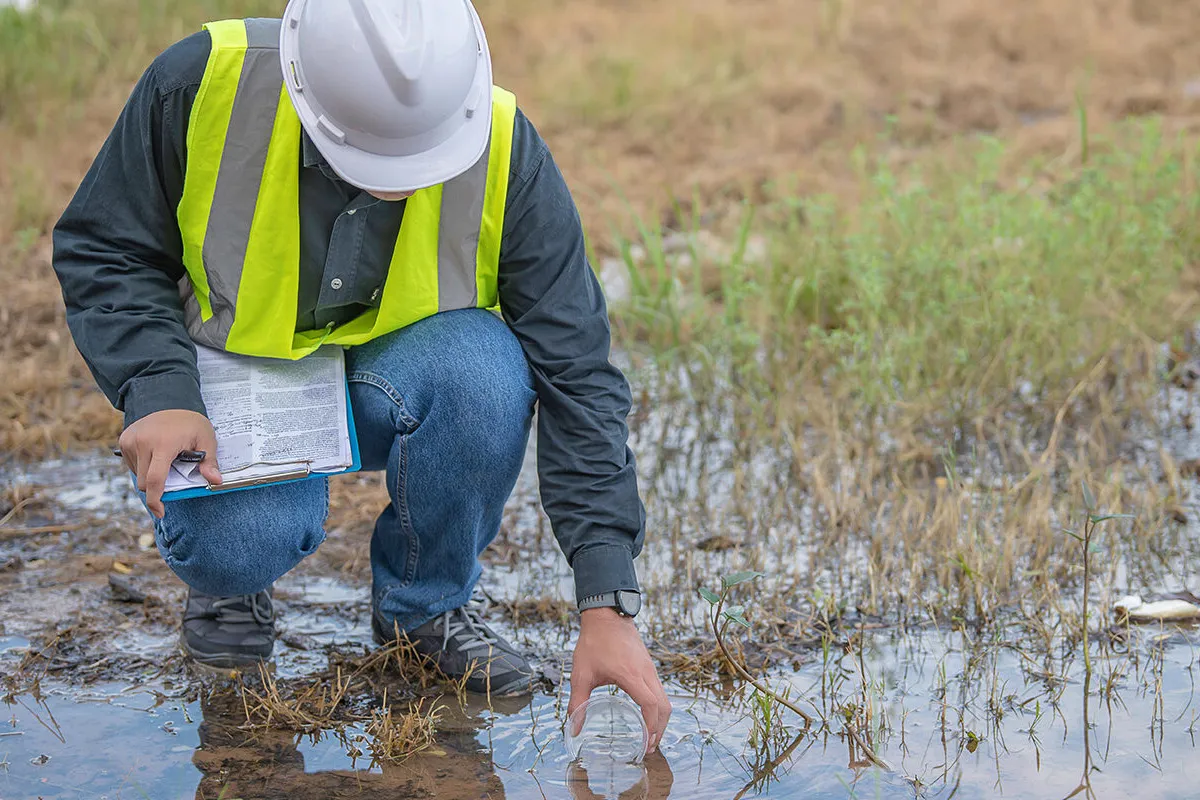
The quality of our watercourses is under the spotlight more than ever. Flanders has a dense and complex network of watercourses, the vast majority of which, an estimated 95%, are non-navigable. In 2024, the Soil Decree of 2006 was amended, with significant implications for how we investigate and remediate sediment contamination in these non-navigable watercourses.
For owners, operators, authorities and watercourse managers, this means greater clarity, but also greater responsibility.
Why sediment studies are becoming more important
Watercourse sediment consists of the solid part of the bed and the sediment. Contaminated sediment or silt can contain hazardous substances that are released under certain conditions, such as low flows or dredging. This can cause the contamination to pollute the water again.
A watercourse is a dynamic system: sediment and surface water affect each other’s quality. This can happen through bank and surrounding-area erosion, sediment input, discharges, maintenance works and so on.
Sediment studies can establish: the extent to which poor water quality or ecological problems are caused by sediment contamination, or whether they are caused by internal loading and/or current discharges.
Watercourse sediment and the Water Framework Directive: a hidden lever for improving water quality
The European Water Framework Directive (WFD) requires Member States to achieve good ecological and chemical status for their surface waters, and to support this with monitoring and concrete measures. According to WFD assessments, water quality in Flanders remains poor:
- the chemical status of (almost) all surface water bodies in Flanders is “failing”;
- only a very limited number of water bodies achieve the required good ecological status or potential.
The new Soil Decree puts the emphasis on accountability
The 2024 Soil Decree introduces two important changes concerning sediment contamination in non-navigable watercourses:
“Sediment study required as part of the exploratory soil investigation”
An exploratory soil investigation (OBO) must now also check for sediment contamination in adjacent or affected watercourses.
“Clear remediation obligations for sediment contamination”
The remediation obligation and its costs are clearly divided between the different parties:
• the operator, user or owner of the investigated land, if the contamination is attributable to risk activities
• the watercourse manager, if the contamination is unrelated to the investigated land
• in the case of mixed contamination, joint soil remediation by the operator, user or owner and the watercourse manager, according to a cost-sharing formula determined by OVAM.
Sweco helped OVAM develop an innovative fingerprinting method to analyse attributable sources.
Find out more about this innovative method
Did you know? In some situations, sediment studies are required by law, such as when risk land is transferred or when a risk activity is closed or discontinued, including in the event of bankruptcy or liquidation. OVAM can also impose a requirement, or require periodic investigations for certain risk sites.
Sediment studies in practice: approach and methodology
Sediment studies therefore investigate a dynamic system, with several possible sources of contamination, both historical and/or current, and multiple stakeholders. All this makes it difficult to attribute the source of the contamination unequivocally.
Sweco takes a system-based approach with a focus on risk management. This goes beyond simply removing the pollutant load. These cost-effective and sustainable solutions require a highly specific approach.
In the FIRST PHASE, our sediment experts investigate the following aspects:
Sediment study phase I: the sediment system
How does the hydrological system, and specifically the sediment system, work?
• The relationship and interaction between surface water, sediment, groundwater, rainwater and discharges
• Water and substance transport mechanisms in stream systems
Sediment study phase I: stakeholder analysis
• Which stakeholders are involved and what is each stakeholder’s role?
• How do the stakeholders approach sediment contamination?
• Who is driving further action?
Sediment study phase I: inventory of contamination sources
A preliminary study analyses historical and current risk activities in the area, such as suspect activities, discharge points and known contamination along the watercourse.
In a SECOND PHASE we refine the analyses through targeted investigation, including fieldwork, sampling and laboratory analysis. In a THIRD PHASE we assess the risks. Using an in-house scoring system, we can quickly distinguish sediment that is unlikely to pose ecological risks from sediment that may pose such risks. A more in-depth assessment determines whether further investigation or remediation is needed.
This methodology enables us to formulate sound, smart and cost-effective measures that effectively improve water management.
• Which risk pathways matter, taking the water system as our starting point;
• Where can action be taken to remove the relevant risks;
• With sufficient support from the various stakeholders.
Case study: the Eindergatloop in the Kempen
In the Kempen, past non-ferrous smelting activities have contaminated the soil and water system with heavy metals across the region. Together with OVAM and other stakeholders, Sweco developed a holistic modelling approach, including remediation measures and protective measures.
Project objective: to map current contamination risks and look ahead to the future development of contamination in groundwater and surface water.
The Eindergatloop: erosion as a vehicle for contamination
The Eindergatloop is a striking example. Along certain stretches, the banks of this watercourse consist largely of zinc ash or metal-bearing waste. Erosion carries Zn- and Cd-rich particles into the water, resulting in elevated metal concentrations in the surface water.
In 2018, bank stabilisation and capping were carried out over a length of approximately 1 km using geotextile and gabions.
• Finishing with topsoil and seeded grass creates a more natural appearance;
• Further erosion of zinc ash into the watercourse is prevented;
• Heavy metal concentrations in the surface water fell at the site.
Although no zinc ash is found further downstream in the sediment, metal concentrations in the surface water remain above the limits because contaminated groundwater continues to flow into the watercourse. Several remediation methods are now being investigated.
This case shows that a site-wide, integrated approach is essential to address historical sediment contamination sustainably. Technical feasibility, cost-effectiveness and ecological benefits must all be carefully weighed.
New rules call for integrated expertise
From a technical perspective, sediment studies interface with a range of disciplines: soil and groundwater, surface water, ecology, industrial discharges, hydraulics and so on. These disciplines also fall under different authorities. Sweco addresses this fragmentation and all its associated complications through an integrated approach.
The new 2024 Soil Decree makes sediment studies a structural part of statutory soil policy. This has implications for owners, operators and watercourse managers: greater responsibility for sediment contamination they have caused or contributed to; the remediation obligation and risks must be determined accurately through thorough investigation; and targeted measures must be taken to improve the water quality and ecological status of our watercourses.
Question about this story? Ask your question
Companies in this story

Keep following this
Get an email when a new story is published. No account needed.
- ThemeUsing and protecting the subsurface
- SubjectGeneral
- CompanyOVAM







