









Soil remediation, a lever for economic development
Flanders aims to have its soil in top condition by 2036. All at-risk sites, meaning potentially contaminated sites of all sizes, must therefore be mapped by 2028.
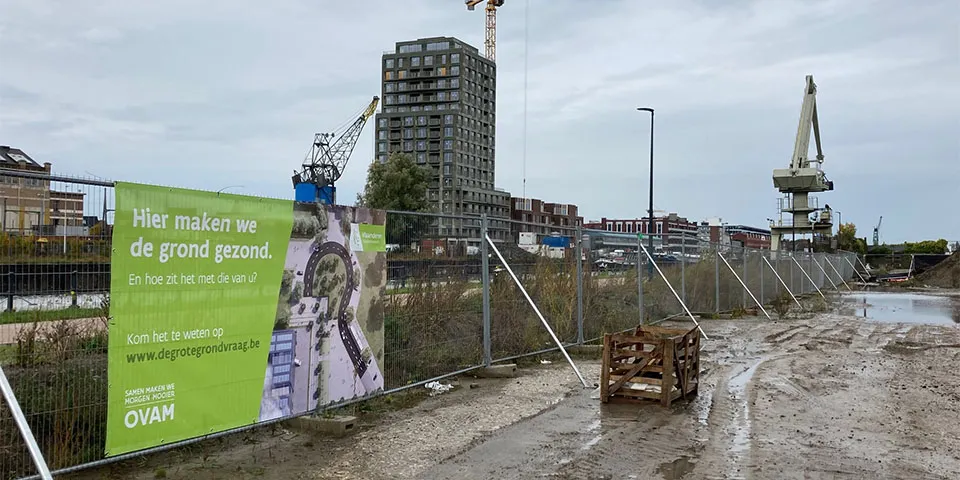
Last year, OVAM launched De Grote Grondvraag, an initiative to raise awareness among all landowners in Flanders of this issue and help them check their land and remediate it where necessary. The organisation has also been busy with remediation work of its own. Over the past year, it carried out dozens of ex officio remediations at contaminated sites, with a budget of €32.4 million. One good example is the CAT-site, the former Renault Vilvoorde grounds.
Text | Valérie Couplez Images | OVAM
The large-scale ‘De Grote Grondvraag’ campaign achieved its aim last year. A total of 138,000 users registered to find out how healthy their soil is. In all, 177,000 plots have already been checked through De Grote Grondvraag. Efforts are being stepped up this year, as Flanders has set particularly ambitious targets for achieving healthy soil. OVAM spokesperson Jan Verheyen says: “By 2036, we want to rid Flanders entirely of soil contamination. We will therefore begin carrying out exploratory soil investigations in phases from 2021. Once a city or municipality has joined, residents can check their land. To date, 214 of Flanders’ 300 cities and municipalities are taking part. We hope to have added most of the rest by the end of the year and encourage even more residents and businesses to get involved.”
Nothing but benefits
Registration offers nothing but benefits for individuals and schools. “Where historical contamination is concerned and they had no part in causing it, they are exempt from the costs of the soil investigation and any remediation,” stresses Jan Verheyen. “If they ever want to sell their land, they will need a soil certificate in any case. By joining De Grote Grondvraag, they will be fully informed about soil quality and avoid any surprises down the line. 55% of all at-risk sites (85,000) have already been investigated. The soil investigations will establish whether remediation is actually required. That is not good news, but a strong Flanders is a healthy Flanders, and soil quality certainly contributes to that. That is why we do not want to make them bear the costs either.”
Tackling larger-scale contamination
Financial support is also available for larger-scale contamination. Dry-cleaning plants and car repair and bodywork businesses are typical examples of activities that can lead to soil contamination. They can seek support from dedicated sector funds. OVAM also carries out ex officio remediation. Jan Verheyen says: “There are still many blackfields and brownfields in Flanders with very serious soil contamination. Over the past year, Flanders has invested €32.4 million in remediating contaminated soil and giving the land a new purpose. It is a substantial sum, but one that pays for itself, because soil remediation often acts as a lever and catalyst for economic activity and renewal. It also helps maintain economic continuity during the Covid-19 crisis.”
Renault Vilvoorde site
One of the best examples of the potential of such redevelopment projects is the CAT-site in Vilvoorde. The industrial past of the Renault Vilvoorde grounds has resulted in serious soil contamination, which has been undergoing remediation since 20 August on behalf of OVAM and in collaboration with MG Real Estate. “There are two major source zones, one linked to a historic domestic waste landfill and another of unknown origin with high concentrations of benzene. By applying the latest techniques, an estimated 80% of the soil will be cleaned on site and reused. Two other locations in the area will also need to be remediated in the near future. In this way, a centrally located area of 60 ha will eventually be able to shed its historical legacy and be put back to use for housing, work, recreation and green space. It is an encouraging prospect, given how scarce space is in Flanders,” says Verheyen.
Een zakelijke vraag aan OVAM? Get in touch
Companies in this story

Keep following this
Get an email when a new story is published. No account needed.
- ThemeUsing and protecting the subsurface
- SubjectGeneral
- CompanyOVAM







