









Safety is a continuous process
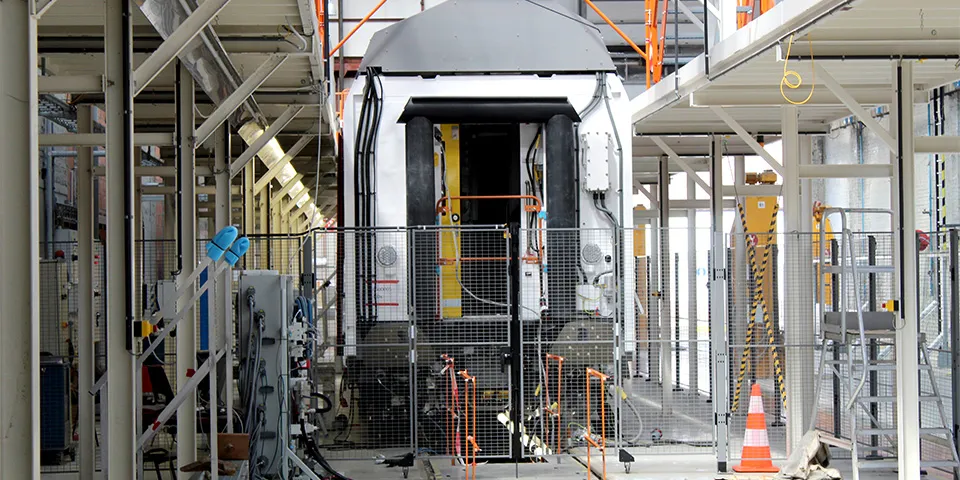
Bombardier in Bruges has been building trainsets for many years. Before these carriages can enter the international rail network, they must first undergo a range of functional and electrical tests. High voltage is connected in the test bays, making safety a paramount consideration in the installation. Pilz developed a safety plan for the test bays at Bombardier, enabling employees to test the trainsets safely. The installation is based on a PSS 4000 safety PLC.
Facility manager Marc Wuidart, who has worked at Bombardier for 34 years, explains the tests carried out on a modern trainset: “Completed carriages are moved by rail into the test bay, where we start with the electrical inspection. Literally every wire is tested. It is a substantial task, as each carriage has more than 5,000 connection points. In the first bay, we test the quality of the wiring and use dielectric tests to check that the insulation is sound. The carriage then moves to another test bay, where we carry out functional tests from A to Z. These range from safety tests, such as checking the tightness of the air lines and carrying out pneumatic brake tests, to tests of the climate control and heating. We also check the converter, which steps the voltage down from high voltage to 220 and 380 V. The presence of high voltage calls for a specific approach, particularly as there was an incident involving 3 kV high voltage at the company a few years ago, although fortunately it was not fatal.”
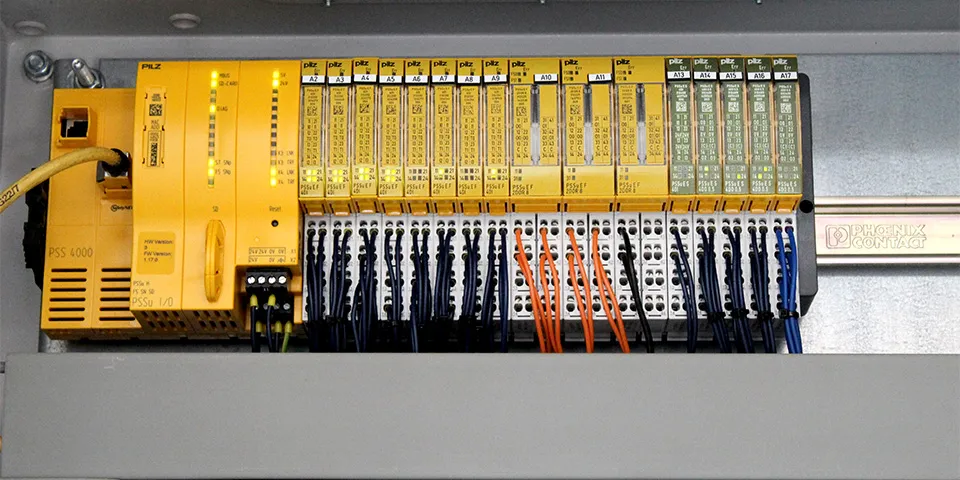
The core of the safety installation is Pilz’s PSS4000 safety PLC, which processes all the I/Os.
Working with SPIE
Bombardier has an in-house technical department responsible for keeping all its machines operational, but when it comes to installing new systems, the train manufacturer calls on SPIE, a major player in the Belgian installation market with 1,800 employees. SPIE site manager Hans Soulliaert explains: “We were asked to oversee the technical design of the test bays for this project. Our speciality is implementing the mechanical and electrical aspects of the installation, but we called on Pilz’s expertise for the safety element. They carried out all the calculations, programming and validation, and developed the concept. They are highly skilled in that niche, just as we are in ours. This synergy results in an installation with a much higher level of safety. It was also an advantage that the three parties had worked together before, as Pilz had already been involved in previous projects at Bombardier.”
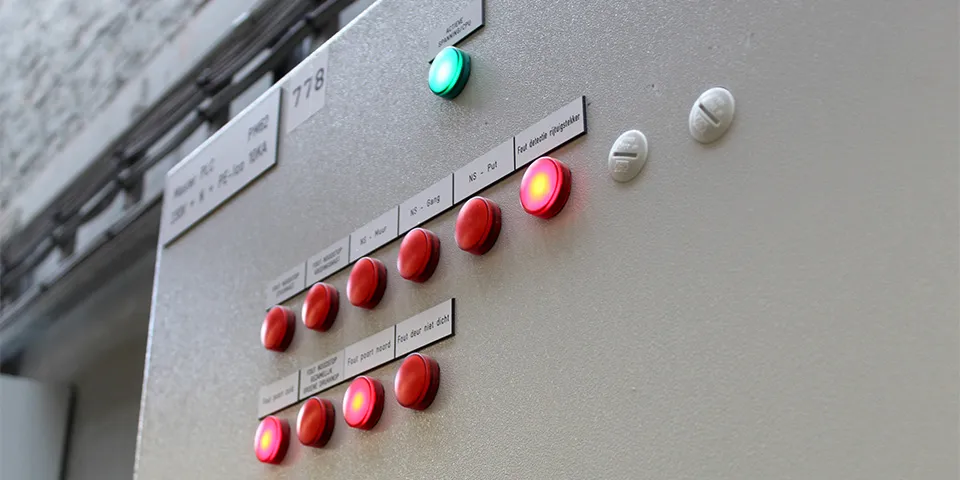
A clear visualisation gives employees an immediate overview of the situation and enables rapid fault diagnosis.
A carefully designed safety cycle
Kwinten Cantraine, sales manager at Pilz, explains the steps involved in the safety study: “We always follow a complete safety cycle. The first and mandatory step is the risk assessment. Next, as part of the safety concept, we work with Bombardier to find practical, compliant solutions to reduce the risks.
Once we have agreed on these, we start drawing up the electrical schematics, programming, compiling the I/O lists and cable lists, and so on, as part of the safety design. After the detailed engineering was completed, SPIE could begin the practical implementation.
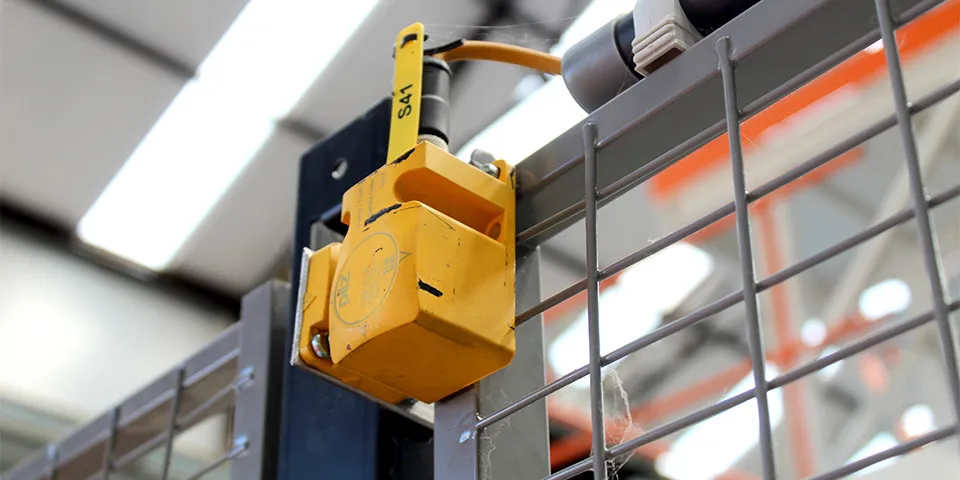
When the coded Pilz safety switches (PSENcode) are activated, the power in the test bay is cut off immediately.
SPIE was responsible for correctly installing the various components, both mechanically and electrically. Finally, Pilz validates the complete system. Every component is then checked step by step using a shutdown matrix to verify that everything works physically and shuts down as it should. Validation is a very important step that is sometimes overlooked.”
Practical safety
“In the past, all staff could simply walk into the test site. The first safety measure was to install a perimeter fence, turning it into a genuine ‘test bay’,” says Benoit Sioen, the Pilz safety engineer responsible for the practical implementation, as he guides us through the safeguards in the installation. “We also introduced access control using RFID badges, so that only authorised personnel can enter the test bay. In addition, the system cannot be started until a uniquely coded key has been entered.”
The design also takes ease of use into account, alongside safety. Flashing lights indicate when the high voltage is live. If an emergency stop is activated, all power throughout the entire bay is cut off immediately. The same applies if the perimeter fence is opened without authorisation, which is monitored using coded PSENcode safety switches. Employees can see the status of the emergency stops and access points immediately on the control cabinet. This enables rapid fault diagnosis and reduces downtime.
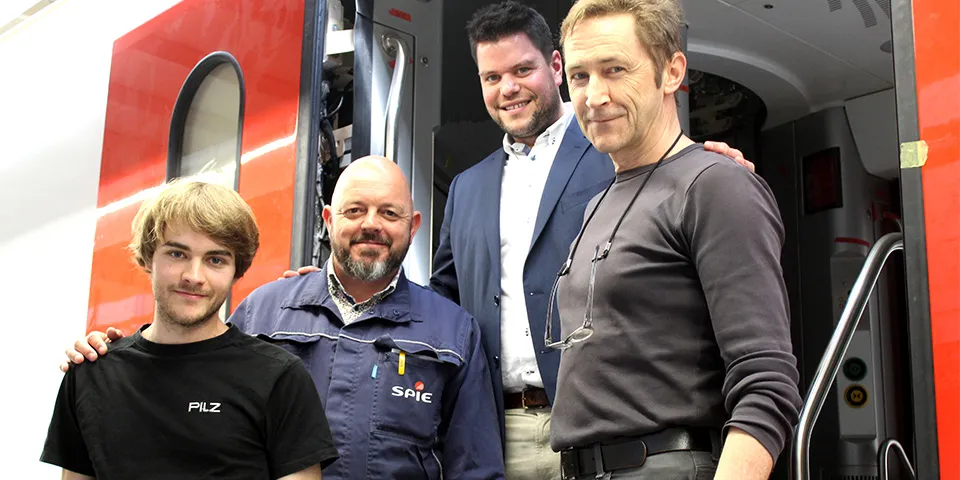
The project was the result of fruitful collaboration between several parties. From left to right: Benoit Sioen (Pilz), Hans Soulliaert (SPIE), Kwinten Cantraine (Pilz) and Marc Wuidart (Bombardier).
Benoit Sioen: “Because this is a large, complex workshop, we introduced a reset procedure. Before starting, staff must complete a mandatory round and activate three reset buttons: one on the ground floor, one upstairs and one in the inspection pit. This prevents anyone from being left unnoticed in the zone when the system is switched on.”
PSS 4000 PLC system as the foundation
“All the safety I/Os are controlled by the PSS 4000 PLC. One PLC is installed for every two test bays. The PLC is located in the first bay, while an I/O module in the second is connected to it via SafetyNet. So one programme controls two test bays.” In PSS 4000, objects can be tested individually and added to a library. New objects can be based on existing parameters, while still having their own specific parameters. This makes writing a second, similar programme much quicker.
Higher safety level
At Bombardier, they are very pleased with the higher level of safety in the test bays. “The test supervisor now has greater authority. They can stop work themselves to carry out certain checks and prevent unsafe situations. But safety is a continuous process, and one we continue to invest in. We are glad Pilz can support us in this,” concludes Marc Wuidart.
Question about this story? Ask your question
Keep following this
Get an email when a new story is published. No account needed.
- ThemeSmarter, safer construction site management
- SubjectGeneral







