









Priority list identifies bridges in the most critical condition
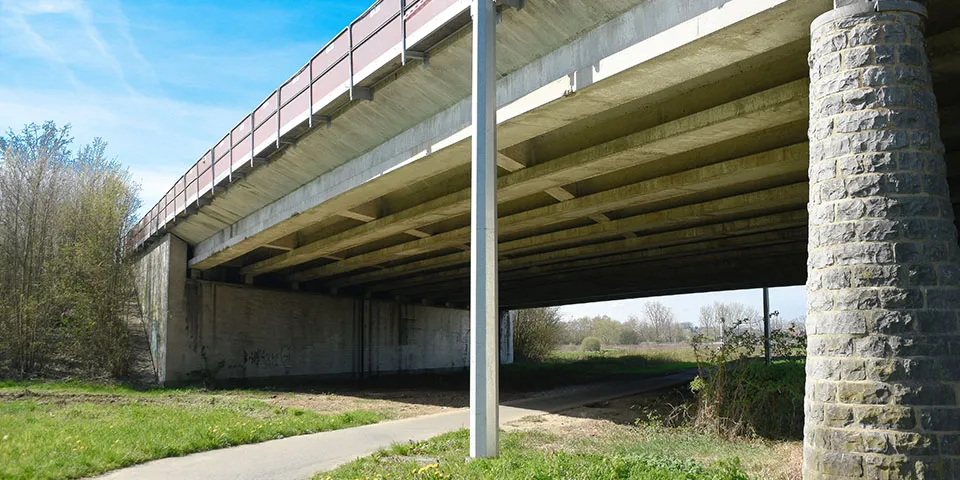
A number of years ago, a decision was made to make the best use of available resources and personnel by moving away from fixed three-yearly inspections of bridges managed by the Flemish government, in favour of flexible inspection intervals of three to five years. A ‘list of priority structures’ ensures that the most critical cases are closely monitored. “It is extremely important to establish the current condition of bridges,” stresses Professor Bart Craeye, lecturer at the Faculty of Applied Engineering Sciences at the University of Antwerp and Odisee University College.
To identify the most urgent cases, AWV drew up a ‘list of priority structures’. “When a bridge is added to the list, it is primarily because we are increasing the level of monitoring,” AWV explains. “This does not mean that immediate action is needed. Bridges in Flanders are designed to last an average of 70 to 80 years. On the basis of the regular inspections we carry out, we compile a list of bridges that will need repairs in due course. We use this list to draw up our investment programme, and each year we carry out work on a number of bridges or plan interventions where necessary. The list is closely monitored by the Commission for the Management of Structures and updated monthly.”
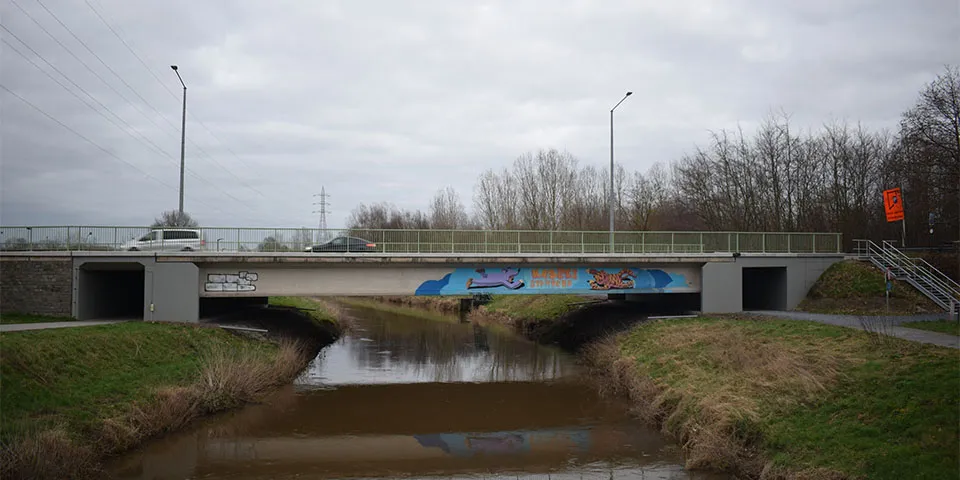
Renotec renovated the bridge over the Demer on the eastern ring road, the R25/N10, in Aarschot on behalf of the Agency for Roads and Traffic.
A preventive approach
Professor Craeye regrets the reduction in inspections: “It takes years for corrosion to begin in reinforced or prestressed concrete elements. However, if action is only taken once signs of damage become visible, valuable time is lost. That is why I advocate a preventive approach rather than the often-used curative approach. Inspection before repair is critical to the entire process. Establishing the current condition of bridge structures is essential, both to rule out dangerous situations in the future and to prescribe targeted, sustainable maintenance and repair in accordance with the applicable EN 1504 standards. It is important that the inspections are underpinned by a clear, objective inspection protocol and an accompanying assessment strategy. The changes in the condition of bridges must also be tracked in order to arrive at the right decision-making strategy.”
Care and commitment
Establishing the condition of bridges is the responsibility of AWV’s structures team. “The team consists of a bridge management unit and a bridge inspection unit,” AWV explains. “The bridge inspectors work with great care and commitment to ensure that structures remain in good condition. On the basis of their inspection reports, they organise and monitor minor maintenance and repair work. The bridge management unit uses these reports, among other things, to determine which structures should be included in a renovation project.
All AWV employees involved in managing structures can also draw on the knowledge and expertise of the Concrete and Steel Expertise Division (EBS), a specialist division of the Flemish government’s Department of Mobility and Public Works. The division provides advice and also carries out certain inspections, checks and tests.”
No immediate risk of collapse
Most of our concrete bridges are beam bridges supported by abutments and one or more intermediate piers, all made of reinforced or prestressed concrete. Professor Craeye says: “Although it is extremely important to establish the current condition of bridges through targeted, periodic inspections, there is no immediate risk of collapse. We should not expect to see the kind of horrific scenes recently witnessed with the collapse of the Ponte Morandi on bridges over Belgian roads. During inspections, however, it is important to focus first on the most critical areas: joints between the different bridge components, locations where water drains through, anchorage zones for the prestressing tendons, and connections between the bridge and the abutments and piers, including the bearing areas. The edge beams of bridge structures are also susceptible to concrete damage.”
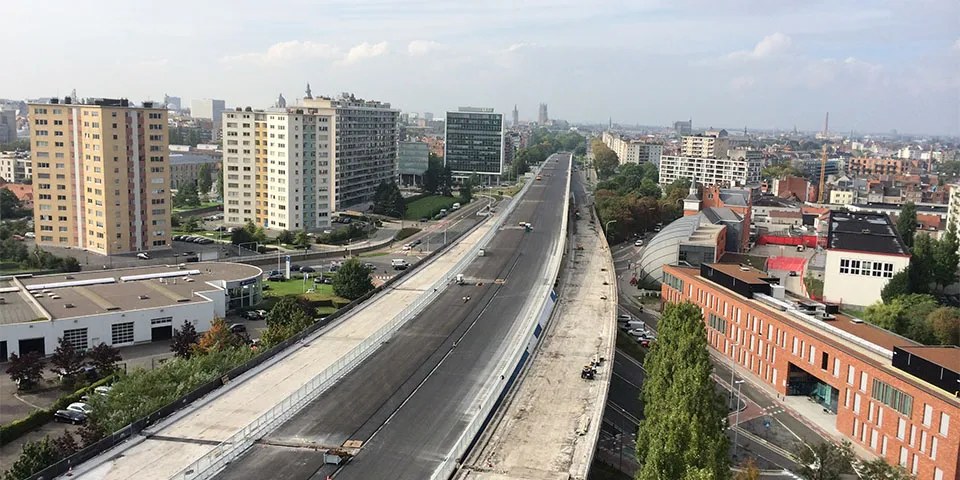
Work on the viaduct in Ghent.
Corrosion is a major culprit
Around 70 to 80% of damage to concrete bridges is due, to a greater or lesser extent, to corrosion of the steel within the concrete element. Corrosion damage occurs when the steel is exposed alternately to wet and dry conditions, as in an outdoor environment, and when it is exposed to CO2 and/or chlorides, for example those present in de-icing salts. “These three criteria are often met at numerous locations on bridge structures,” Professor Craeye explains. “Physical damage caused by frost, in combination with de-icing salts, is another common culprit. This damage affects ‘only’ the concrete, causing pieces to become loose, but leaves the reinforcement untouched. Chemical damage, such as alkali-silica reaction (ASR), is less common but cannot be ruled out and can lead to serious concrete damage. Finally, cracks caused by restrained shrinkage are also possible. If these cracks are wider than 0.2-0.3 mm, transport processes through them are accelerated, which can in turn accelerate the damage mechanisms mentioned above.”
A shortage occupation
While demand for concrete repair is continuing to rise in 2020, there is a severe shortage of well-trained concrete experts, Professor Craeye notes. “In other words, concrete expert is becoming a shortage occupation. This comes at a time when skilled staff are needed, not only for diagnosis and inspection, but also for carrying out concrete repair projects. Finally, a change in mindset is also needed. Instead of a curative approach, we need to move towards preventive measures and interventions. In the long term, the investment cost of a preventive approach, with maintenance and several smaller costs spread over a longer period and with limited impact on society, is lower than that of a curative approach involving highly disruptive repair work and the associated costs,” concludes Professor Craeye.
Question about this story? Ask your question
Keep following this
Get an email when a new story is published. No account needed.
- ThemeExtending the life of bridges and tunnels
- SubjectGeneral







