









Oostende’s Westerstaketsel fully accessible again from 1 July
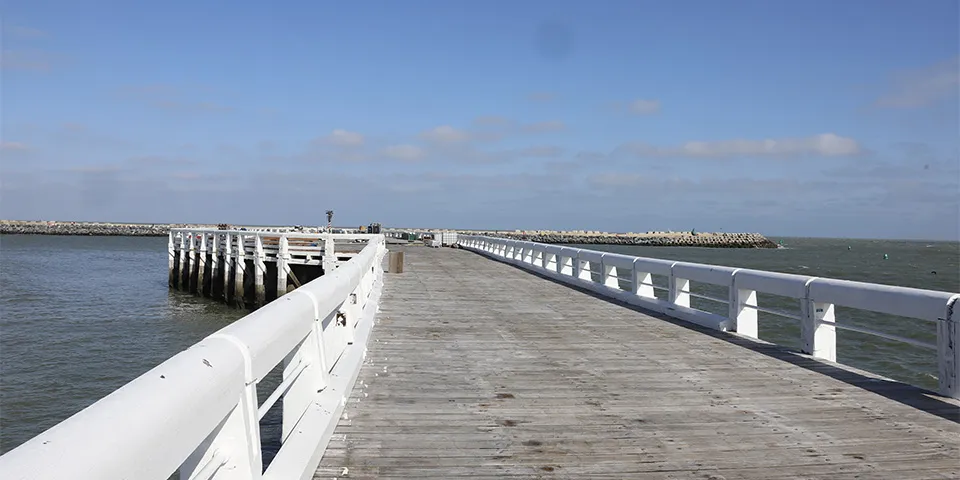
The Westerstaketsel in Oostende will reopen on Monday 1 July. This summer, everyone can once again walk to the very end of the pier. “We are investing more than 7 million euros to restore this landmark of Oostende to its former glory. The full renovation will take several years, but during the summer tourist season we want everyone to have the chance to enjoy one of the longest piers in the world,” says Ben Weyts, Flemish Minister for Public Works and Tourism.
Meticulous approach
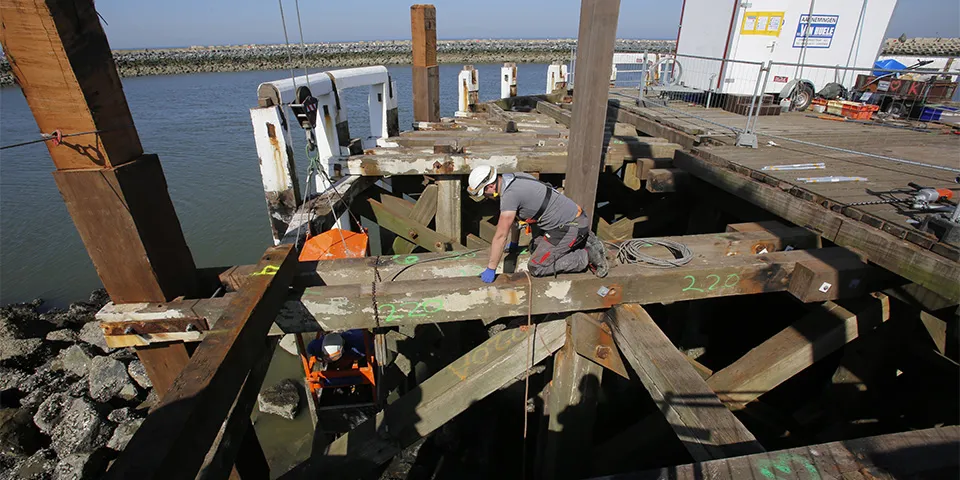
The Flemish Government took a meticulous approach to the renovation. Every cm2 was thoroughly inspected. “At first glance, certain parts looked to be in good condition. But once we removed the planks, the damage became visible,” says project manager Hadewych Verhaeghe of the Department of Mobility and Public Works. And that was far from the only challenge. “As the pier could not withstand heavy loads, we had to use lighter equipment. Replacing the wooden piles was also no easy task. Given the limited load-bearing capacity of the pier, we had to do this from the water, using a crane on a pontoon. And from time to time, the weather, waves and tides threw a spanner in the works.”
Painting and lighting work in the autumn
No work is scheduled this summer, so that the pier can be returned to the public, but that does not mean the renovation is complete. “Final acceptance is scheduled for 2020,” says Hadewych Verhaeghe. “We will carry out painting work in September. In October, the final floorboards will be replaced, just beyond the Franlis shipping company’s landing stage. Some parts of the structure will therefore be temporarily inaccessible in the autumn. The new light fittings will also be installed on the lighting columns during this period. The wooden structure will thus have new lighting before winter. The tower with the fog bell will be put back at the end of the pier during 2020. No major works are planned for the next 20 years, but we will continue to monitor the condition of this protected monument closely.”
Technical information
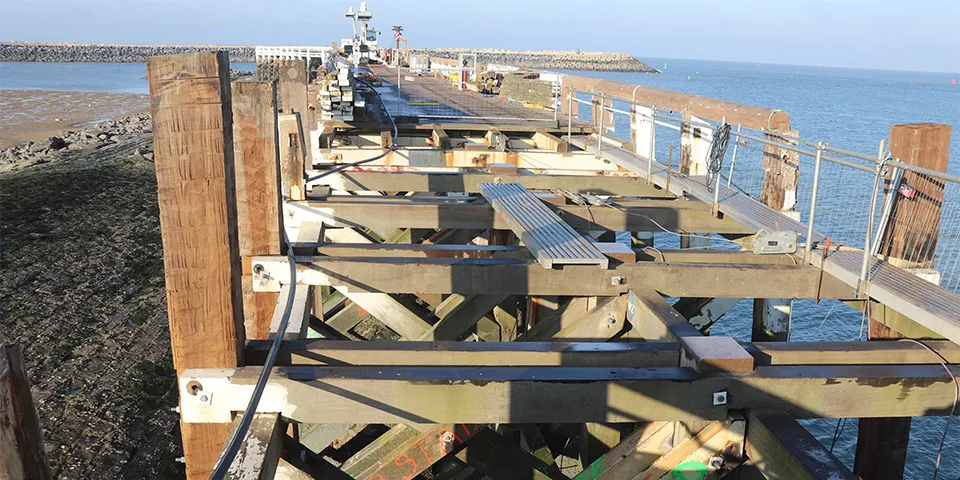
Renovation work began in October 2017 and is primarily intended to ensure the structure’s stability. The structure has not been completely renewed. The first phase focused on the end of the pier. From 1 October 2018, work was carried out on the damaged timber and joints along the length of the pier. In many places, the timber was in very poor condition. “We replaced the planks, piles, beams and handrails. Some joints were reinforced with wooden wedges and steel plates. To prevent wood rot in future, we protected the pile tops with an epoxy coating,” says Verhaeghe.
Cost: 7 million euros
The Flemish Government owns this historic heritage site. The renovation work is being carried out on behalf of the Maritime Access division of the Department of Mobility and Public Works. “We worked closely with the Agency for Immovable Heritage on the repairs. We restored the pier as closely as possible to its original condition and used original materials and techniques wherever possible.” The work was carried out by the temporary partnership Van Huele-Soetaert. The cost of the works, including VAT, is more than 7 million euros.
One of the longest in the world
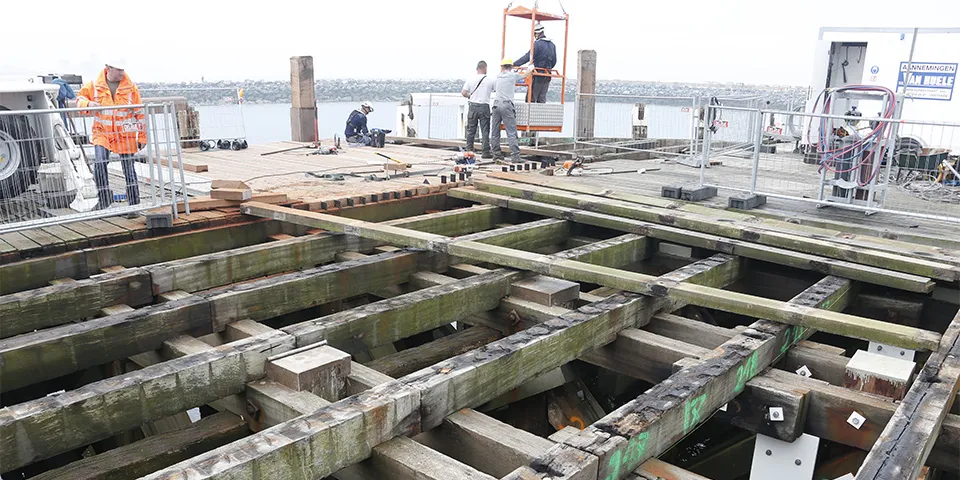
The pier has been a protected monument since 2006 and has a long and fascinating history. The current structure dates from 1888-1889, when the former Westerstaketsel was moved further west to widen the harbour channel. At approximately 650 metres long, it is one of the longest piers in the world from that period. At the end of the 19th century, steamships calling at the foot of the pier provided a link to London. In the 20th century, the Westerstaketsel survived two world wars, the 1953 storm and a string of collisions, though not without damage.
Question about this story? Ask your question
Wie aan Westerstaketsel werkte
Keep following this
Get an email when a new story is published. No account needed.
- ProjectWesterstaketsel
- SubjectGeneral







