









New oxygen pipeline to keep 150 lorries a day off Flemish roads
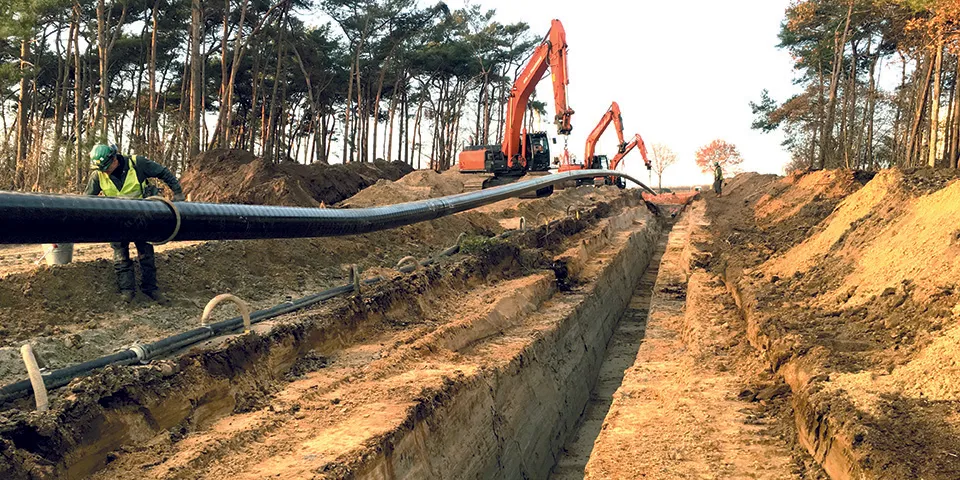
In June 2019, Air Liquide will commission a new underground oxygen pipeline between Temse and the ArcelorMittal site in Ghent. The 35 km pipeline will connect Arcelor Mittal to the French multinational’s existing oxygen network. A study showed that the pipeline would keep 150 lorries a day off the road. “All the parties are working hard to meet the target deadline of the end of June,” says Philippe Engels, Pipelines Director at Air Liquide.
The new 35-kilometre oxygen pipeline, of which just under 2 kilometres are on the ArcelorMittal site, crosses the territory of nine municipalities in East Flanders. Philippe Engels says: “Delivering oxygen by pipeline is the safest and most reliable means of transport. The increased oxygen capacity will enable ArcelorMittal to boost its steel production and thereby contribute to the further economic development of industry in Flanders. For Air Liquide, it means growth in the metal industry sector, supplying oxygen to a factory with a bright future in Belgium. And that is in a sector that has been hit hard several times in recent decades.” Denys NV is the main contractor on this major project. “We will install a T-piece on an existing Air Liquide pipeline near Temse,” says Patrick Berré, Division Manager Cables & Pipelines at Denys, “then lay a 33-kilometre pipeline to the ArcelorMittal site. A project on this scale is certainly not an everyday occurrence in Flanders.”
Preliminary studies
The oxygen pipeline is being laid over a period of nine months, but extensive studies were carried out before the first spade went into the ground. “In mid-2016, we began route feasibility studies between the Sint-Niklaas–Temse area and the pipeline’s endpoint in Zelzate,” says Peter Van der Bauwhede, Contract Manager Pipelines at Antea Group. “The first step was to find the most suitable location for connecting to the existing pipeline. Hofstraat in Temse proved to be the best site. In November 2016, Air Liquide appointed Antea Group to carry out the entire package of studies. The steel company itself assigned Antea Group the engineering of the final section of pipeline, on the ArcelorMittal site. We then worked out a route, taking account of all the constraints, whether technical, land-related, planning or environmental.”
Antea Group guided Air Liquide through the entire preliminary process. Van der Bauwhede says: “In addition to the feasibility and environmental studies, the full package of studies included all permit applications, agreements with private landowners, the complete technical dossier and so on. In short, everything involved. One of our final tasks was to prepare the tender documents and invite bids from potential contractors. This had to be completed by spring 2018, as the selected contractor needed to be able to start work on site in early autumn 2018. In the end, the entire preliminary process was completed in less than two years. That is highly unusual for a project of this scale.”
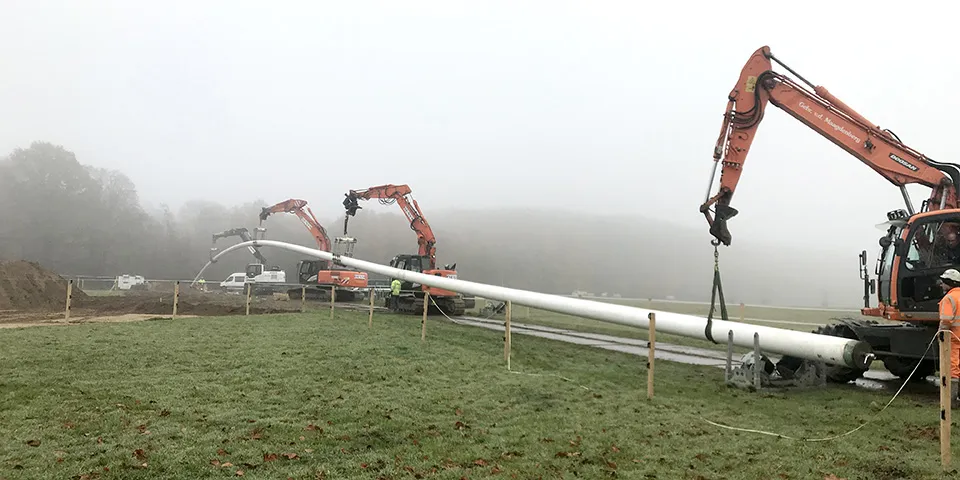
The new 35-kilometre oxygen pipeline, of which just under two kilometres are on the ArcelorMittal site, crosses the territory of nine municipalities in East Flanders.
Challenges
Not only the project itself, but also the challenges it presented were substantial. Patrick Berré says: “The main challenge when building a pipeline through Flanders is taking account of all the stakeholders and parties involved. Everyone has their own views to put forward, and there is also the issue of public acceptance. A pipeline is the safest means of transport, but generally people would rather not have one in their own back garden. Antea Group and Air Liquide handled the dialogue with private parties, including farming organisations, properly during the preliminary phase. The land is only used temporarily, and there is no expropriation. Farmers are compensated for any crop losses in line with Boerenbond’s rates.” Peter Van der Bauwhede agrees: “Involving so many different parties was a challenge. The ultimate aim is to secure formal agreement from everyone involved, or to conclude an agreement that allows the work to start. This also applies to all the public authorities and organisations, such as the Department of Environment, the Agency for Roads and Traffic, the Agency for Nature and Forests, and farming organisations. It is only right that clients and contractors must meet all the requirements. You cannot simply start work in nature areas or carry out arbitrary drilling beneath railways, motorways, regional roads and waterways.”
Environmental permit
The scale and multidisciplinary nature of the project call for considerable flexibility. “Engineering, permits, safety, the environment, archaeology… We need different experts in a range of fields,” says Peter Van der Bauwhede. “We also had to contend with revised federal legislation, the so-called Belgian Gas Act, which came into force in July 2017. This made risk analysis compulsory. In addition, the new environmental permit decree had come into effect. It combines planning permission and
environmental permits into a single permit, and applications must now be uploaded digitally through the environmental permit portal. This required a completely new approach to preparing and digitising plans and documents. In that respect, this project was a test case for both us and the authorities. This was all the more so because the environmental permit portal is not really suited to applications for long linear infrastructure projects. Together with the regional planning officers, we looked at how to work around the portal’s limitations.”
“During the preliminary phase, we had extensive contact with all the parties involved and held several information meetings to inform landowners and operators about our project,” adds Philippe Engels. “A further difficulty was that this was the first major pipeline project for which a permit application was submitted under the new environmental permit procedure. The engineering firm, ourselves and the responsible government administration all identified a number of gaps during the process, but through extensive communication and consultation we were ultimately able to resolve them.”
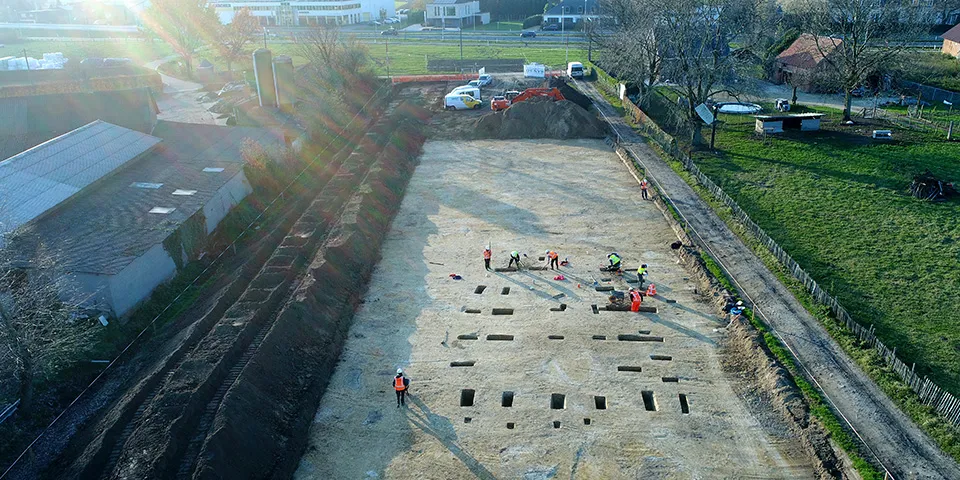
The route was screened and investigated for archaeological remains. During peak periods, around 20 to 30 archaeologists were working along the route.
A special project
The considerable challenges did not prevent Antea Group from completing the preliminary phase on time. Most of the route is being laid in an open trench, with a 20-metre-wide working corridor marked out in the Flemish landscape in advance. “A range of techniques were used,” says Patrick Berré. “Horizontal drilling and a microtunnel beneath the E17, for example, are all well-established techniques. We also carried out a guided bore of around 1,300 metres using the meet-in-the-middle principle, with drilling from two locations towards each other. Around five to six kilometres of the entire route were drilled underground, mainly through nature and woodland areas. As a specialist in high-pressure pipeline construction, we have delivered larger projects, but this one is special because it is in our own backyard. It is great that our people can get their teeth into a good local project for a change, rather than sending them off to Poland, Germany or France again. That is also why we attach such importance to stakeholder management. We may operate internationally, but we are still a Flemish contractor.”
While Denys is still physically active on site, Antea Group has taken more of a back-seat role since completing the preliminary phase. Peter Van der Bauwhede says: “In principle, our study assignment ends after the kick-off meeting with the contractor. Our task is to make sure everyone is fully aware of all the permit conditions that must be met. Naturally, we still get the occasional question during the project, but on the whole there have not been many. It is simply not possible to deviate from the permit conditions. Our main responsibility is to ensure that our design meets all the requirements without creating insurmountable technical difficulties for the contractor during construction. There is no denying that a project like this causes temporary disruption for all the private parties involved. But the impact is temporary and they are properly compensated. That message needs to be clearly communicated. An access agreement is also concluded with each landowner.”
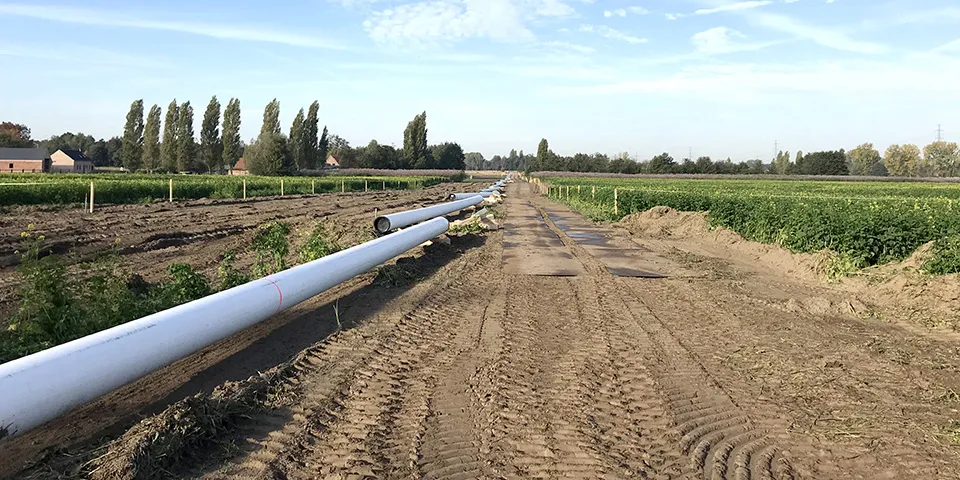
A study showed that the pipeline would keep 150 lorries a day off the road.
Archaeological supervision
Despite the project’s logistical complexity, all the parties are pleased with how things have gone. “Unfortunately, we had some wet periods when working conditions were less favourable, but work is progressing well and the target deadline is certainly achievable. The main final task will be restoring the sites. When we leave, it should look as though we were never there. Sometimes we even leave the land in better condition than we found it. That is our calling card,” says Patrick Berré, who also highlights the archaeological investigation carried out in advance. “The archaeological supervision is certainly worth mentioning. Before we started work, the site was screened and investigated for archaeological remains. During peak periods, around 20 to 30 archaeologists were working along the route. A few finds were made, but constructive and pragmatic solutions were found with all the parties involved to ensure the project could progress. This proactive approach meant we were not faced with any unpleasant surprises later on. Archaeological research often gets a negative portrayal in the construction sector, as if it only ever holds things up. That was certainly not the case here.”
Question about this story? Ask your question
Keep following this
Get an email when a new story is published. No account needed.
- ThemeUsing and protecting the subsurface
- SubjectGeneral







