









New bridges in Halle are taking shape
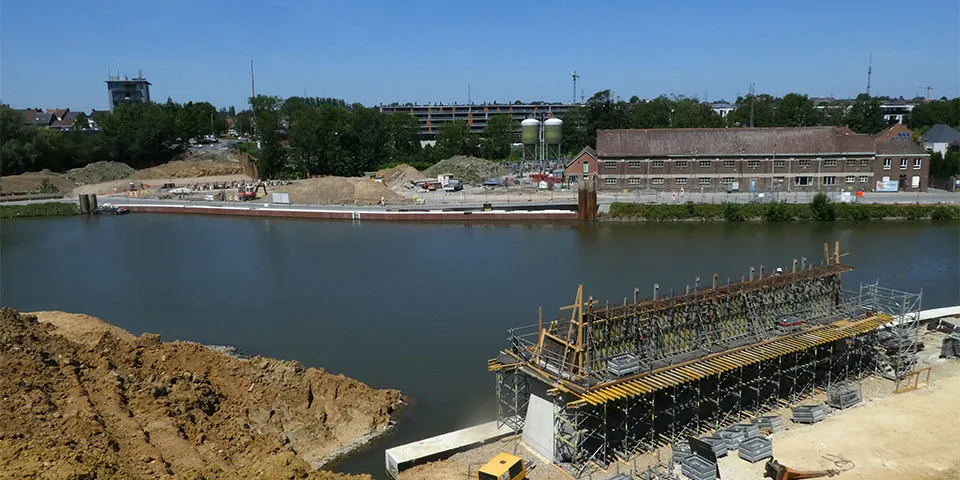
With the renovation of the Zennebrug and the construction of the Zuidbrug and Klarabrug, main contractor Herbosch-Kiere is currently carrying out a major project in Halle. The works form part of the Hallemaal Bruggen project, which aims to improve quality of life and mobility in and around the city, while also potentially increasing the accessibility of the Brussels-Charleroi Canal in the longer term.
The Zennebrug will replace the existing bridge over the Zenne on René Deboecklaan and, connecting seamlessly with the Zuidbrug, will provide a safe crossing for all road users between Bevrijdingsplein and Sint-Rochus. The Zuidbrug will in turn carry all the traffic currently using the Bospoortbrug, which also needs replacing. As De Vlaamse Waterweg plans to widen and deepen the canal in the longer term, the Bospoortbrug is being replaced by a new movable bridge. This movable bridge would cause long delays for anyone travelling to Sint-Rochus or the town centre, prompting the city of Halle to call for an alternative bridge: the Zuidbrug.
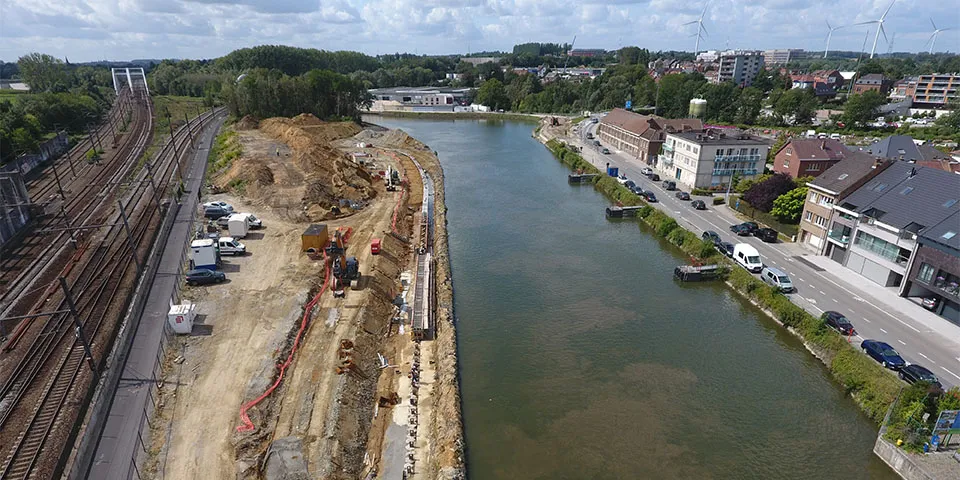
Aerial view of works on the right bank.
City of Halle and De Vlaamse Waterweg
“We are carrying out the renovation of the Zennebrug on behalf of the city of Halle. De Vlaamse Waterweg is the client for the construction of the Zuidbrug and the Klarabrug. Herbosch-Kiere is the main contractor for the entire package and is leading the civil engineering works. The construction of the bridges has been subcontracted to three different steelwork contractors,” explains Landerik Van Eynde, project manager at Herbosch-Kiere. “The Zuidbrug and Zennebrug are right next to each other, so the works are being carefully coordinated. The Zennebrug was an arch bridge built from old masonry and was in urgent need of replacement. It was demolished early this year and is being replaced by another bridge on roughly the same alignment.”
The Zennebrug will be open to all types of traffic. It will have two lanes for motor traffic, with a speed limit of 50 km/h. Public transport will also be able to use the bridge, and one-way cycle lanes and footways are provided on both sides. Public transport, cars and bicycles will also be allowed on the Zuidbrug. Its one-way cycle lanes will connect seamlessly to the cycle lanes on the new Zennebrug and Vogelpers. The number of pedestrians using the Zuidbrug is expected to be fairly low. A 2.5 m-wide shared zone for cyclists and pedestrians will therefore be provided.
Progress update
The brand-new Klarabrug will significantly shorten the journey for pedestrians walking from the station or the Sint-Rochus district to the town centre. By improving access to the station and town centre, the city of Halle hopes that even more people will use public transport.
Landerik Van Eynde: “The first section of the Klarabrug’s access ramp, a concrete box, has now been built. In the next phase, the steel columns will be installed, with the remainder of the concrete deck then cast on top. The bridge is due to be floated into position and completed by the end of the summer.”
“For the Zuidbrug, we have built a temporary towpath on the right bank to safely divert cyclists around the works, and the bank protection works have been completed,” continues Landerik Van Eynde. “We are currently working on the abutments and preparing to construct the steel arch bridge on the right bank. The bridge is being assembled there on temporary supports and is scheduled to be moved to its final position by the end of the year. Pile foundations for the Zennebrug abutments have also now been started.”
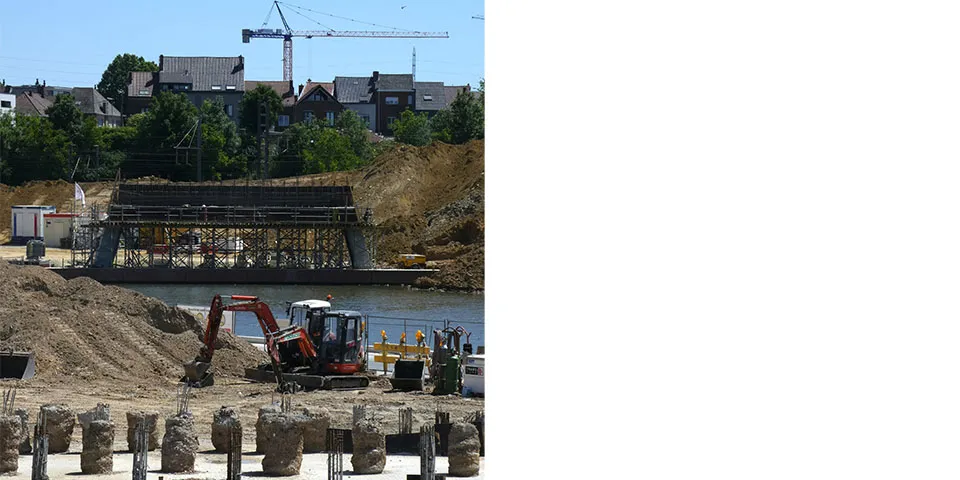
Pile foundation for the Zennebrug abutment.
Expertise and experience
Working on three bridges at the same location at the same time calls for considerable expertise and experience. “Herbosch-Kiere has that know-how. We are also familiar with the bridges over the Albertkanaal and have enough in-house staff and equipment to take on a project like this. The works are fairly conventional water engineering works. One important consideration was that the secant piles and ground anchors for the bank protection works had to be drilled into rock, particularly as the rock formation in Halle is very irregular.
Another distinctive feature is that the Zennebrug is an integral bridge, with the superstructure connected monolithically to the substructure. This required a specific approach and coordination during the design phase. During construction, it will be essential to follow the planned sequence of works with extreme precision. This will ensure that the heavy reinforcement connecting the bridge’s longitudinal girders to the abutments can be installed without difficulty. The impact of the coronavirus crisis on our works has so far been limited. Because we responded quickly and made our work and site Covid-19 proof, we were able to continue most of the activities,” concludes Landerik Van Eynde.
Een zakelijke vraag aan Herbosch-Kiere? Get in touch
Companies in this story
Keep following this
Get an email when a new story is published. No account needed.
- ThemeExtending the life of bridges and tunnels
- SubjectGeneral
- CompanyHerbosch-Kiere







