









New bridge over the Charleroi Canal to ease traffic problems
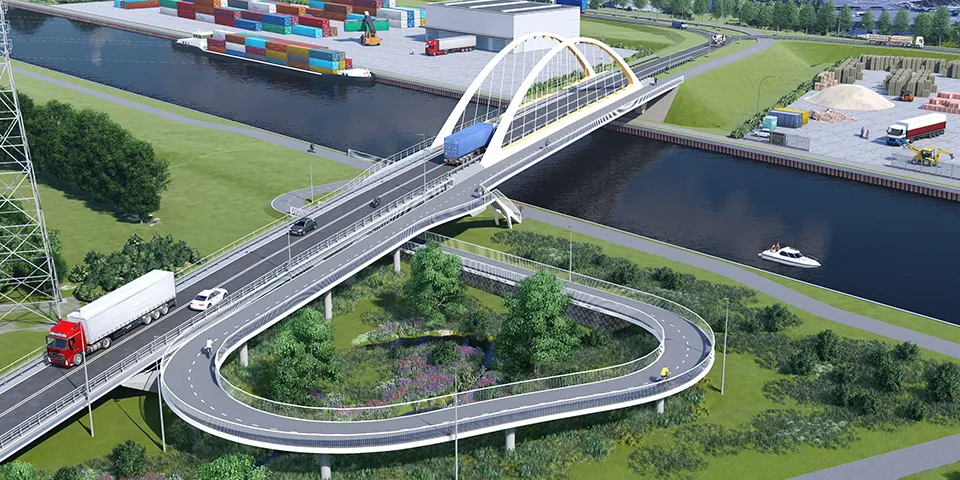
Although the business park beside the canal in Sint-Pieters-Leeuw is close to the Brussels Ring, it is not the best-connected area in the region. At present, lorries heading for the business park have only one route: along the busy Bergensesteenweg and through the neighbouring residential areas. This causes considerable congestion. The new Drie Fonteinenbrug is intended to help solve the problem.
The Drie Fonteinenbrug will connect the business park on the canal’s left bank with Drie Fonteinenstraat on the right bank, providing an alternative route towards the Brussels Ring. This will spread traffic more evenly across both banks and improve the quality of life in the residential areas. Work began in the summer of last year, with completion expected around autumn 2021.
Upgrading the canal
Although the mobility problem in and around the area was a priority for all the parties involved, the bridge offers benefits that go far beyond this. Kevin Polfliet, regional communications manager at De Vlaamse Waterweg: “The construction of this bridge is part of our multi-year project to upgrade the canal and give it a new dimension. We will be rebuilding the banks, adding new bridges and locks, and deepening and widening the canal. We want to turn the business park in Sint-Pieters-Leeuw into a regional transhipment hub, enabling businesses in the wider area to organise their transport via the canal. We also hope to shift some freight traffic from road to water.”
De Vlaamse Waterweg commissioned engineering consultancy Sweco to carry out a mobility study and design the bridge, as well as provide communications and administrative support throughout the project.
Local traffic only
De Vlaamse Waterweg commissioned engineering consultancy Sweco to carry out a mobility study and design the bridge, as well as provide communications and administrative support throughout the project. Leen Laeremans, senior infrastructure expert at Sweco: “Following the mobility study, our partners opted for a scenario in which the bridge would be open only to lorries and cars travelling to and from the business park. However, we designed the bridge so that it could be opened to all traffic crossing the canal between Sint-Pieters-Leeuw and Drogenbos in the future, following further mobility research.
Fixed bridge with cycle paths
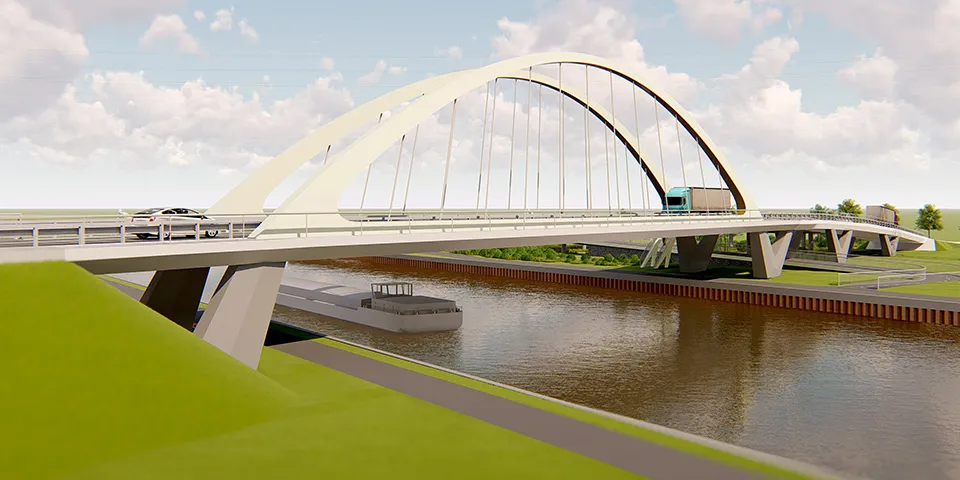
By providing cycle paths on the bridge, which can connect on the canal’s right bank to the new Halle-Brussel cycle superhighway, the municipality also aims to encourage cycling. Laeremans says De Vlaamse Waterweg preferred a fixed bridge that does not need to open: “This means the bridge will not obstruct shipping or access to the business park, and cyclists will not be inconvenienced either. However, a fixed bridge had to provide at least 7.2 metres of clearance for vessels. This was quite a challenge, as the gradients had to be kept low enough for cyclists to cross comfortably. The solution was to design an arch bridge with the roadway between the arches and the cycle path cantilevered at a lower level. We developed the design in collaboration with the bridge architects at Royal HaskoningDHV. This also immediately improves cyclist safety by separating them from the road. In addition, we positioned the bridge at an angle to the canal rather than perpendicular to it, to lengthen the approach ramp on the right bank.”
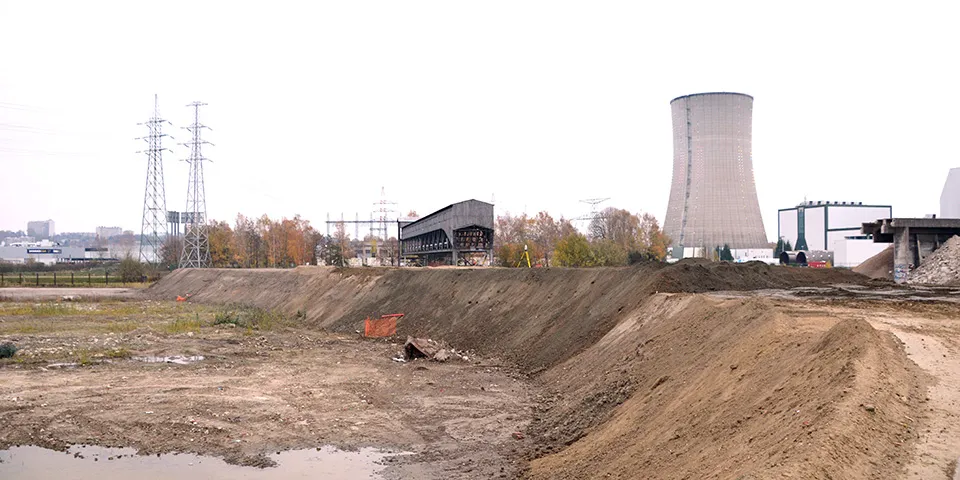
Construction of the bridge is taking place in two phases, the first of which began in August last year.
Weak ground
Construction of the bridge is taking place in two phases, the first of which began in August last year. Laeremans: “We found that the ground had very poor bearing capacity. On the left bank, we built an embankment with extra height, which needs to settle for at least six months to consolidate the weak ground. The area, near Engie’s power station, also contains a great deal of utility infrastructure. By raising the approach-ramp structures on a limited number of supports, we can avoid disturbing the existing infrastructure. Three approach spans and a cycle bridge on the right bank will provide access to the arch bridge.”
A challenge for engineers
For Sweco, the Drie Fonteinenbrug is no ordinary project: “We are involved in many major projects at home and abroad, but designing a bridge is always a special undertaking. A structure like this is highly visible in its surroundings, so architectural design is just as important as the technical design. Add the structural requirements and constraints, and you have a very challenging project,” Laeremans concludes.
Question about this story? Ask your question
Who worked on it
Drie Fonteinenbrug in Sint-Pieters-Leeuw
- engineering consultancySweco
- brugarchitectenRoyal HaskoningDHV
Keep following this
Get an email when a new story is published. No account needed.
- ProjectDrie Fonteinenbrug
- ThemeExtending the life of bridges and tunnels
- SubjectGeneral
- CompanySweco
- CompanyRoyal HaskoningDHV







