









Nearly 60-tonne towing carriage arrives in Ostend to enable innovative research
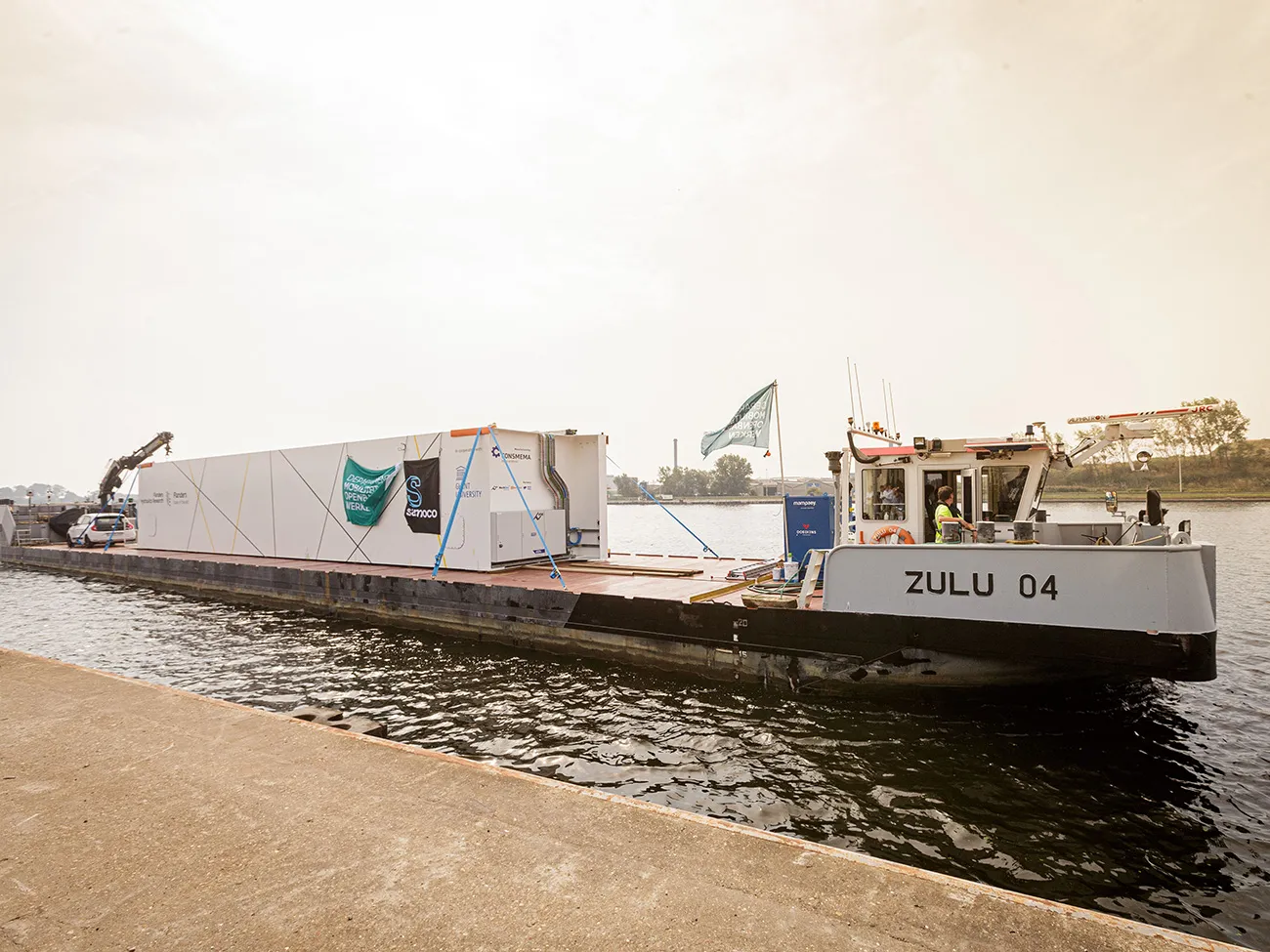
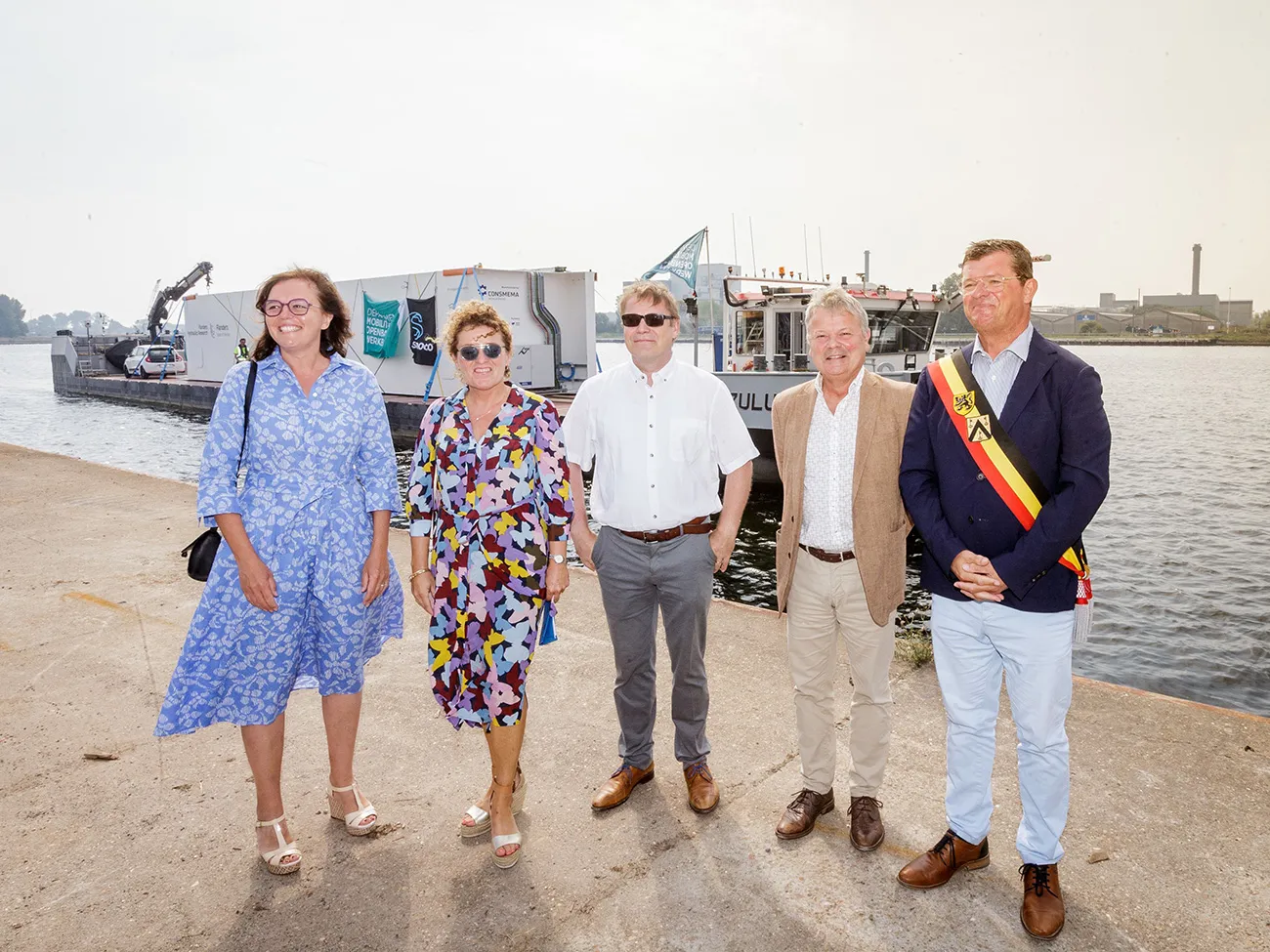
Yesterday afternoon, the giant towing carriage for the new maritime research centre in Ostend arrived. Weighing no less than 55 tonnes, it travelled from the Netherlands to Ostend by inland waterway. “This towing carriage is vital for scientific nautical research in Flanders. From spring 2023, the Flanders Hydraulics Research Laboratory will be able to use it to begin innovative research into more energy-efficient shipping, increasingly large vessels and navigation in shallow water. This towing tank is unique in the world and will ensure that Flanders remains a global leader in innovative and sustainable nautical research,” said Lydia Peeters, Flemish Minister for Mobility and Public Works.
New component of a previously built towing tank
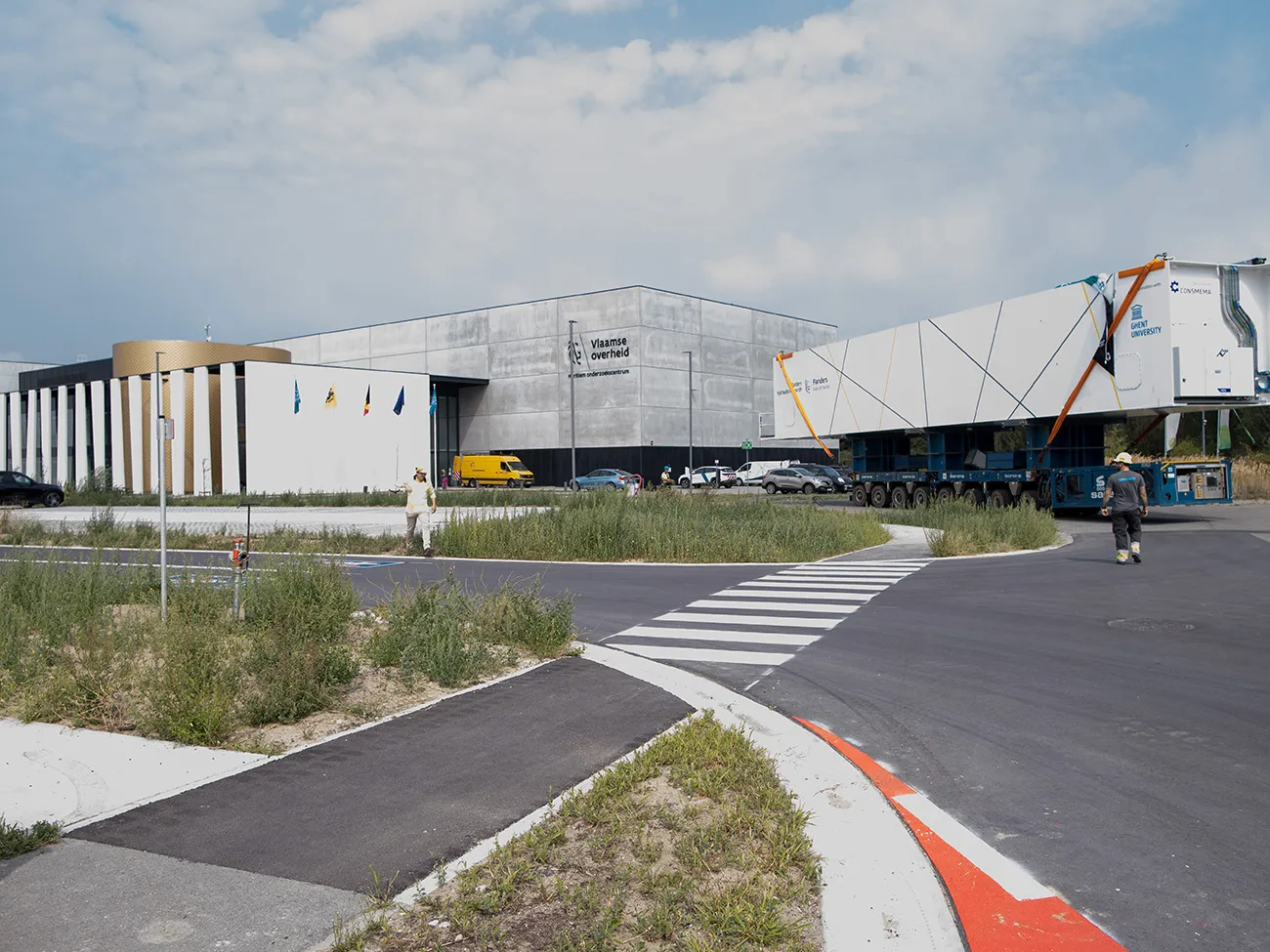
The carriage is 23.5 metres wide, has a cross-section of 3.5 x 3.5 metres and weighs 55 tonnes. It resembles a fully automated train carriage and can tow ship models up to 8 metres long through the water. The models are attached to the towing carriage and guided along a predefined path. The measured forces and movements can be used to derive a mathematical model, which is then used to simulate a ship’s manoeuvring behaviour in the ship manoeuvring simulator. The towing carriage is therefore the most important component of the recently built towing tank at the Maritime Research Centre in Ostend (MOC), and will be installed above the tank from Friday 26 August. The towing tank is 174 metres long and 20 metres wide, making it considerably larger than the first towing tank at the Flanders Hydraulics Research Laboratory’s Antwerp site. Testing is due to begin in spring 2023.
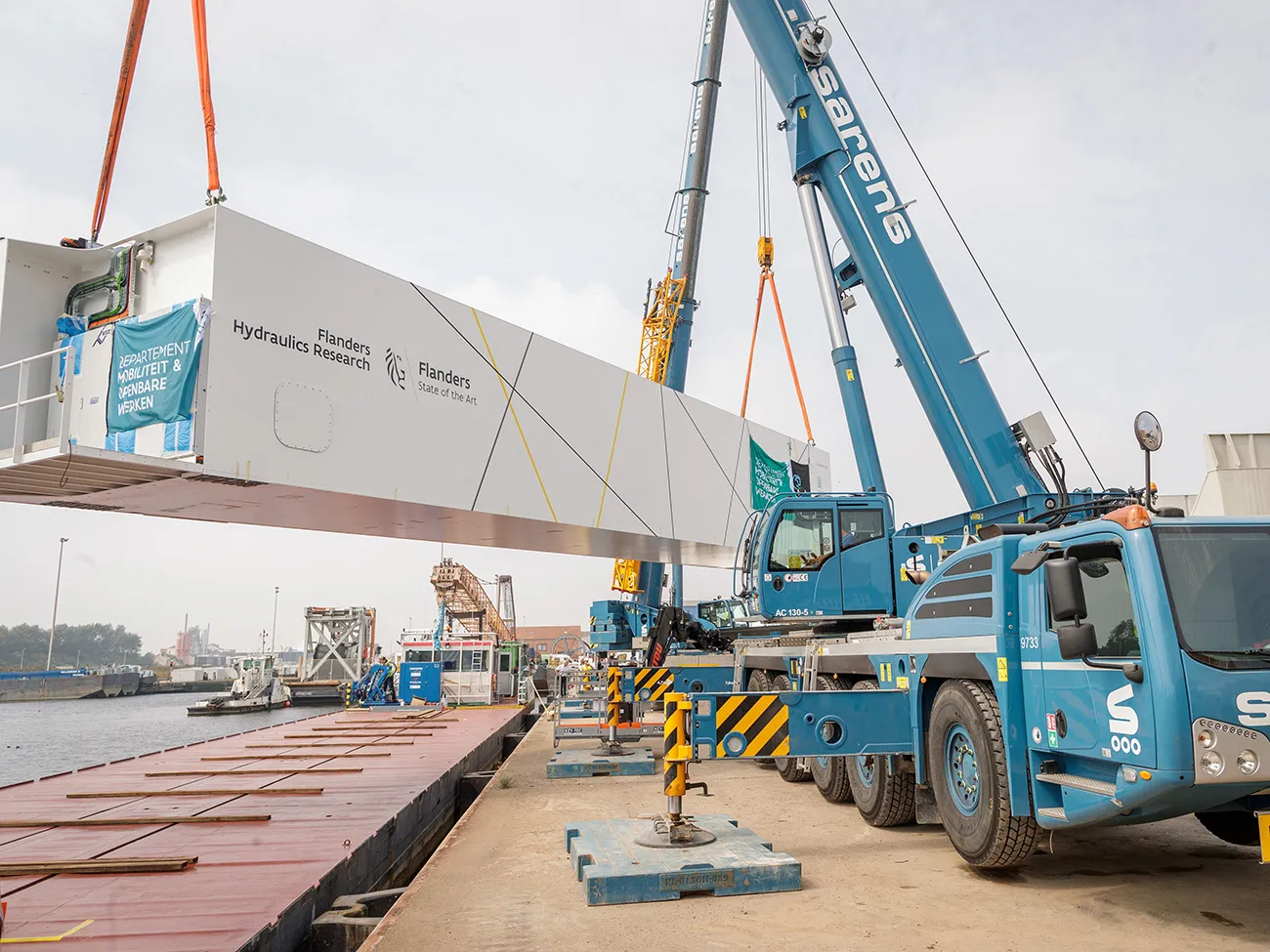
The towing carriage travelled from the Netherlands to Ostend via inland waterways, passing the Port of Antwerp, the Upper Scheldt, the ring canal around Ghent, the Ghent-Bruges Canal and the Bruges-Ostend Canal. The journey went smoothly, with no incidents. The carriage was built by Consmema BV in the Netherlands, near Zwolle.
Essential for forward-looking policy
“The combination of ever-larger ships and prolonged periods of drought is putting increasing pressure on our waterways,” said Thibaut Van Zwijnsvoorde, nautical researcher at the Flanders Hydraulics Research Laboratory. “The towing tank will enable us, together with Ghent University, to deepen our knowledge in this area. A ship behaves very differently in shallow water, for example on inland waterways or in port areas. We can simulate that behaviour precisely in the new towing tank and study it in detail.” Towing-tank research is also vital for autonomous navigation on inland waterways. Finally, research can help further optimise vessel propulsion, reducing fuel consumption and emissions wherever possible.
Accurately predicting vessel behaviour also makes it possible to further develop the waterway network and improve access to our ports. This will allow seaports to continue developing as multimodal gateways for Flanders and as key nodes in the wider freight network. “This kind of research not only underpins the development of new structures and technologies, but also ensures that this development takes place with due regard for safety, a long-term vision and social relevance in Flanders,” Minister Lydia Peeters concludes.
About the Maritime Research Centre in Ostend (MOC)
The Maritime Research Centre conducts pioneering research into the effects of waves, tides and wind on ships and objects at sea. The new building is a two-in-one complex featuring a large towing tank at its centre, unique in its class for its size (174 x 20 metres), as well as a coastal and ocean basin (30 x 30 metres and 1.5 metres deep).
The wave basin and towing tank are vital for scientific research in Flanders. They will also give the port area a boost by creating further opportunities for large and small companies to develop their expertise in this field. The research centre was built on the Plassendale 1 site, in Ostend’s outer harbour, at Ostend Science Park.
The MOC is one of the sites of the Flanders Hydraulics Research Laboratory, which has been a centre of expertise for research and consultancy on hydraulic engineering, nautical, hydraulic, sediment-related and hydrological issues for more than 80 years.
Question about this story? Ask your question
Wie aan Maritiem onderzoekscentrum in Oostende werkte
- sleepwagenConsmema BVIn this story
- gezamenlijk initiatiefUniversiteit GentMentioned in A new wave basin in Flanders to support research and the economy
- gezamenlijk initiatiefKU LeuvenMentioned in A new wave basin in Flanders to support research and the economy
- gezamenlijk initiatiefWaterbouwkundig LaboratoriumMentioned in A new wave basin in Flanders to support research and the economy
Keep following this
Get an email when a new story is published. No account needed.
- ProjectMaritiem onderzoekscentrum in Oostende
- SubjectGeneral
- CompanyConsmema BV







