









More targeted ground investigations for an economically viable design

As the European standard for the geotechnical design of structures, Eurocode 7 now sets out a number of requirements, covering both geotechnical design (NBN EN 1997-1) and ground investigation (NBN EN 1997-2). Geosonda, which specialises in ground investigation for engineering & consulting projects, welcomes this regulatory framework. “The more clarity and consistency there is around ground investigation, the better,” says Stijn Huyghe, who works with Geosonda as an independent geotechnical expert.
One of Belgium’s pioneers in geotechnical investigation, Geosonda, acquired by ABO-Group in 2010, now operates as a multidisciplinary company specialising in ground investigation for geotechnical, environmental and archaeological studies and engineering assignments. Geosonda therefore keeps a close eye on standards and guidelines for ground investigation. With the introduction of the revised national annex (ANB) to Eurocode 7, Geosonda underlines the importance and necessity of clearer preliminary ground investigation, which is now also mandatory.
The specific application of Eurocode 7, Part 2, which concerns ground investigation, is determined by the guidelines of the Belgian Association for Soil Mechanics and Geotechnics (BGGG). Stijn Huyghe: “Geotechnical investigations are carried out in accordance with standard procedures set out in a series of BGGG documents. With the revised national annex to Eurocode 7, and the resulting regulatory framework, those documents are no longer guidelines but standards. If you want to carry out a ground investigation, you have to follow those rules. One of the guideline documents describes three types of ground investigation. First, there is a G1 investigation, where you simply carry out and report on what the client requests. A G2 goes a step further and requires additional preliminary ground investigation, a desk study. A desk study is mandatory, although Eurocode 7 does not specify who must carry it out. The client could, for example, do it themselves. A G3 investigation also includes setting baseline parameters. This is a very important point, because those values are needed to perform calculations.”
Baseline parameters
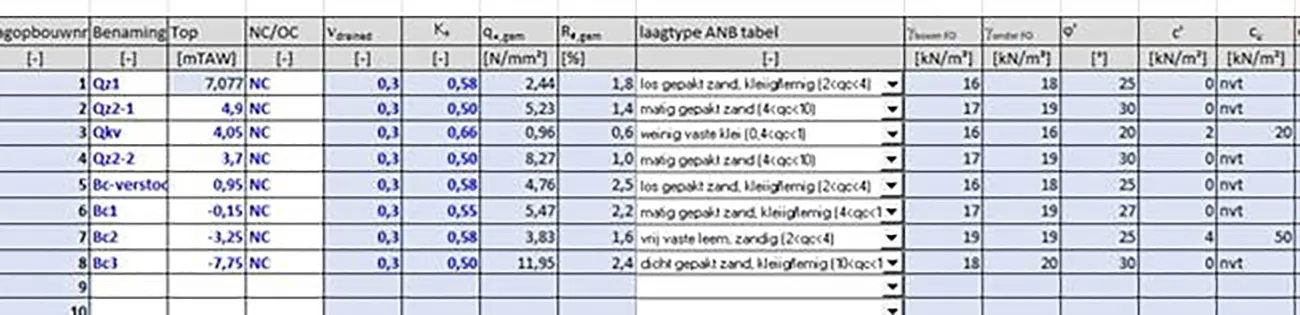
In brief, baseline parameters are the lower-bound values of geotechnical properties. These parameters take account of uncertainties relating to the ground profile and soil properties, as well as any limitations of the ground investigation, such as the type and number of tests. They are therefore indicative values, suitable mainly for preparing a preliminary design. The friction characteristics based on cone penetration test results, as set out in the ANB table, are an example of baseline parameters. “Determining and using these parameters correctly is crucial to the subsequent progress of a project,” says Stijn Huyghe. “It is important to base baseline parameters on official Belgian standards and guidelines, such as the national annex to Eurocode 7, the VMM dewatering guideline or the WTCB guideline on applying Eurocode 7 to retaining structures. Using correlations that are not officially endorsed to determine baseline parameters, by contrast, is highly risky and must be avoided. Baseline parameters are a safe estimate of the situation, but they remain lower-bound values and are therefore highly conservative. The baseline parameters listed in the ANB table for a particular ground type are based on the poorest version of that ground found anywhere in Belgium. It is very likely that your ground will be better than the worst-case version. So, for anyone seeking the most economical design, further investigations are essential to refine the parameters.”
Additional ground investigations
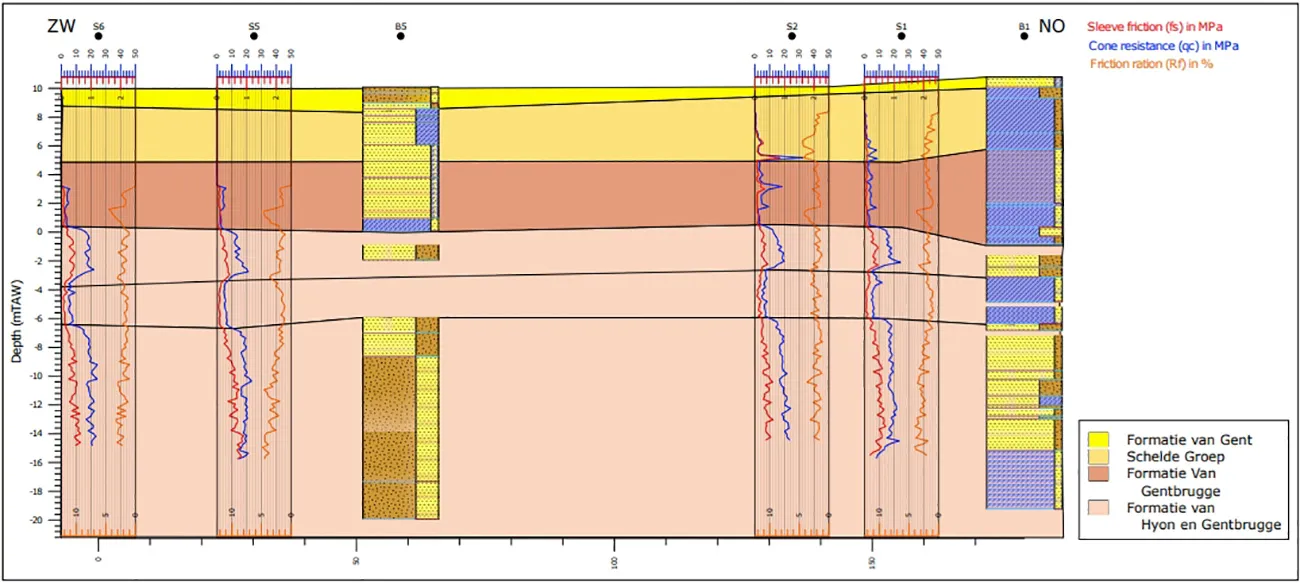
“Carrying out cone penetration tests, determining baseline parameters and using those values to begin a preliminary design is an efficient approach,” Stijn Huyghe continues. “But additional ground investigations alongside the preliminary design are essential to refine the conservative parameters, resulting in a cheaper, lighter final design. Depending on the structure to be built, these additional investigations could include further cone penetration tests, pressuremeter tests, dilatometer tests, dynamic probing, laboratory tests … Geosonda can advise on, carry out, interpret and analyse the work, from the initial investigation through to the additional tests. Of course, I am describing the ideal process a project should follow. In practice, clients still often ask for everything at once: cone penetration tests and boreholes. This often results in samples and piezometer filters being placed in the wrong soil layers, with costly consequences later on. Geosonda is therefore not calling for more ground investigation, but for more targeted investigation. The revised national annex to Eurocode 7 can help lower the barrier to achieving this.”
In any case, the regulatory framework brings greater clarity and consistency to preliminary investigations. “In principle, the regulatory framework is good for all parties because it creates clear parameters and helps ensure insurability. Above all, the best approach is always to produce the most economically viable design possible: as cheap and lightweight as possible, while complying with all applicable guidelines and standards,” concludes Stijn Huyghe.
Question about this story? Ask your question
Keep following this
Get an email when a new story is published. No account needed.
- ThemeUsing and protecting the subsurface
- SubjectGeneral







