









Major remediation project at the Fort Sint-Filips site well under way
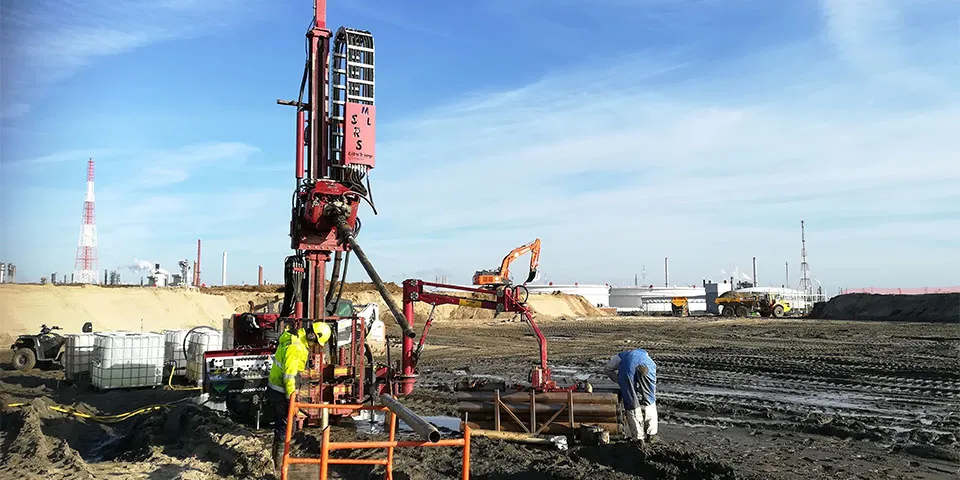
In 2012, recognised soil remediation expert ABO nv was appointed by the Port of Antwerp to investigate and map any contamination at the Fort Sint-Filips site. Seven years after the initial soil investigations, one of the largest remediation projects ever undertaken in Flanders got under way in October 2019. “The entire contaminated zone will be contained using a cement-bentonite wall and a surface cover, with Boom clay providing the base seal,” explains Toon Moeskops, project manager at ABO nv, part of ABO-Group.
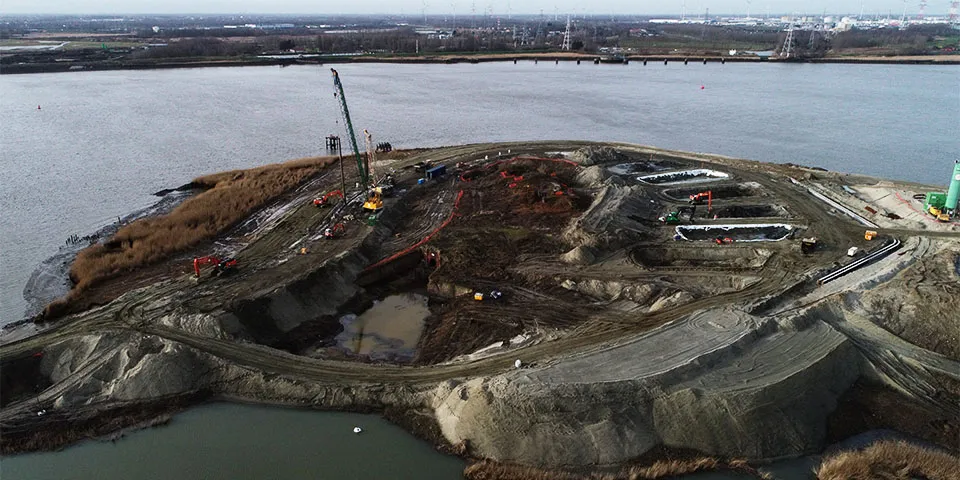
For this project, it was decided to isolate contamination in and beneath the fort using a cement-bentonite wall.
Fort Sint-Filips is one of the oldest forts around Antwerp. It dates from the 16th century, but in the 19th century it had to make way for an armoured brick structure, which was partially blown up during the First World War. Toon Moeskops explains: “In 2012, the Port of Antwerp commissioned ABO nv to carry out a preliminary soil investigation at the site. During the first investigation phase, in October 2012, it quickly became clear that the contamination was substantial, with very high concentrations of a wide range of contaminants. In the densely overgrown area around the fort, we found visible petrochemical waste, and the soil was also contaminated with a huge cocktail of pollutants.”
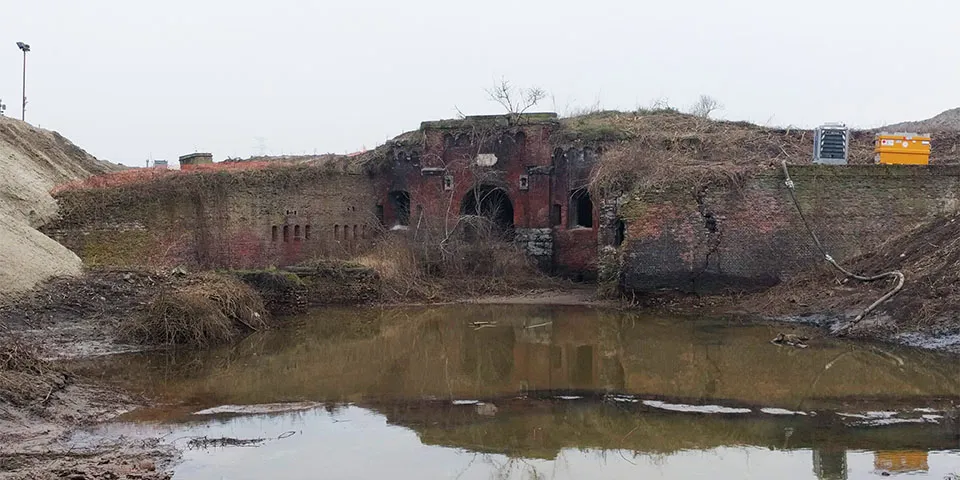
The fort’s main entrance
Historical contamination
Historical research showed that more than 50 million litres of oil were discharged and burned on the Fort Sint-Filips site between the 1950s and 1970s. Toon Moeskops explains: “At first in the open air, and later inside the fort itself. We also inspected the site. With ladders and face masks, we entered the fort, going as far as safety allowed. The floors of the rooms that were still accessible were covered in a thick, tar-like substance. It quickly became clear that we were dealing with historical contamination.”
ABO nv then carried out a descriptive soil investigation to determine both the extent of the contamination and the associated risks. “The contaminated area proved to be exceptionally large,” says Toon Moeskops. “It covers nearly 6 ha, and the contamination extends to a depth of 30 m. An estimated 1.2 million m³ of soil is contaminated. The investigation was also extended to include a nearby balancing pond. With around 40,000 m³ of contaminated sediment, remediation of the pond was also necessary.”
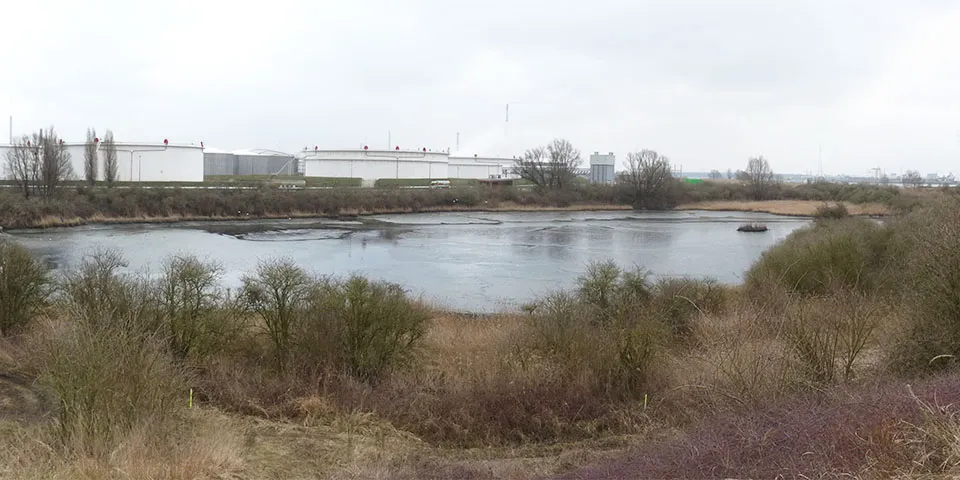
With around 40,000 m³ of contaminated sediment, a nearby balancing pond also needed to be remediated.
Constraints
The preliminary investigations were completed in 2016, making it possible to develop a remediation approach. Toon Moeskops explains: “It was no easy task, as the solution had to be comprehensive and take account of numerous constraints. The fort has historical and heritage value. Moreover, the site lies in a nature reserve, where not just any kind of work is permitted. On top of that, Sigma works are also planned near the fort, to be carried out by De Vlaamse Waterweg and the Agency for Nature and Forests, ed. These were all factors we had to take into account.”
Sarcofagus
At OVAM’s request, ABO nv carried out a multi-criteria analysis (MCA) to determine the remediation approach. Toon Moeskops explains: “The best solution is selected on the basis of the MCA, taking into account a range of factors, including remediation objectives, sustainability, waste generation, resource use, safety, disturbance to the surrounding area and cost. For this project, it was decided to isolate contamination in and beneath the fort using a cement-bentonite wall. With Boom clay at the base and a surface cover in place, the contaminated area is effectively enclosed in a sarcophagus. The discharge pond is being remediated in a similar way. The contaminated sediment is being left in place, but contained to prevent further spread.”
Intensive monitoring
The remediation work itself began in October last year. The works are being carried out by the Jan De Nul-Envisan-DEC consortium. ABO nv’s involvement did not end with the investigation phase. “The cement-bentonite wall is scheduled for completion by the summer. The next steps are further remediation of the site and the start of sediment remediation. ABO nv remains closely involved as the soil remediation expert, with daily oversight and continuous monitoring. The contamination will continue to be monitored intensively for many years after remediation is complete. This is one of the largest remediation projects ever undertaken in Flanders. Given the severity and extent of the contamination, as well as the various constraints, it is an excellent reference project for us,” concludes Toon Moeskops.
Question about this story? Ask your question
Wie aan Fort Sint-Filips werkte
- bodemsaneringsdeskundigeABO nvIn this story
- consortiumJan De NulIn this story
- consortiumEnvisanIn this story
- consortiumDECIn this story
- clientDe Vlaamse Waterweg nvMentioned in Fort Sint-Filips site transformed following complex redevelopment
- contractorDEME EnvironmentalMentioned in Fort Sint-Filips site transformed following complex redevelopment
Keep following this
Get an email when a new story is published. No account needed.
- ProjectFort Sint-Filips
- ThemeUsing and protecting the subsurface
- SubjectGeneral
- CompanyABO nv
- CompanyJan De Nul
- CompanyEnvisan
- CompanyDEC
- CompanyOVAM







