Sustainable concrete repairs under the microscope
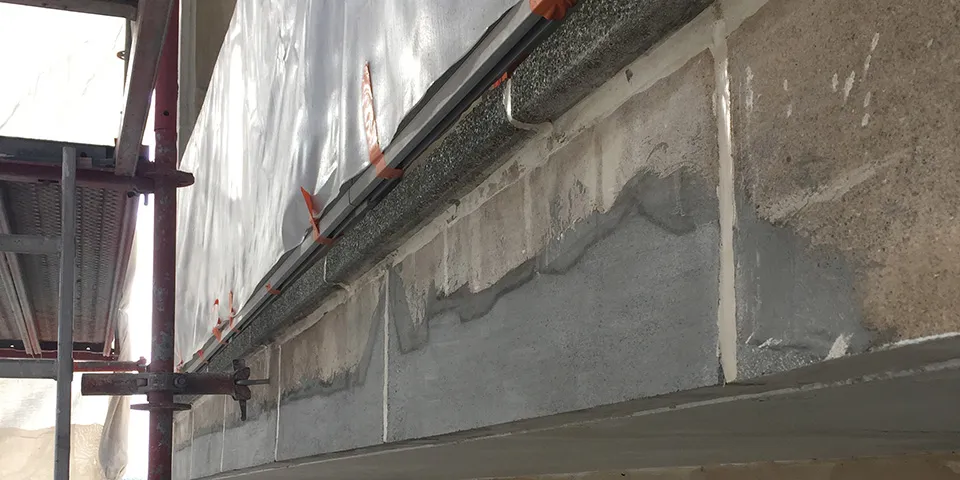
More and more concrete structures are in need of urgent, sustainable repair. But achieving a durable result requires thorough knowledge of the parties involved. Are we ready for this? At the fourth and final FEREB roadshow, “Concrete repair: crucial aspects for contractors seeking durable repairs”, held in Diepenbeek at the end of April, experts explained several key aspects of sustainable concrete repair in detail.
Failing concrete infrastructure and buildings are, unfortunately, almost a daily occurrence in Belgium. The number of concrete repair projects will therefore only increase. However, a European study from 2005 shows that in more than 50% of cases, these repairs fail within 10 years. Yet the knowledge needed to achieve durable results is available. So where does it go wrong? The roadshow, organised by Fereb in collaboration with the Flemish Confederation of Construction (VCB), the Belgian Building Research Institute (WTCB) and Netwerk Architecten Vlaanderen (NAV), got to the heart of the matter: from types of concrete damage, repair methods and pitfalls in tendering to insurance, legal regulations and product and process certification.
Certification
There are many European standards relating to the protection and repair of concrete, but the most important and relevant is undoubtedly EN 1504. “If an EN includes an Annex ZA, it is a harmonised standard, and CE marking is required in order to market the product,” says ir. Benny Broekaert, Head Coordinator of Special Products and Techniques for Structural, Finishing, Renovation and Restoration Work at the Belgian Construction Certification Association (BCCA). “Alongside mandatory CE marking, there is the voluntary but strictly controlled BENOR certificate, a quality mark monitored by an independent body. BENOR can be made a requirement in the specifications, but only in the private sector. The regions must leave the door open to products that are not BENOR-certified.” A process certificate, in turn, is a document stating that work complies with certain specifications. Benny Broekaert: “Process certification does not assess specific work, but rather execution processes. So it is no guarantee, but it should increase confidence in the processes used. Poor record-keeping, incorrect storage of cement-based repair mortars, using repair products beyond their expiry date and failing to observe atmospheric limits for use are just a few examples of why process certification is so useful. And, crucially, a correct diagnosis and detailed preliminary investigation are vital to the whole process.”
Insurance
The roadshow also took a close look at insurance and liability in concrete repair. Frank Burssens, a lawyer at Everest Law, explained in detail the liability of the client, engineering consultancy, architect and contractor. “Here’s a golden tip: get a specialist broker on board, one who specialises in construction,” he says. “Preferably a large player, who will rewrite part of the insurer’s policies. And the insurer will allow them to do so, to an extent.”
According to Frank Burssens, an all-risks construction insurance policy, supplemented by third-party liability cover, ten-year liability insurance and a guarantee insurance policy, are more or less essential. “An all-risks policy covers damage to property, not liability. You can extend it with third-party liability cover for damage caused to third parties through negligence. Since 1 July 2018, ten-year liability insurance has been compulsory, but for concrete repairs this applies only to façade work on residential buildings that requires an environmental permit or notification. In other words, work affecting the building’s stability. There is also guarantee insurance, a specific policy for concrete repairs linked to a particular approach involving all construction partners. If a concrete repair has been carried out entirely in accordance with the prescribed procedure and nevertheless fails within 10 years, this insurance will cover the repair.
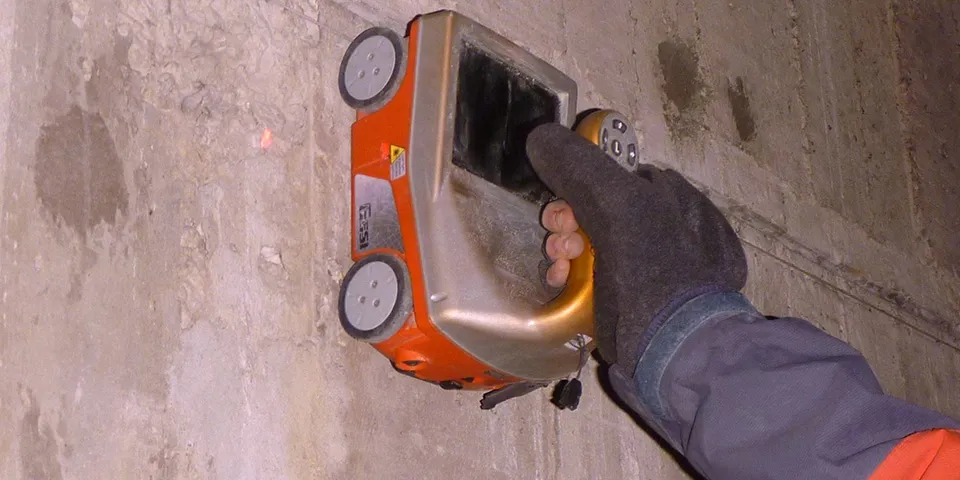
EN 1504 stipulates that every concrete repair must be preceded by a diagnosis, including not only a visual inspection but also tests to determine the condition of the concrete and reinforcement.
Preliminary investigation
The importance of a comprehensive preliminary investigation ran like a thread through the roadshow. “A correct diagnosis, the right products and techniques, experienced contractors, and maintenance and aftercare are four pillars of success,” says ir. Hugo Wildemeersch of engineering consultancy ABG. “The first step is to make the right diagnosis. EN 1504 stipulates that every concrete repair must be preceded by a diagnosis, including not only a visual inspection but also tests to determine the condition of the concrete and reinforcement. A thorough investigation provides deeper insight into areas including reinforcement detection, potential measurement, bond strength, laboratory analyses, microscopy, endoscopy, monitoring, structural assessment and surface hardness.”
“Most concrete damage is caused by corroding reinforcement,” explains Hugo Wildemeersch. “Reinforcement corrosion is triggered by carbonation and chlorides. The concrete itself can be damaged by alkali-silica reaction (ASR), mechanical damage, frost damage (with or without de-icing salts) or aggressive substances (from industry, agriculture or wastewater). The basic investigation provides the starting point for selecting the repair method. It is very important to take the right measures, and enough of them, address the cause and avoid unnecessary measures.”
Clear communication
Joost Beke of Bureau voor Expertise also stressed at the roadshow the importance of a preliminary investigation that leads to the right, sustainable approach to the problem. “The best repair is no repair,” he says with a wry smile. “Protecting concrete is also a form of repair. For example, a one-component, water-based high-polymer acrylic coating can be used to protect and finish concrete repairs, and to protect concrete against carbonation and salt ingress. Thorough investigation remains essential.”
At least as important is agreeing clearly on what needs to be done and how much it will cost. Estimates can vary considerably depending on the extent of the repair and the techniques used. Clear communication from the outset can prevent problems and disputes later on.
A business enquiry for FEREB vzw? Get in touch
Companies in this story

Keep following this
Get an email when a new story is published. No account needed.
- ThemeExtending the life of bridges and tunnels
- SubjectMachines & equipment
- CompanyFEREB vzw
- CompanyBCCA