









Lydia Peeters wants as many roadworks as possible to go ahead or restart
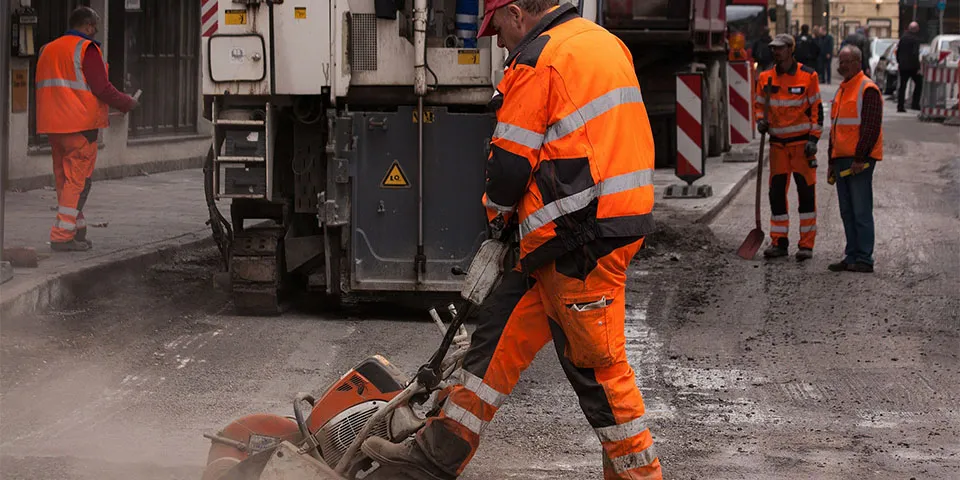
Flemish Minister for Mobility and Public Works Lydia Peeters (Open Vld) is calling for as many roadworks as possible to be carried out during this period and is taking measures to prevent liquidity problems in the road construction sector.
The current coronavirus crisis and the emergency measures imposed in response have had a considerable impact on our economy and on businesses. This is particularly true of the construction sector, where sites have been shut down, are experiencing delays or have effectively become impossible to work on.
It is still up to each contractor to decide whether to continue its activities, in whole or in part, provided that the mandatory coronavirus measures are observed.
Flemish Minister for Mobility and Public Works Lydia Peeters is calling on companies to keep working as much as possible: “My policy area is one in which a great many public contracts and investments take place. Particularly at this time, when there is little traffic, such works can be carried out in safe environments. I would therefore like most works to be able to make progress. Many projects are urgent and require close monitoring. Consider, for example, tackling accident blackspots on regional roads, major works on our motorways, building cycle paths, modifying bridges, resolving conflict points and much more. There is a great deal of work to be done, and postponement is absolutely undesirable.”
Flanders Agency for Roads and Traffic sites
Before the coronavirus crisis began, there were 186 sites in the Flemish Region for the Flanders Agency for Roads and Traffic alone. Now, two weeks later, work is continuing at just 80 sites.
Overview of works by province:
| WV | OV | A | VB | L | Total | |
| Number of sites at the start of the “lockdown” | 31 | 25 | 62 | 30 | 38 | 186 |
| Number of sites still active | 12 | 5 | 40 | 4 | 19 | 80 |
Preventing liquidity problems
We want to support the construction sector and, as a first step, have examined how measures can be taken, within the rules governing public contracts, to avoid or limit liquidity problems for companies as much as possible. The following measures have been developed:
1. Interim payments
We are asking the administration to make extensive use of interim payments on account in the form of monthly claims. Even for contracts where payment is only due once the works have been fully completed or certain milestones reached, meaning that contractors have to pre-finance a large share of the costs, we are proposing a different payment arrangement so that costs already incurred can be claimed and reimbursed. The parties can agree on such a new payment arrangement by means of an addendum.
2. Shortening payment periods
We are calling for payment periods to be kept to an absolute minimum. Under public procurement legislation, the contracting authority has a payment period of up to 30 calendar days. This is preceded by a verification period of up to 30 calendar days. In the current circumstances, we are asking the administration to verify and pay claims and invoices more quickly.
3. Delay penalties
Delay penalties for works are, in principle, due automatically and without notice of default. We are introducing a concessionary measure and will waive delay penalties if the delay is due to an unforeseeable circumstance or if the penalty is disproportionate to the limited importance of the work completed late. This discretion will be applied generously.
4. Advances to prevent liquidity problems
Finally, we are examining the extent to which advances can be paid to contractors. By way of exception, contractors may be granted an advance before the services have been provided and accepted. In our view, the coronavirus crisis is an extreme situation in which the application of an exception to the payment terms should be considered.
Restarting worksites
Flemish Minister Lydia Peeters is calling on the road construction sector to keep as many sites moving forward as possible and, where feasible, restart sites that have been shut down. We particularly want to see priority sites move ahead quickly: sites involving a high safety risk, sites causing considerable disruption and sites that form part of a larger project. Sites that were almost complete should also be finished quickly so that they can be finalised without delay.
Next week, Minister Peeters will convene a meeting bringing together her administration, her cabinet and contractors to consider how this can be facilitated. Local authorities are also being asked to do everything they can to help restart these works.
Source: Lydiapeeters.be
Question about this story? Ask your question
Keep following this
Get an email when a new story is published. No account needed.
- ThemeFuture-proofing roads and railways
- SubjectGeneral







