









Leopold II Tunnel made asbestos-free in a single summer holiday
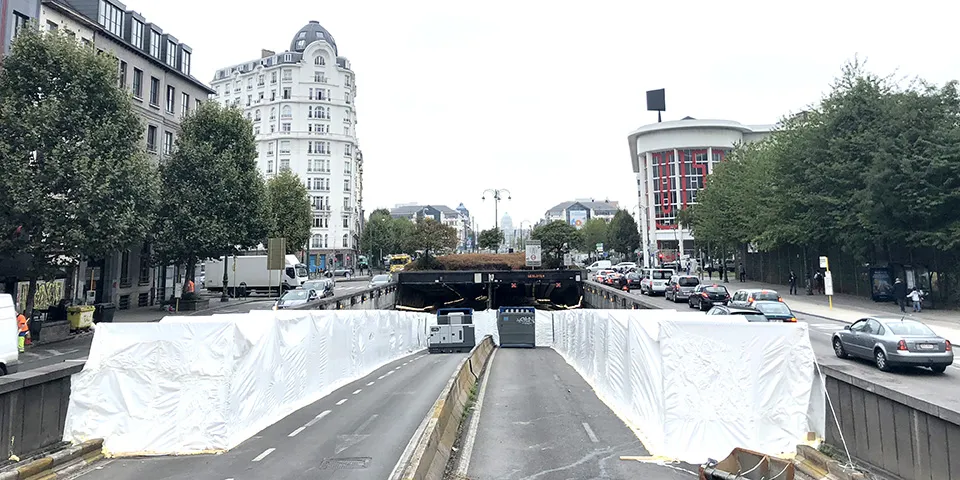
Before renovation work on the Leopold II Tunnel itself could begin, the asbestos first had to be removed. It was mainly contained in the paint coating applied to the walls. The tunnel was made completely asbestos-free while it was closed during the past summer holiday. The Circul 2020 consortium called on De Meuter to carry out the work.
Inspections carried out in preparation for the tunnel renovation revealed the presence of asbestos, which is not unusual in a structure dating from the 1980s. As it was bonded asbestos, it posed no danger, but it still had to be removed before renovation work could begin. De Meuter, based in Ternat, specialises in asbestos removal and earthworks and demolition. It certainly has plenty of experience. “Most of the asbestos was in a paint coating applied to the concrete structure when the tunnel was built,” says Frederic De Medts, head of De Meuter’s asbestos removal division. “The coating covered the full length of the tunnel, on both sides, up to a height of 1 metre.”
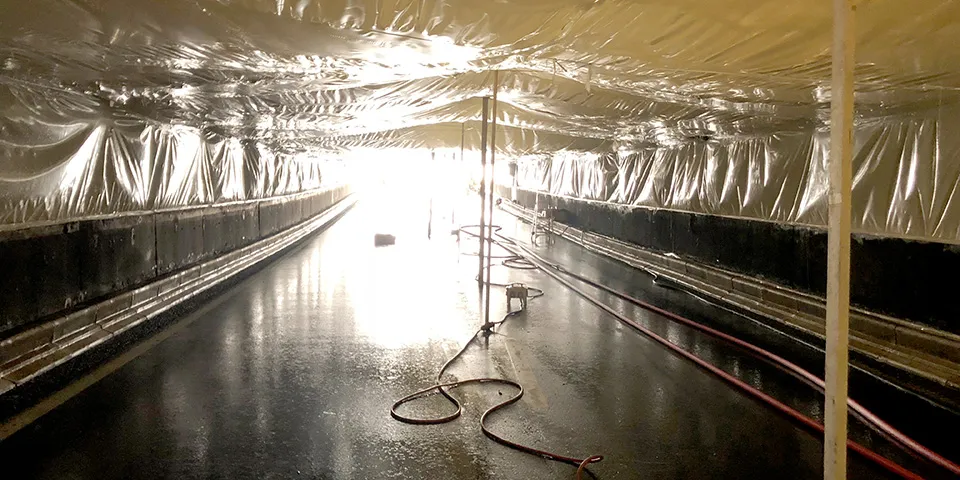
Most of the removal was carried out using a sanding machine.
Sealed work area
The asbestos was removed using the sealed-area method. “This involves completely sealing off the area, putting it under negative pressure and sanding off the paint. In total, this covered 12,000 m2: as well as 2.7 kilometres of tunnel, we also worked on all the entrances and exits,” says Frederic De Medts.
The main challenge in renovating the Leopold II Tunnel was the limited working time. De Meuter had the summer holiday to make the entire tunnel asbestos-free. “We built the sealed work area and sanded everything down in less than two months. We had to be finished by 15 August. The last two weeks of the month were needed to return the tunnel to service. We used 75,000 m2 of plastic, which is no small amount. We worked continuously with a large team of specialist asbestos removers. For this reason, we partly robotised the removal process. We built a sanding machine with an integrated extraction system specifically for this project. This allowed us to complete the work much faster.”
Once everything had been sanded and vacuumed up, the asbestos was bagged and taken to a processing facility. “There, the asbestos is mixed with cement to make concrete blocks, rendering it inert so it can be safely disposed of in landfill,” says Frederic De Medts.
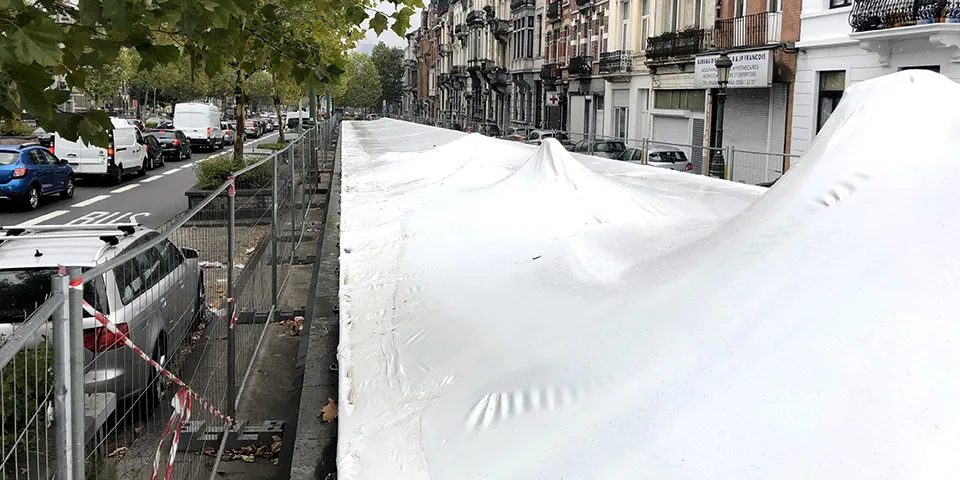
The entire tunnel was enclosed in a sealed work area.
Question about this story? Ask your question
Wie aan Leopold II-tunnel werkte
- asbestverwijderingDe MeuterIn this story
Keep following this
Get an email when a new story is published. No account needed.
- ProjectLeopold II-tunnel
- ThemeExtending the life of bridges and tunnels
- SubjectGeneral
- CompanyDe Meuter







