









Brussels | Leopold II Tunnel
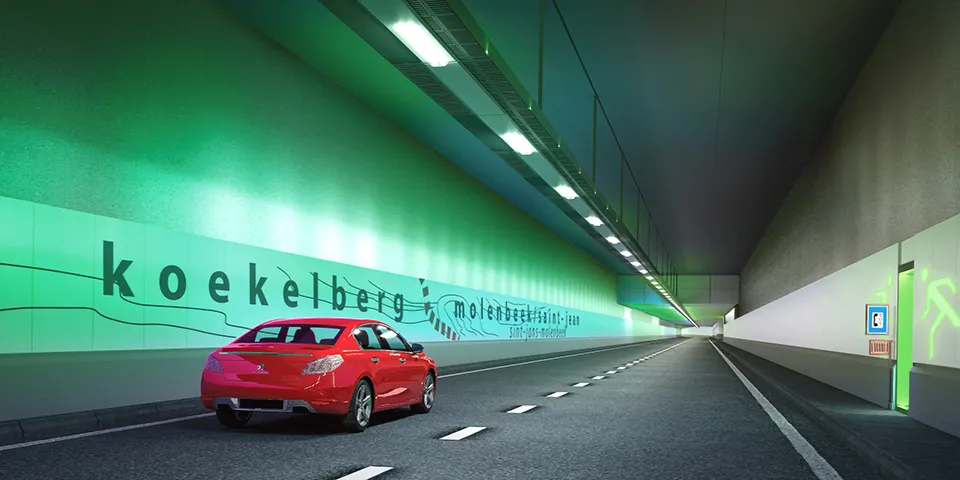
Renovation work on the Leopold II Tunnel began this spring. The project includes renewing the electromechanical systems, carriageway and waterproofing, upgrading fire safety and building seventeen new emergency exits. This extensive renovation calls for specialist expertise and meticulous coordination. To minimise disruption as far as possible, the tunnel is closed for the works only during the summer holidays and at night from Sunday to Thursday. It is a challenge that Circul 2020, the consortium comprising Jan De Nul Group, Besix and ENGIE Fabricom, is ready to take on.
Leopold II Tunnel renovation: a technical and logistical challenge
The Leopold II Tunnel was built between 1979 and 1986, linking the Koekelberg Basilica with the inner ring road in Brussels. At 2.5 kilometres, it is the longest and one of the most complex road tunnels in Brussels. Every day, 40,000 motorists use it in each direction. Inspections carried out in 2015 and 2016 in preparation for the Brussels-Capital Region’s multi-year investment programme for tunnel renovations found that the tunnel was in need of a thorough overhaul. The waterproofing, carriageway and electromechanical systems all need to be renewed. Asbestos encapsulated in certain joints and in paint also had to be removed. In addition, all the emergency exits are being renewed and 17 more are being built, in line with European safety regulations. Fire-resistant cladding is also being installed to bring the tunnel into line with current standards. Finally, the tunnel is getting a new look, with a complete overhaul of both the lighting and the visual design.
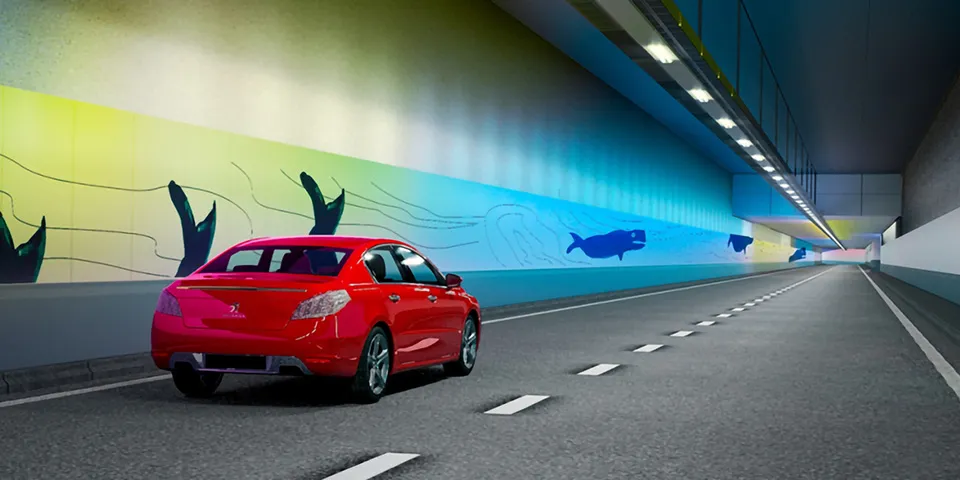
The visual design is also being completely overhauled.
The DBM contract was awarded by the Brussels-Capital Region to Circul 2020. The consortium of Jan De Nul, Besix and ENGIE Fabricom is carrying out the renovation and will be responsible for maintenance for 25 years after the tunnel is handed over. “We chose a Design, Build and Maintain model because it makes the private partner accountable. They are responsible for maintenance, so they have every incentive to ensure the work is carried out properly during the construction phase,” says Mathias Dobbels, spokesperson for the Cabinet of minister Pascal Smet.
ENGIE Fabricom, Jan De Nul and Besix have joined forces on this major project. Jan De Nul and Besix are responsible for all the civil engineering works, while ENGIE Fabricom is handling the electromechanical systems. “All the partners have extensive experience with this type of tunnel renovation, so we were natural partners for the work on the Leopold II Tunnel,” says François-David Jonard, project director at Jan De Nul Group.
Preparatory work on the tunnel began in May this year. Work stepped up a gear during the first summer closure in July and August. “During the closure, our first task was to remove all the asbestos from the tunnel,” says François-David Jonard. “Asbestos was mainly present in the paint layer on the walls. The paint was sanded off along the full length of the tunnel in several hermetically sealed zones.”
Concrete repairs and protective coating
As for the civil engineering works, the first phase of concrete repairs and application of the waterproof coating is currently under way. “The tunnel’s concrete roof slab was in urgent need of renovation,” says Bram Vandewalle, project manager at Besix. “Based on previous investigations and our own analysis, we are carrying out the necessary concrete repairs. Hydrodemolition is being used in certain areas. The concrete is removed to 3 cm behind the reinforcement using high-pressure water jets. We then apply sprayed concrete. This is necessary because chloride concentrations and carbonation levels in these areas exceed the permitted limits, causing corrosion and resulting in concrete that has already spalled or is at risk of spalling. The chlorides probably come from de-icing salt. Carbonation is caused by CO2 emissions in the tunnel.”
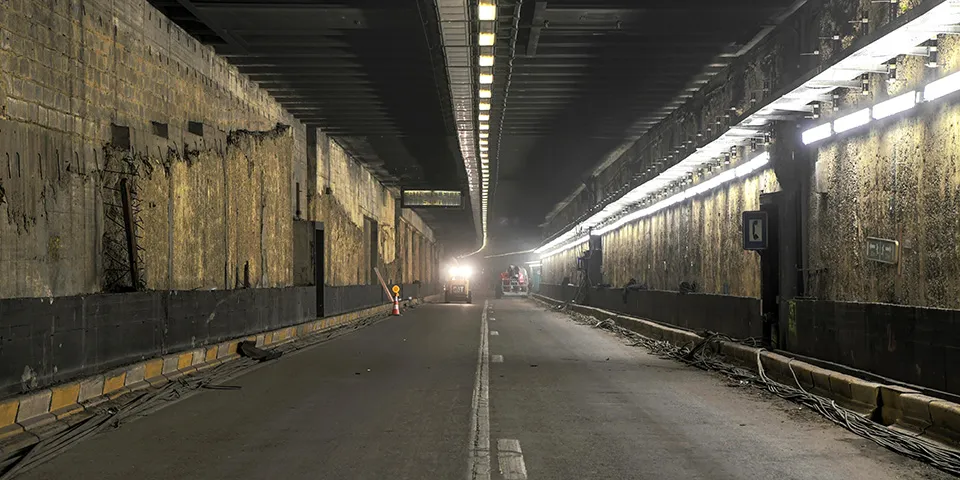
The Leopold II Tunnel before renovation work began.
Once the concrete slab has been repaired, a waterproofing layer must be applied to the inside of the tunnel. “Applying the waterproofing to the top of the tunnel would cause too much disruption, so the Brussels-Capital Region asked us to apply it to the ceiling on the inside,” explains Bram Vandewalle. “Waterproofing has two purposes: to keep out water coming from above and to protect the concrete,” adds François-David Jonard. “A coating of this kind on the inside of a tunnel has never before been applied on such a large scale in our country. We are using a liquid waterproofing system that needs reinforcement in some areas. The fire protection is also being upgraded to meet the latest standards. We are installing fire-resistant panels on the tunnel ceiling.”
New carriageway
Once the concrete repairs, waterproofing and fire protection are complete, the contractors will start renewing the road surface. “One half will be tackled in summer 2019 and the other half in summer 2020.
Everything will be removed down to the tunnel’s foundation slab, and a completely new road structure will be installed. We are also building new footpaths on both sides of the carriageway,” says Bram Vandewalle.
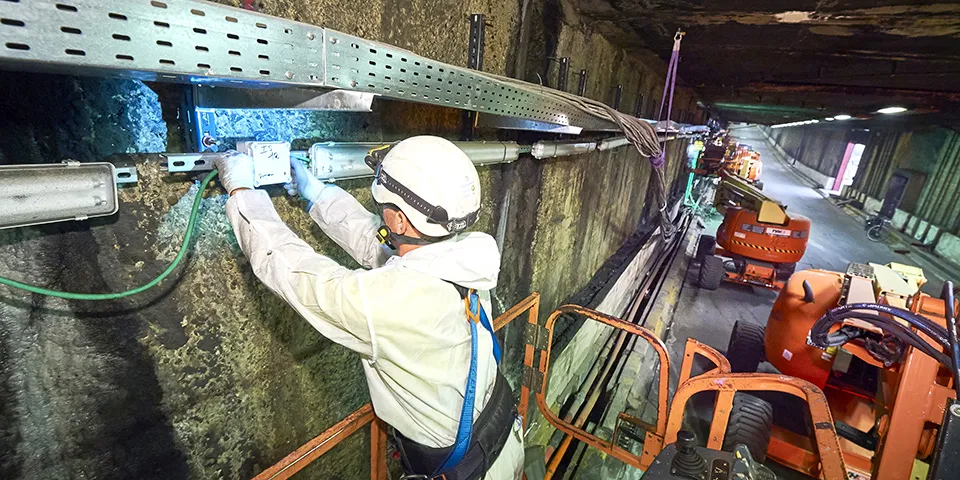
ENGIE Fabricom is renewing all the electromechanical installations in the tunnel.
Emergency exits
Work is also being carried out outside the tunnel. “Part of our contract is to renew the existing emergency exits and build seventeen new ones,” says François-David Jonard. “Some of the new emergency exits are being integrated into existing rooms. In those cases, we only need to open the roof to the outside. For most of the other new emergency exits, however, we have to excavate a new shaft, sometimes as deep as 20 metres, to connect the area where the vehicles travel with the surface. These works have a limited impact on through traffic, as much of the work has to be carried out alongside Leopold II-Laan. We have opted for secant pile walls for the emergency exits to minimise disruption.”
Construction design studies
Jan De Nul and Besix are basing their construction methods on studies by ENGIE Tractebel. The engineering consultancy carried out the structural design during the tender phase and is now responsible for the construction design studies. “Tractebel is closely involved in the civil engineering works. We meet with Besix and Jan De Nul at least once a week to discuss the construction methods to be used,” explains Olivier Lorio, project manager at Tractebel. “We are responsible for the technical studies covering fire safety, concrete repairs, emergency exits, technical rooms and roads. Fire safety has to be upgraded to meet the latest standards. For the concrete, we calculated what could be retained and what needed to be added to meet the standards. The challenges of a project in the centre of Brussels are obvious. The tunnel is in a densely built-up urban area. In some places, we are working within 7 metres of existing buildings, so we have to proceed with care. Part of the tunnel runs beneath the protected Elisabeth Park. The trees must not be damaged when the emergency exits are built there. Another complication is that the Leopold II Tunnel runs alongside and partly beneath the metro tunnel. In some places, the only option is to excavate beneath the metro’s base slab, but this must not compromise the stability of the metro tunnel. In a few cases, we are partly integrating the new emergency exits into disused passages in the road and metro tunnels.”
Electromechanical renewal
At the same time as the civil engineering works, ENGIE Fabricom is renewing all the electromechanical installations in the tunnel. “This is a highly phased project: we first have to install the new systems before we can remove the old ones, all in coordination with the civil engineering works being carried out by Jan De Nul and Besix,” says Bart Embrechts, project manager at ENGIE Fabricom. “All the installations are being decentralised. A technical cabinet will be installed at each emergency exit to control all the systems in a particular zone.”
To enable asbestos removal to begin last summer, Engie Fabricom removed 80 % of the 800 km of cable from the tunnel’s cable trays and routed it through temporary cable ladders. “That cleared the cable ducts, allowing us to renew the carriageway next summer,” says Bart Embrechts. “We also installed and commissioned temporary lighting along the sides of the tunnel instead of on the ceiling. This left the ceiling clear for the concrete repairs and new waterproofing. A new fibre-optic cable for fire detection was suspended beneath the temporary cable ladder along the side of the road. We also installed the radio radiating cable and the Astrid network along the side. We are currently dismantling the ceiling lights.”
Fire safety is a key part of the electromechanical renewal. “Among other things, we are installing a new fibre-optic cable that can detect heat and control the fire ventilation in each zone. The tunnel is divided into twelve zones. If smoke develops, the aim is to contain it within a single zone. To achieve this, all the extract fans and boosters are being replaced and the thrust capacity increased, so that safe evacuation from the tunnel is possible in all fire scenarios, in line with European standards,” says Bart Embrechts.
Cameras are also being used for fire detection. In the Leopold II Tunnel, ENGIE Fabricom is installing a DAI system that can detect events and interpret images. “For example, if a vehicle stops in the tunnel or smoke suddenly develops, the camera system will detect it very quickly and send an alarm to the operator,” explains Bart Embrechts. “This smart camera system allows us to respond much more quickly to a fire, because the cameras detect the first plume of smoke.”
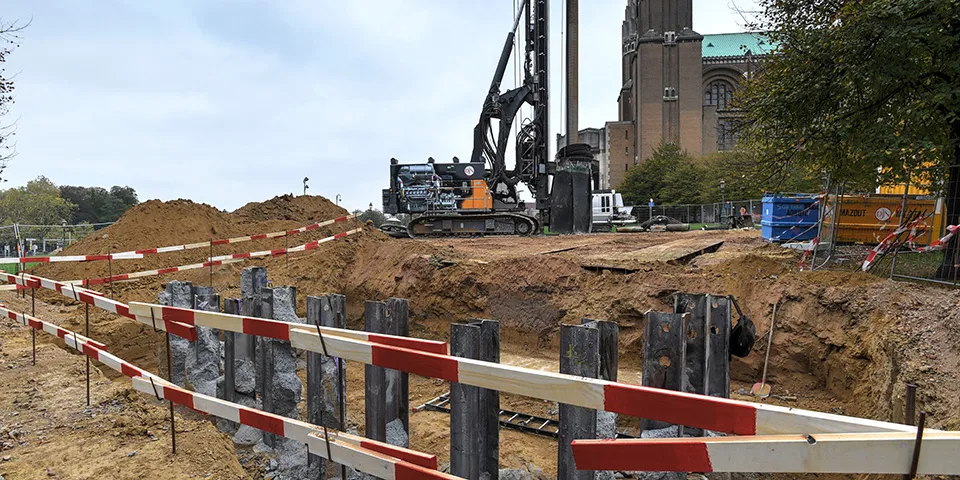
Circul 2020 is renewing the existing emergency exits and building seventeen new ones.
ENGIE Fabricom is also responsible for renewing the entire medium- and low-voltage networks. Its scope of work also includes installing dimmable, energy-efficient LED lighting, ANPR cameras and dynamic signs. The technical rooms are also being completely refurbished, and three additional rooms are being created. “The challenge lies in coordinating the different works,” says Bart Embrechts. “Existing systems have to remain operational so that the tunnel can be opened safely every day. This requires many temporary arrangements to enable civil engineering works, install new technology and then remove the old equipment.”
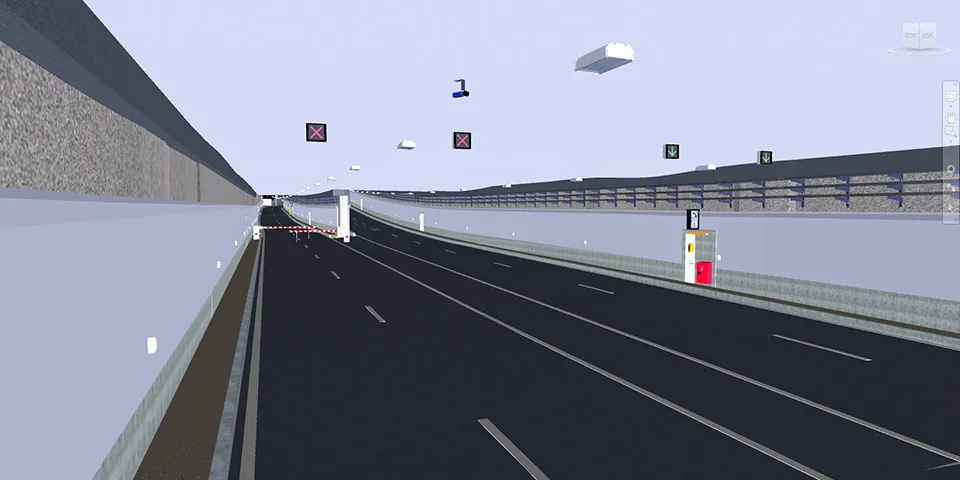
BIM model of the final design, showing all disciplines (infrastructure, finishing, civil engineering and building services) for the Leopold II Tunnel.
BIM model
To coordinate all the works and systems, the consortium is using a BIM model. “All the partners are responsible for the tunnel’s complete design,” says Bram Vandewalle of Besix. “Before work began, we scanned the entire tunnel to capture its existing condition. We used the scan to create a model of the tunnel, giving us an as-built drawing. Not all the original tunnel plans were available, so the scan was indispensable. We are using that model as the basis for the new design.”
“The biggest advantage is that we can consult the BIM model during the day. We work mainly at night and cannot be on site during the day. BIM is also crucial for clash detection, because we have little room in which to install all the systems. With such limited working hours, we cannot afford to discover things on site at the last minute. Everything has to be mapped out in advance.”
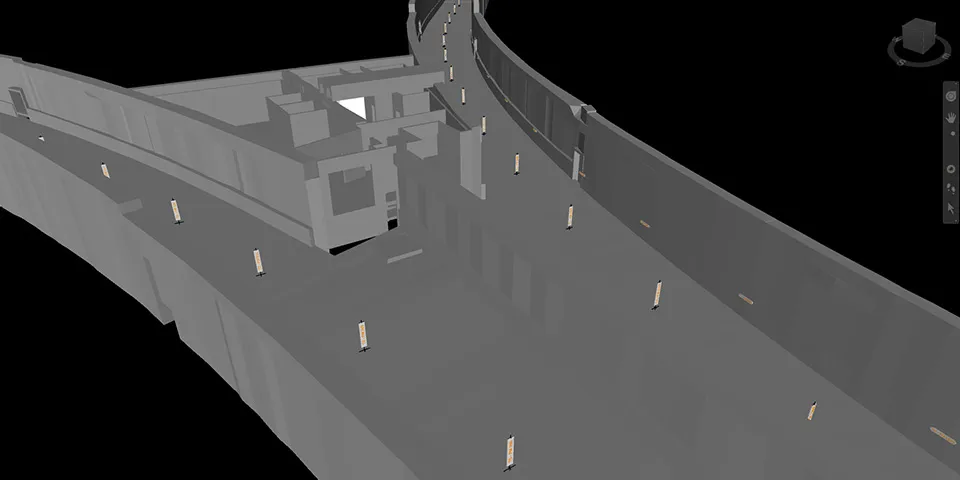
BIM modelled in phases, viewed from above: existing, to be demolished and new.
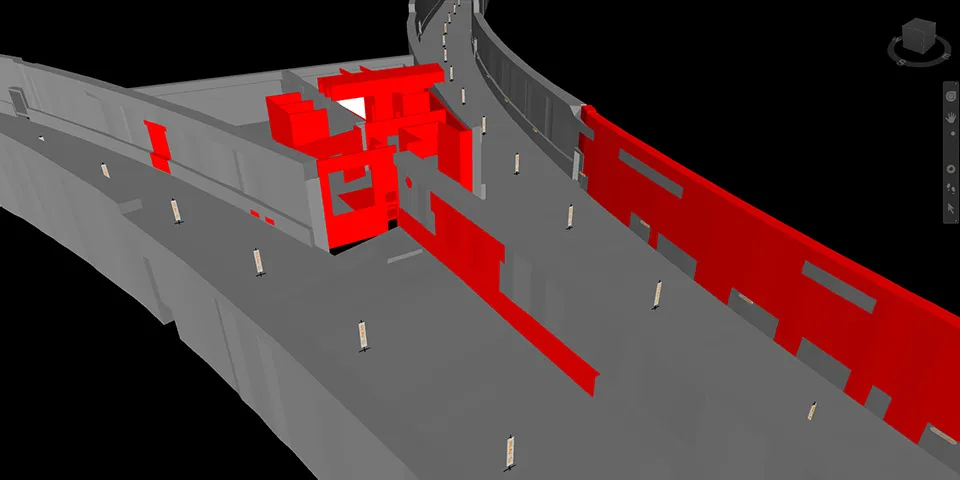
BIM modelled in phases, viewed from above: existing, to be demolished and new.
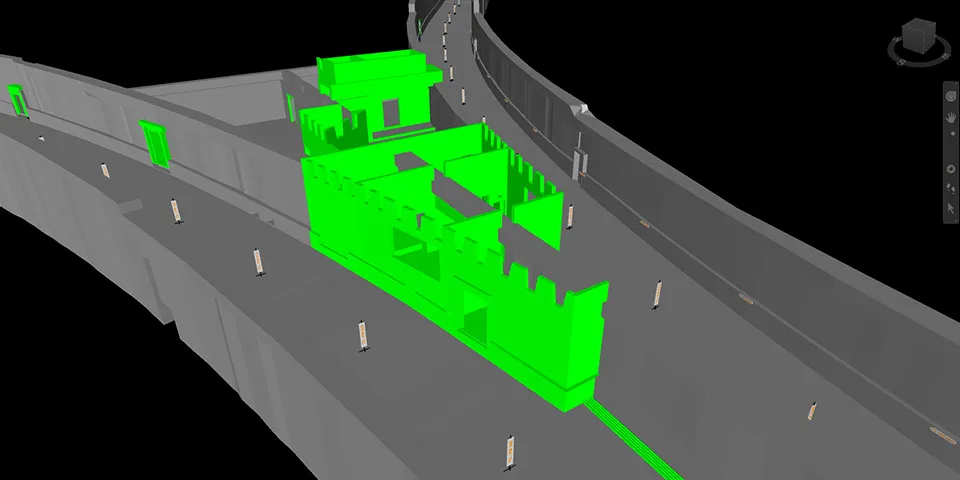
BIM modelled in phases, viewed from above: existing, to be demolished and new.
Optimising maintenance costs
“The BIM model contains an integrated package of information that will also be used during the maintenance phase,” says François-David Jonard. “For example, we can look up how concrete repairs were carried out in a particular location, so we know what type of materials to use for maintenance.” Maintenance was taken into account from the outset of the renovation works. “At the design stage, we drew up a maintenance and replacement programme for each system, covering the 25-year maintenance phase,” says Bruno Janssens of Engie Fabricom’s Maintenance Long Term department. “Our department is actively involved in the renovation phase to ensure that all the necessary conditions are taken into account, bearing in mind our long-term maintenance obligations. Critical systems are overdesigned to provide sufficient reserve capacity in the event of a system failure. We also consider interchangeability. Components must be installed in such a way that they can easily be removed and replaced later if necessary. This approach minimises disruption to tunnel users during maintenance.”
The maintenance contract also affects the civil engineering works. “We made the necessary choices during the design stage to deliver a tunnel of the highest possible quality and optimise maintenance costs,” adds François-David Jonard. “This means that we invest more in certain aspects now to reduce costs later.”
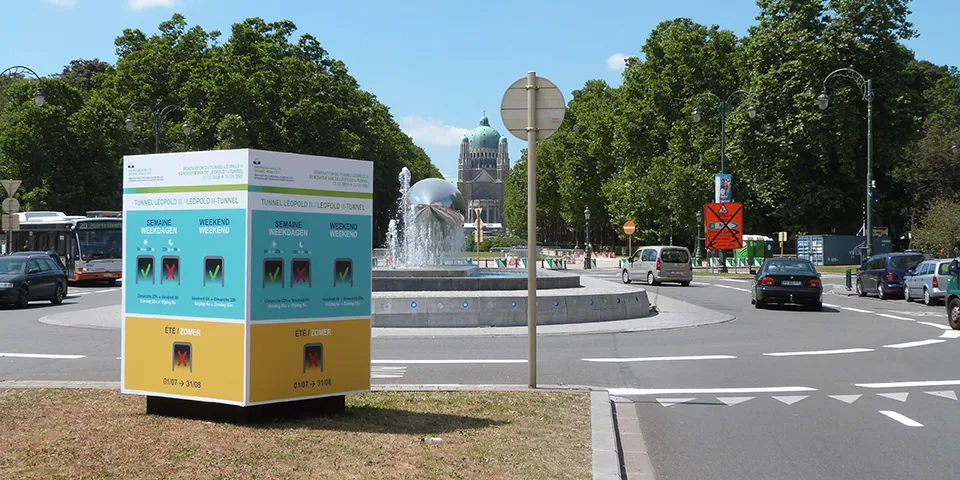
Measures to mitigate the effects of summer closures.
Logistical challenge
The major challenge in renovating the Leopold II Tunnel is logistics. “All machinery and equipment has to be removed by 6 am so that the tunnel can reopen to traffic, and everything has to be brought back in the following evening. All the partners have extensive experience with complex projects like this. We always manage to meet the deadline,” says François-David Jonard.
“When we disconnect an installation, we have to make sure it is back in service before the tunnel opens in the morning,” adds Bart Embrechts of ENGIE Fabricom. “That means working hours are very limited. The tunnel is closed for 8 hours, but you can never actually work for 8 hours.” “Most of the work is carried out at night, but work on the emergency exits also takes place during the day. That means we need a 24-hour operation. We completed the work successfully last summer. That was an important milestone for the project. We are confident that we can maintain that momentum,” concludes Bram Vandewalle.
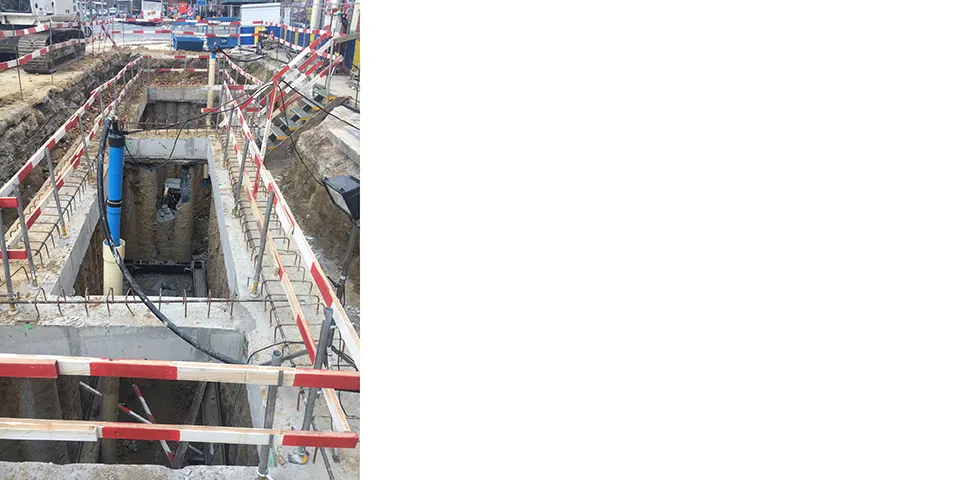
To minimise disruption, the emergency exits are being constructed using secant pile walls.
Mitigating measures
The tunnel works will take three years. Throughout the year, work takes place only at night on weekdays. The tunnel will be closed completely during the summers of 2018, 2019 and 2020. The entire operation has been planned to minimise disruption on this major traffic artery. Brussels Mobility has introduced numerous mitigating measures. Inge Paemen, spokesperson for Brussels Mobility, says: “We launched a major communication campaign aimed at our target audience. As well as using traditional channels, we advertised on Waze, so that anyone looking for a detour could reach our website with a single click. We also invested heavily in alternatives for all possible modes of transport, such as Park and Ride C, a bus lane and a segregated two-way cycle path on Keizer Karellaan… The mitigating measures have clearly paid off. There was no chaos last summer, but we are not resting on our laurels. We have evaluated the campaign and will now make adjustments where necessary so that we can launch it again before the next summer holiday.”
Multi-year investment programme
The renovation of the Leopold II Tunnel is part of the Brussels Region’s multi-year investment programme for Brussels’ tunnels. The programme runs over ten years and is now in its second year. “A great deal has already been done: the Montgomery and Stefania tunnels have been renovated, the Hallepoort tunnel and the Reyers complex are due to be completed early next year, and work on the Leopold II Tunnel has begun. We are confident that everything will be completed successfully,” says Mathias Dobbels of the Cabinet of Minister Pascal Smet.
Question about this story? Ask your question
Wie aan Leopold II-tunnel werkte
- DBM-contractCircul 2020In this story
- civil engineering worksJan De Nul GroupIn this story
- civil engineering worksBesixIn this story
- elektromechanicaENGIE FabricomIn this story
- uitvoeringsstudiesENGIE TractebelIn this story
- asbestverwijderingDe MeuterMentioned in Leopold II Tunnel made asbestos-free in a single summer holiday
Keep following this
Get an email when a new story is published. No account needed.
- ProjectLeopold II-tunnel
- ThemeExtending the life of bridges and tunnels
- SubjectGeneral
- CompanyCircul 2020
- CompanyJan De Nul Group
- CompanyBesix
- CompanyENGIE Fabricom
- CompanyENGIE Tractebel







