









Infrabel back at full speed after solving complex construction-site puzzle
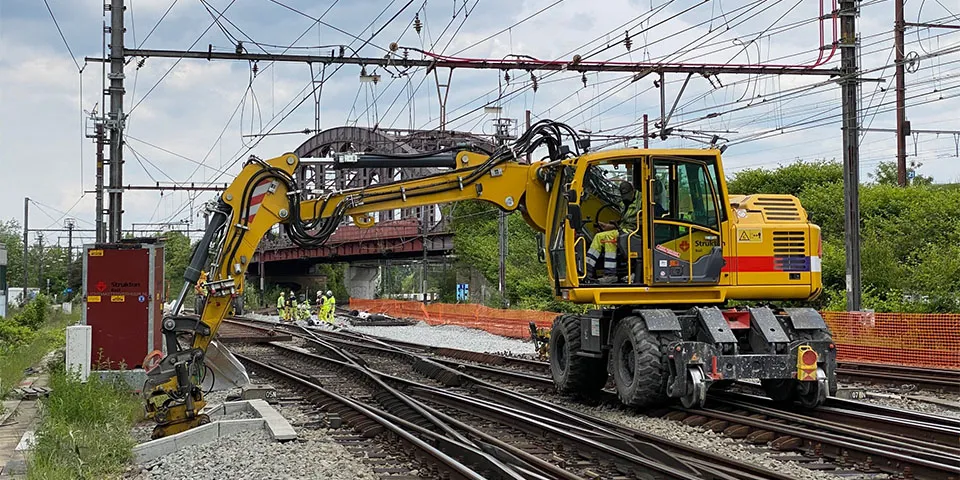
In May, Infrabel and its subsidiary TUC RAIL began gradually restarting their construction sites. In close consultation with its customers, the infrastructure manager solved a complex construction-site puzzle in difficult times to save crucial rail projects. GWW spoke to Benoît Gilson, Infrabel’s newly appointed CEO: “When society is hit by something as enormous as the coronavirus crisis, it is in everyone’s interest to engage in dialogue with customers and partners as quickly and transparently as possible.”

Benoît Gilson, Director of Strategy and Communications at Infrabel.
How did Infrabel respond at the start of the coronavirus crisis?
Benoît Gilson: “When an unprecedented crisis like this hits, you have to act quickly. The first priority is, of course, to ensure the safety of all our people. Among other things, we allowed all colleagues who could do so to work from home. Those who still had to come to the workplace were given face masks and hand sanitiser. Measures were introduced to maintain social distancing, and our buildings are also cleaned regularly. In addition, together with our colleagues at NMBS, we organised a train service of National Importance, and all our non-essential construction sites were shut down. During that first phase of the crisis, we worked around the clock so that we could provide safe working conditions for everyone. Afterwards, I made regular site visits to check whether the measures in place were working well and whether any adjustments were needed. It is very important to me to see and listen to our people on site and get their feedback.”
What were the deciding criteria for whether or not to shut down construction sites?
“Can our people work safely or not? That is the key criterion. But there are also many practical things to consider: do you still have enough people to carry out the work? At one point, you could see that several people were falling ill and had to stay at home. It was then decided to bring all non-essential construction sites to a controlled standstill. One by one, they were put into a kind of construction holiday mode, so to speak.”
How important is consultation with customers and partners in a situation like this?
“It is our responsibility to respond to our customers’ needs and requirements. When society is hit by something as enormous as the coronavirus crisis, it is in everyone’s interest to engage in dialogue with customers and partners as quickly and transparently as possible. Everyone understands that this is a very unusual situation. But as a company, we also have to be able to offer our customers a realistic outlook and alternatives. That means sitting down together, working constructively and focusing on solutions. And I have to say, we have done pretty well.”
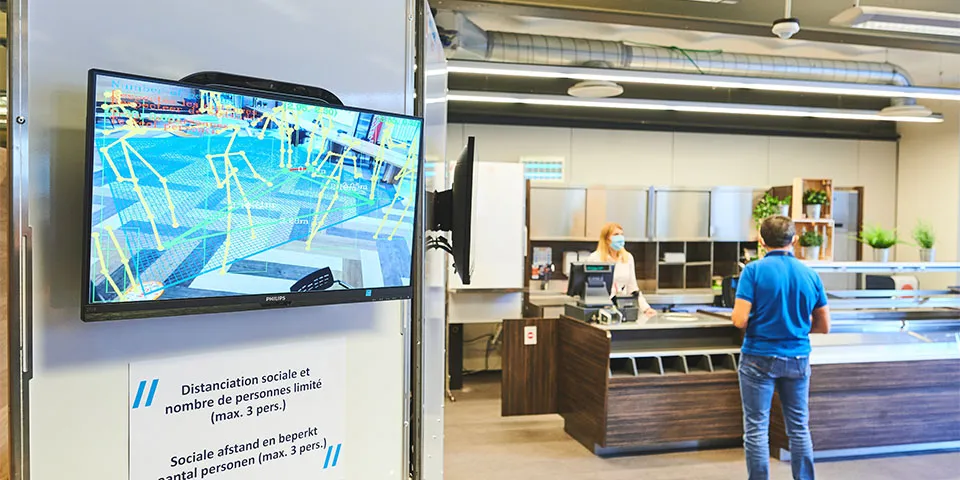
In the meantime, Infrabel is also using Artificial Intelligence to ensure safety.
What impact did the coronavirus crisis have on passenger and freight services?
“If the coronavirus crisis has taught us anything, it is that transport and logistics are essential parts of our economy. People still need to get to work, and raw materials and goods need to be transported. Infrabel is a crucial player in this. Everyone at Infrabel has a role to play and contributes to safe, punctual train operations. Of course, the coronavirus crisis has had a major impact on our core task.
But throughout the crisis, trains in our country continued to run, and I am very proud of that. There was excellent cooperation between NMBS, the freight operators and Infrabel.”
Normal life began to return from the end of May. What does this mean for Infrabel’s construction sites?
“In May, we began gradually restarting our construction sites. But restarting a construction site is not something you can just do. When Infrabel carries out work on the railway, it always affects the surrounding area. In many cases, trains cannot run, and there may also be disruption to road traffic and inconvenience for local residents … Many people need to be informed in good time, and alternatives such as replacement buses and diversions for train services have to be provided. That is already a very complex puzzle in itself. And that is under normal circumstances.”
“I made regular site visits to check whether the measures in place were working well and whether any adjustments were needed.”
There are also 3 construction sites that are closely interconnected. How does that work?
“Belgium is a small country with a great deal of railway infrastructure. For the whole picture to come together, all the puzzle pieces have to fall into place. Timing is very important here. Three such pieces are the work on the Mechelen, Dendermonde railway line (L53), the planned railway works in Schaarbeek and the rail bypass at Mechelen station. When rescheduling our construction sites, we were able to move the Schaarbeek site to a later date so that we could work on L53 first. That is because the Mechelen-Dendermonde railway line serves as a diversion route for train services when we carry out work in Schaarbeek. But the work on L53, at Mechelen station, also affects the commissioning of the Bypass, which in turn plays a role in the overall Mechelen station project. These are three specific examples, but in fact many of our construction sites are linked in a similar way.”
Can we call the reorganisation of all these construction sites a logistical nightmare?
“I would call it a logistical challenge. Our people have made a phenomenal effort to restart or reschedule all our construction sites. And that means not only our people at Infrabel, but also our colleagues at NMBS, the freight operators active in Belgium and the contractors we work with. Everyone understood the urgency and rallied behind this relaunch. To make up for some of the delays, work will even continue during the construction holiday. That is necessary too, because if we cannot make up some of the lost time on our projects in the second half of 2020, we risk a flood of construction sites in the years ahead. We want to avoid that.”
Question about this story? Ask your question
Keep following this
Get an email when a new story is published. No account needed.
- ThemeFuture-proofing roads and railways
- SubjectGeneral







