









Ford Site Remediation, Genk | Large-scale remediation of the Ford site closely monitored
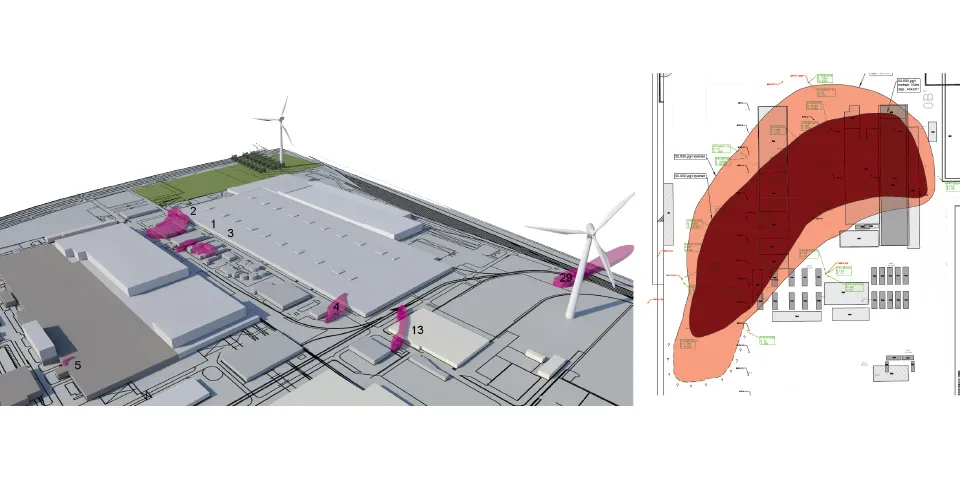
After months of intensive preparation and investigations, soil remediation began in February at the former Ford site in Genk. “As part of a joint venture, ABO Group and Tractebel are responsible for coordinating and providing environmental oversight of the soil remediation works,” says Jan De Vos, business manager at ABO Group.
The remediation is taking place on the site of the former Ford factory, where more than 14 million cars were assembled between 1964 and 2014. There are 5 contamination hotspots on the site for which a soil remediation project has been drawn up. Investigations are also under way to select the most appropriate remediation approach for the groundwater contamination plume. The total cost of demolition and remediation is estimated at more than 15 million euros. The aim of the overall project is to redevelop the former Ford site as an industrial estate for new activities. This requires a remediation operation involving the demolition of existing industrial buildings and infrastructure, asbestos removal, the appropriate reuse and disposal of all materials and waste generated, and soil remediation.
Tractebel has already come a long way in its work on the redevelopment of the Ford site. “Tractebel was involved, among other things, in the 2014 report on the redevelopment of the Ford site,” says product manager Michael Borremans. “The report sets out the wider framework for redevelopment, including environmental and technical factors such as the masterplan, with a 3D model. A market survey and feasibility study on soil remediation were also carried out in 2016, and Tractebel was involved in the demolition of Hall C and all the buildings along the central street in 2018.”
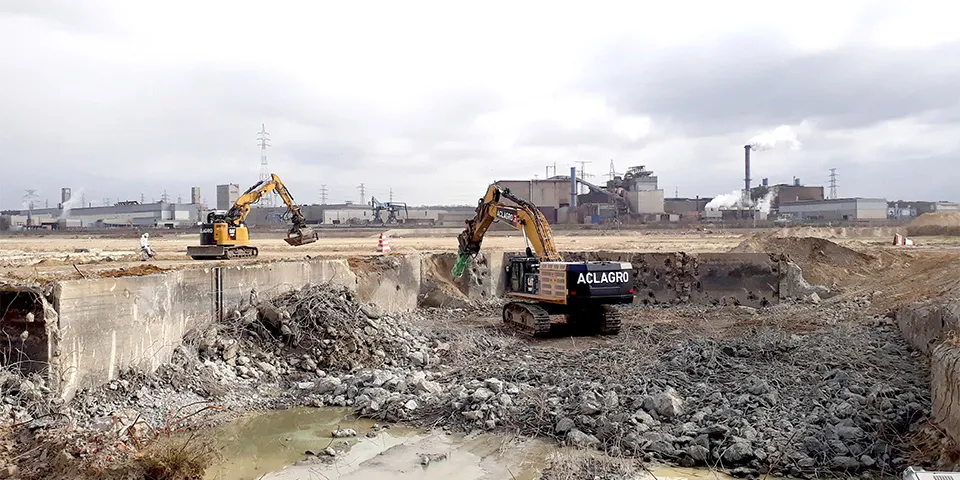
Excavation of the hotspot areas was ultimately selected as the most appropriate remediation technique.
Joint venture
The Tractebel/ABO joint venture was set up to oversee the soil remediation works (2018-2020). Michael Borremans says: “The joint venture’s remit includes project management, designing the soil remediation measures and preparing the soil remediation projects for the hotspot areas. It also covers the demolition of part of Hall B, Hall G and the central street infrastructure, including the design, technical specifications and bill of quantities, as well as monitoring the works and further investigating the extent of the plume zones and how to remediate them.”
Both ABO and Tractebel are experienced soil remediation experts, able to independently design and coordinate complex remediation projects. For the Ford site, however, it was decided that pooling their expertise would add value. Tractebel’s site-specific knowledge, combined with ABO’s experience overseeing exceptionally large remediation projects, makes the team particularly well suited to carrying out this project.
5 hotspot areas
A total of 5 hotspot areas will be remediated. These are the most heavily contaminated areas, corresponding to the locations where the soil contamination originated. “The first step in the soil remediation process was to map the contamination,” explains Jan De Vos. The specific approach is then determined, with the extent, depths, techniques and other factors needing to be aligned. Once the design is complete, it is our job to monitor and coordinate the works, ensuring everything is done correctly and that environmental requirements are met.
The soil remediation works are now in full swing. Jan De Vos says: “Alongside overseeing and coordinating the works, we are also carrying out a feasibility study for groundwater remediation. The hotspot remediation is under way, but there is also a large volume of contaminated groundwater on the site, and remediating it is even more complex. We are screening all available data, carrying out further investigations and laboratory tests, flux measurements and DNA analysis, all to find solutions to the groundwater problem. The selected technique will first be trialled on a small scale in a pilot test. These tests may take place as early as spring 2020.”
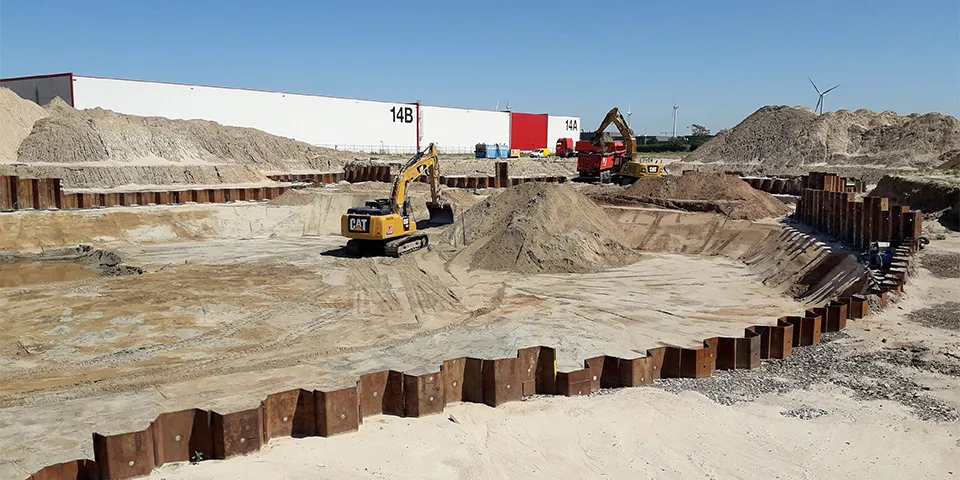
A total of 5 hotspot areas will be remediated. These are the most heavily contaminated areas, corresponding to the locations
where the soil contamination originated.
Preparation
Mapping the five hotspot areas and determining the right remediation methods is a lengthy process. Excavation of the hotspot areas was ultimately selected as the most appropriate remediation technique. “It takes a lot of investigation to determine which soils need to be removed and which can be reused,” says Jan De Vos. “A contamination plume does not have clearly defined boundaries. Sometimes the topsoil is clean, while the soil at depth is heavily contaminated. The environment is obviously the guiding principle in this kind of project, but financial considerations also play a part. Unnecessary earthmoving must be avoided. As well as removing material, incoming materials and soils must also be carefully checked. There is a lot involved.”
Good preparation is half the battle, but unforeseen circumstances can always arise. Jan De Vos says: “We also need to be able to act proactively. We carry out measurements, boreholes and analyses, but these are still local checks. We cannot inspect every square metre of soil, but we can eliminate as many uncertainties as possible. So far, we have not encountered any unexpected obstacles.” Michael Borremans agrees: “Given the thorough preparation for the soil remediation and demolition works, the schedule and budget currently seem to be under control. No serious complications are expected. Tractebel’s work does not end with the remediation, either. We remain closely involved in designing and preparing the specifications for a new industrial estate on the site of the former central street. We are also developing a masterplan for green energy and logistics mobility across the entire site.”
ABO’s involvement on the site also extends beyond soil remediation. “As a multidisciplinary consultancy, we offer our clients a wide range of services for brownfield redevelopment projects. At the Ford site, this includes carrying out a demolition monitoring plan and preparing an archaeological investigation to obtain an environmental permit,” concludes Jan De Vos.
Question about this story? Ask your question
Keep following this
Get an email when a new story is published. No account needed.
- ThemeUsing and protecting the subsurface
- SubjectGeneral







