









Fast and efficient deep foundation techniques for Pepsico expansion
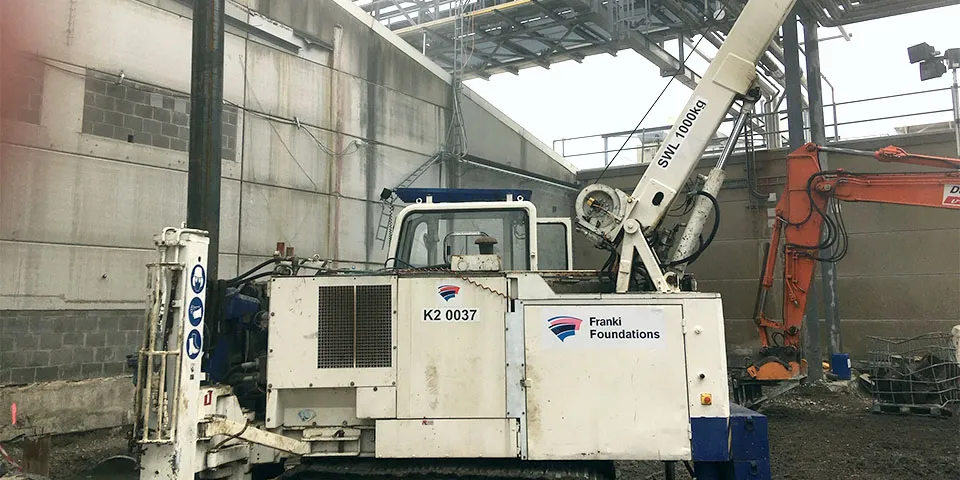
When demand for a product rises, expanding production capacity is often the logical next step. The same is true for PepsiCo in Veurne, where a second production line is being built to make the well-known Doritos tortilla chips. Franki Foundations was brought into the project at an early stage to plan and carry out the deep foundation works. “An interesting and challenging project for several reasons,” says Piet Kindt, head of projects at Franki Foundations.
Demand for Doritos is rising, so Veurne Snack Foods, part of the PepsiCo group, is investing in a high-tech second tortilla chip line, equipped, among other things, with an ultra oven and an automated packaging unit that will enable the chips to be produced sustainably. The new technology means the tortilla chips will be produced using 30 % less energy. The recipe is also being refined, with products containing less fat and less salt.
The new line will also make it possible to develop new products in the future. The total cost of the line is estimated at 30 million euros, and it is being built entirely in line with PepsiCo’s ‘Winning with Purpose’ sustainability vision. At the end of December 2019, Flemish Minister for the Economy Hilde Crevits (CD&V) announced that Veurne Snack Foods would receive a grant of 550,000 euros for staff training.
Stadsbader is the main contractor on the project. The client called on Franki Foundations, which has specialised in deep foundations for more than 100 years, to carry out the foundations for the new production line. “We were involved in the project at an early stage, during the architect’s and structural engineer’s preliminary study,” says Piet Kindt. “At that meeting, it quickly became clear that timing, efficiency and a range of foundation techniques would be key to minimising disruption to the company, which would continue production throughout.”
Selecting the right technique
Franki Foundations set out to identify the right foundation technique. Piet Kindt explains: “The ground conditions in Veurne require careful consideration from a geotechnical perspective. The ground is poor, with a great deal of peat in the upper layers. When it comes to selecting construction methods and determining load-bearing capacity, you need to know your stuff to design the deep foundations. That is why the architect and engineer approached us during the preliminary phase to assess what was feasible in terms of both ground conditions and construction methods. In addition, there is an existing factory that has to keep operating, and we had to work beneath pipe tracks. These factors also affect the choice of technique and the work schedule.”
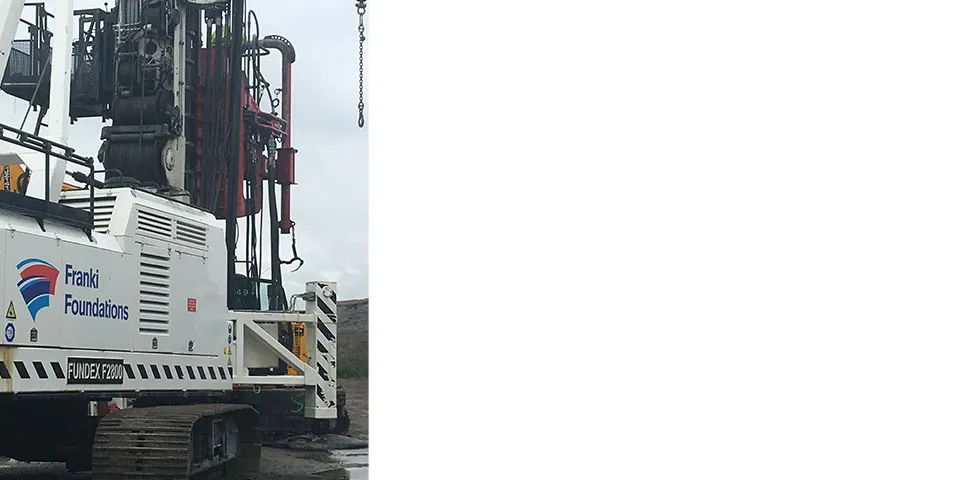
“The biggest challenge in this project is undoubtedly the combination of the geotechnical conditions, the stability of the machines on site and the limited storage space available.”
Complexity
Working in areas with limited headroom makes this project particularly complex.
“Installing the piles with conventional, large machines is not an option,” Piet Kindt explains. “For the new production line, we ultimately chose to use screwed hollow-section piles for the foundations. This technique involves progressively screwing tubes into the ground where headroom is limited. For the foundation works in the existing unit, we opted for driven hollow-section piles. These piles can easily bear the loads specified by the structural engineering firm without disrupting the existing production line. The work had to be carried out safely and with care.”
All the deep foundation works outside have now been completed. Piet Kindt says: “Our work on the brand-new production line is finished. Once the coronavirus crisis is over, we’ll continue with the works on the existing unit. The biggest challenge in this project is undoubtedly the combination of the geotechnical conditions, the stability of the machines on site and the limited storage space available. We had to find a practical foundation system for a fairly heavy load, and complete the work within a fairly tight timeframe.”
In-house design team
Franki Foundations’ wide range of construction techniques and the expertise that goes with them are major assets. “So is our in-house design team, which has extensive experience in geotechnical calculations. It is a real added value for clients to know that we have this technical expertise in-house. We always seek a technical and economic balance within a project, taking all the parameters into account. This means we are willing to turn everything inside out and challenge assumptions. If we can ultimately propose an alternative that is technically equivalent but cheaper, that gives the client confidence,” concludes Piet Kindt.
Question about this story? Ask your question
Who worked on it
Tweede productielijn Veurne Snack Foods in Veurne
- diepfunderingFranki Foundations
- Main contractorStadsbader
- clientVeurne Snack Foods
Keep following this
Get an email when a new story is published. No account needed.
- ProjectTweede productielijn Veurne Snack Foods
- ThemeUsing and protecting the subsurface
- SubjectGeneral
- CompanyFranki Foundations
- CompanyStadsbader
- CompanyVeurne Snack Foods







