









Extra safety measures for road workers on motorways
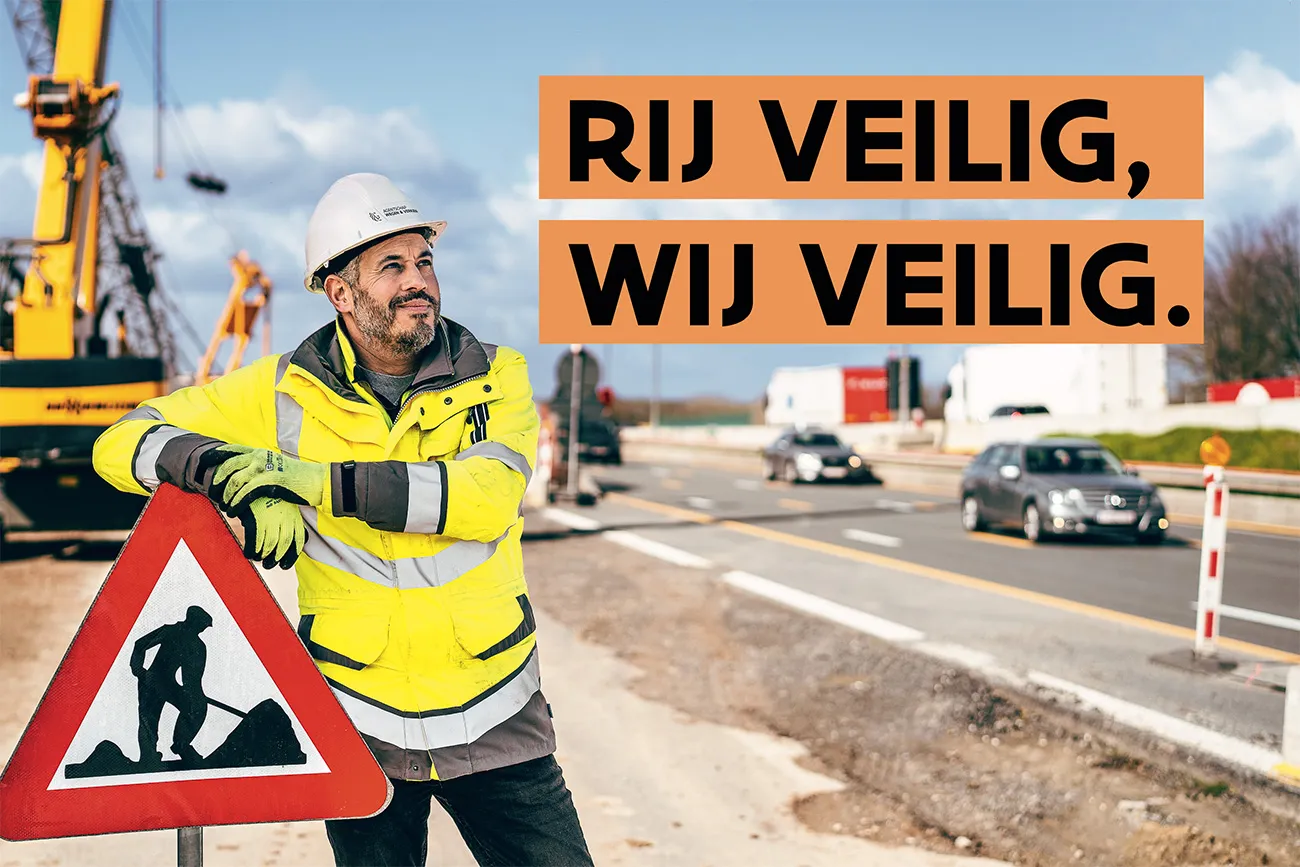
New ‘Drive safely, stay safe’ campaign calls for safe driving past roadworks
Every week, there are an average of almost 10 injury accidents at roadworks, half of them on regional roads and motorways. The ‘Drive safely, stay safe’ campaign urges drivers to obey speed limits and road signs. A wider safety zone and fixed barriers at motorway roadworks will provide even better protection for workers in future.
514 accidents at roadworks
‘Drive safely, stay safe’: with this appeal, the Flemish Minister for Mobility and Public Works and the Agency for Roads and Traffic (AWV) are once again highlighting the need to drive safely past roadworks.
In 2022, there were 3 fatal accidents and 511 injury accidents at roadworks, figures comparable to the previous year. Just over half (54%) of these accidents occurred at, or on the approach to, roadworks on regional roads and motorways. The remaining accidents took place on local roads.
Fixed barriers and a wider safety zone for road workers on motorways
For each roadworks site, AWV assesses what is needed to improve the safety of drivers and road workers. Roadworks are announced well in advance using permanent and variable road signs. Mobile roadworks are also always protected by impact protection vehicles. Speed limits are reduced, and where necessary speed checks are carried out in consultation with the police, for example using mobile average speed checks and speed cameras.
To further improve safety for road workers, AWV is introducing additional measures following consultation with representatives of the road construction sector, such as Constructiv. Fixed concrete barriers will be installed alongside motorway roadworks. Unlike loose work-zone delineators, these physically protect workers from traffic.
Where loose delineators are still used, for example at short-term motorway roadworks, the speed limit is reduced to 50 km/h. The space between the delineators and the work area, known as the safety zone, is made as wide as possible, up to a maximum of one lane. A recovery strip is also used alongside the delineators to reduce the risk of them being catapulted into the work area as projectiles if struck, which could be fatal.
The measures follow a thorough analysis of their impact on road safety and traffic flow. During roadworks, AWV aims to minimise disruption and therefore retain as much capacity as possible for through traffic. However, this must never put workers’ safety at risk.
Question about this story? Ask your question
Keep following this
Get an email when a new story is published. No account needed.
- ThemeFuture-proofing roads and railways
- SubjectGeneral







