









E411 section resurfaced smoothly thanks to tight planning and thorough preparation
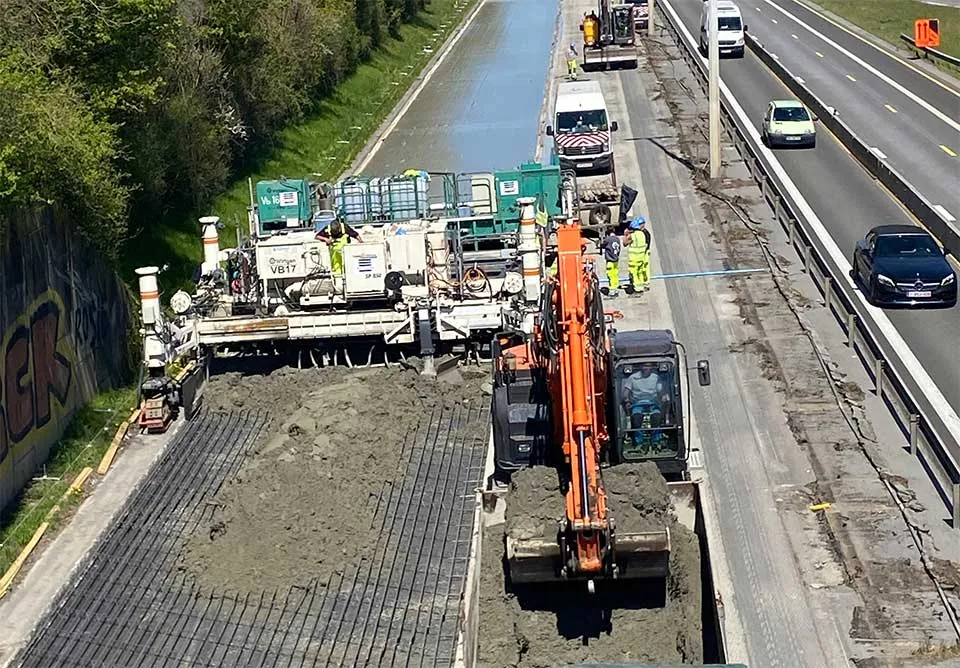
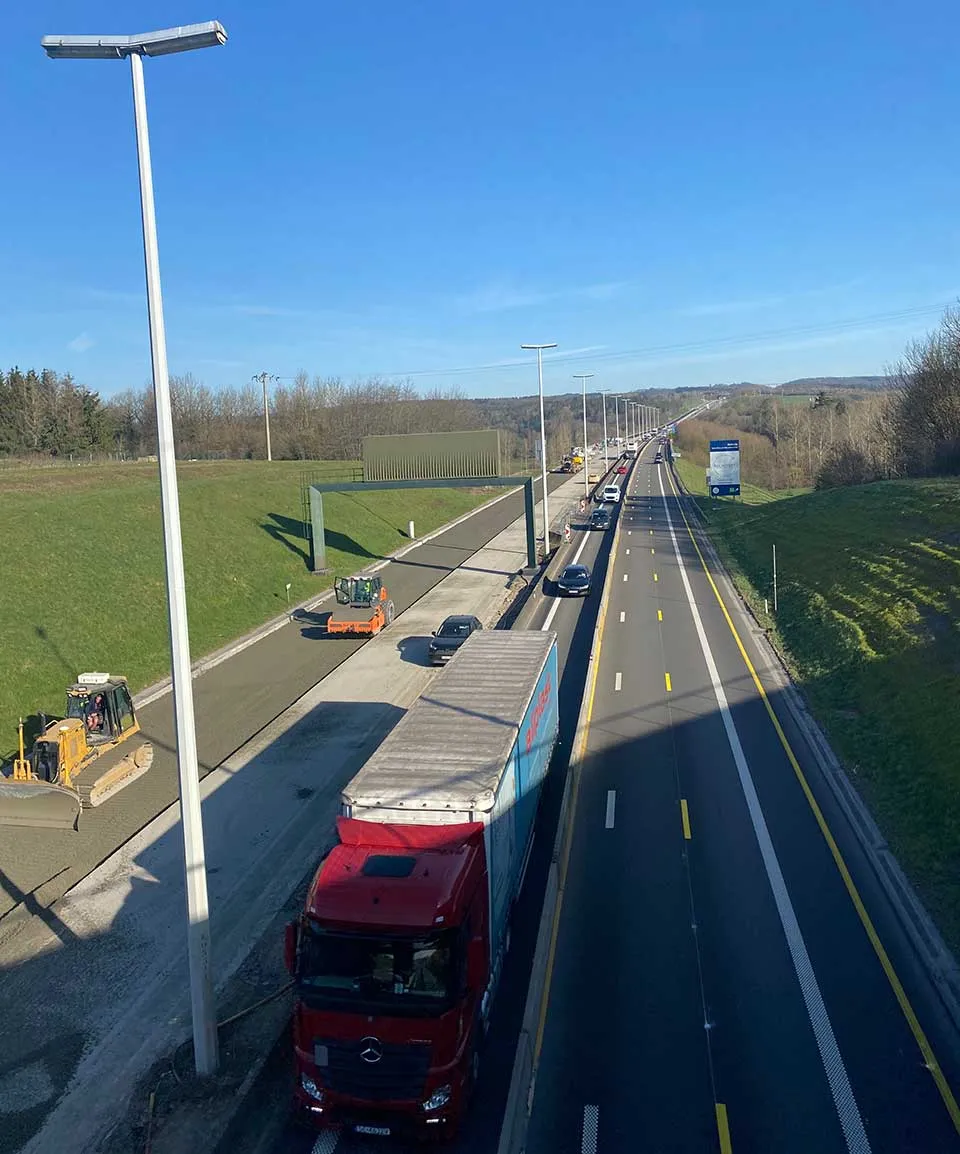
The E411 carriageway towards Aarlen is being renewed between Wanlin and Lavaux-Saint-Anne. The works, which began at the end of February, are being led by Willemen Infra.
“Planning, preparation and making sure all the pieces fit together neatly are among Willemen Infra’s strengths, and they are certainly coming in useful on this project,” says project manager Pieter Bossaert.
Willemen Infra’s contract covers a 7-kilometre stretch. On the carriageway towards Luxembourg, Willemen Infra is providing a completely new road surface for the hard shoulder and the first lane. The central reservation is also being upgraded, with new New Jersey barriers being installed in both directions. Halfway along the route, a bridge over the road will also be renovated by Willemen Infra. “The section of the E411 was clearly in need of replacement,” says Pieter Bossaert. “The concrete dated from the early 1980s, so it was already forty years old. The road surface had been injected and repaired in several places. It was really a patchwork. Service public de Wallonie (SPW) had already laid a new layer of asphalt over it, but that too was starting to come loose. A major overhaul was therefore needed.
Mobile mixing plant for roller-compacted concrete
The works began in February with the milling of the top layer. Pieter Bossaert: “That layer was milled down to the concrete, and a saw cut was then made between the first and second lanes. The first section was then broken up, and dowel bars were drilled into the old concrete in the second lane. We also had a mobile crushing and mixing plant on site, which produced roller-compacted concrete from the old concrete rubble. Along the entire route, the old New Jersey barriers in the central reservation are also being removed and replaced with new ones, in line with the latest European regulations. Two layers of asphalt are being laid on the upgraded sections, a base layer to reprofile the road and a surface course. This means the existing New Jersey barriers would no longer be high enough.”
800 metres per day
In the first phase of the project, the necessary demolition work was carried out, followed by the laying of the roller-compacted concrete and the carriageway concrete. Asphalt works began after the Easter weekend. “The key to this project is making sure all the pieces move at the right pace. We had to make progress of 800 m per day, which is only possible if all parties follow the schedule perfectly and work at the same pace. The works themselves are routine for Willemen Infra, but the big challenge is putting all the pieces of the puzzle together in advance and making sure the whole operation runs smoothly.”
As the concrete was not allowed to have any joints under the contract specifications, concrete was poured day and night in the second week of May, with just one construction joint between the pours. Exposed aggregate concrete was also required to ensure good bonding, and another requirement was that the adjacent petrol station had to remain open. Pieter Bossaert: “Traffic can cross over at either end of the works, but at the petrol station we also had to provide a passage through the central reservation. We therefore tackled that section first, allowing the petrol station to remain open at all times. Of course, we had no choice but to provide an extra joint there.”
Experience and expertise
The need to work on the central reservation ultimately proved to be a logistical bonus. Pieter Bossaert: “Without the works on the central reservation, we could only have used the second lane as a work zone. But removing the New Jersey barriers also made part of the central reservation passable, giving us an extra 1.5 m of manoeuvring space. This meant the lorries could pass one another, significantly increasing our productivity.”
Willemen Infra’s many years of experience and extensive expertise in this type of roadworks are proving their worth on this project. “Projects like this can only succeed with thorough preparation and a tight, achievable schedule. That is certainly one of Willemen Infra’s key strengths. Every project has its own specific considerations, and this one was no exception. For example, dowel bars had to be drilled every 80 cm, by far the most time-consuming task. It was therefore important to carry out this work first, to get ahead and avoid disrupting the subsequent works. Willemen Infra sets aside the time needed to prepare every project. That allows us to anticipate and optimise in advance,” concludes Pieter Bossaert.
Question about this story? Ask your question
Keep following this
Get an email when a new story is published. No account needed.
- ThemeFuture-proofing roads and railways
- SubjectGeneral







