









Custom formwork helped build the Dorpsbrug Ingelmunster
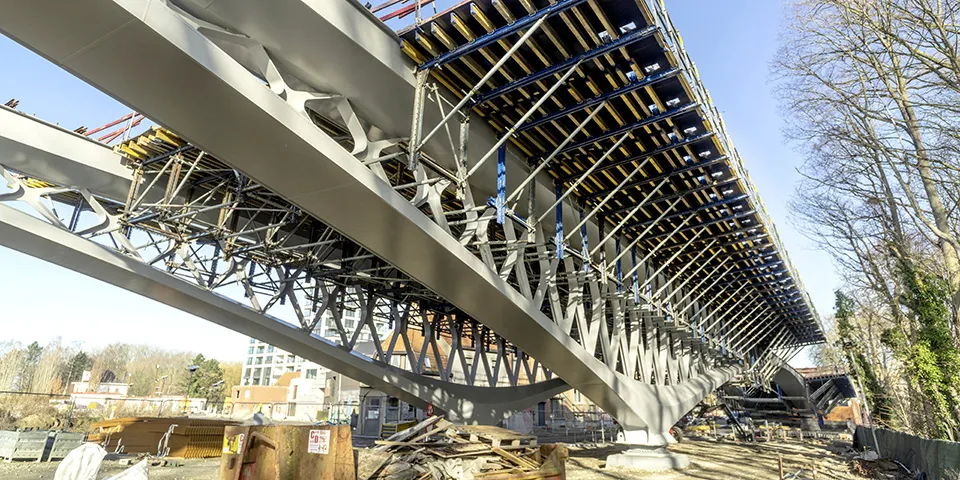
With the successful casting of the bridge deck, work on the new Dorpsbrug in Ingelmunster has entered its final phase. Main contractor Artes Depret called on Doka to provide the formwork for the pour. “The bridge’s unusual design called for equally unusual formwork. And that is exactly the kind of challenge we enjoy taking on,” says ir. Koen Lamers, managing director at Doka, the Austrian formwork specialist with its Belgian head office in Ternat.
The construction of the Dorpsbrug in Ingelmunster is part of the Seine Schelde Vlaanderen inland waterway project, a major project led by De Vlaamse Waterweg nv with support from the European Union. It aims to make inland shipping a fully fledged alternative to road freight transport. The new bridge in Ingelmunster is 286 m long and offers a navigational clearance of 7 m, allowing vessels carrying three layers of containers to pass.
Doka has also provided formwork for work on the lock in Harelbeke as part of the Seine Schelde project, but in terms of complexity, the Dorpsbrug in Ingelmunster stands out. “The design is unusual. The girders in the steel structure move apart in the middle, then come together again towards the end,” explains Koen Lamers. “This special construction presented a challenge when casting the bridge deck, particularly given the wide cantilever and the opening in the centre of the bridge. Doka therefore designed a made-to-measure formwork system.”
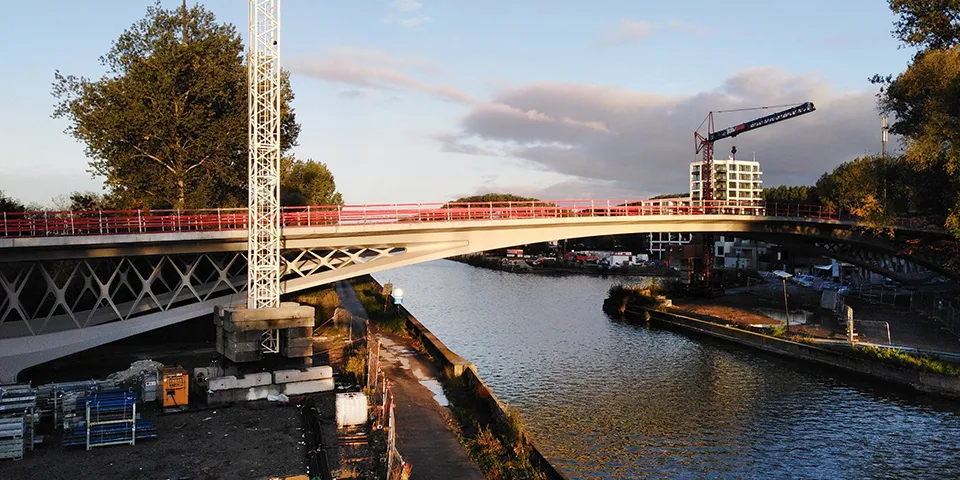
The closure pour, at the centre of the bridge, was cast at the end of September.
Custom ParaTop
The starting point was Doka’s ParaTop bridge formwork, a falsework-free cantilever formwork system for composite bridges and bridges made from precast concrete elements. ParaTop allows the cantilever brackets to be suspended from the steel structure. “However, our standard components were not suitable in terms of dimensions. We therefore had to start from scratch and resize them to suit the project,” explains Koen Lamers. The result was a bespoke cast-in shoe, based in form and concept on the standard cast-in shoe. Koen Lamers says: “It looks like our standard system, but much larger. Those dimensions were necessary to support the weight of the cantilevered modules.”
Carefully planned sequencing
When designing the new cast-in shoe and the overall formwork plan, Doka had to take into account the movement of the steel structure under the weight of the concrete. The steel structure could deflect by up to 70 cm beneath the entire bridge deck. “We therefore had to allow for the formwork to move down with it,” says Brecht Diependaele, technical engineer at Doka. “A detailed, clearly defined sequence was crucial. By working in a fully symmetrical way, we ensured that the structure lowered in stages. We proceeded phase by phase, with the closure pour at the centre of the bridge as the final phase in September. The work went entirely to plan.”
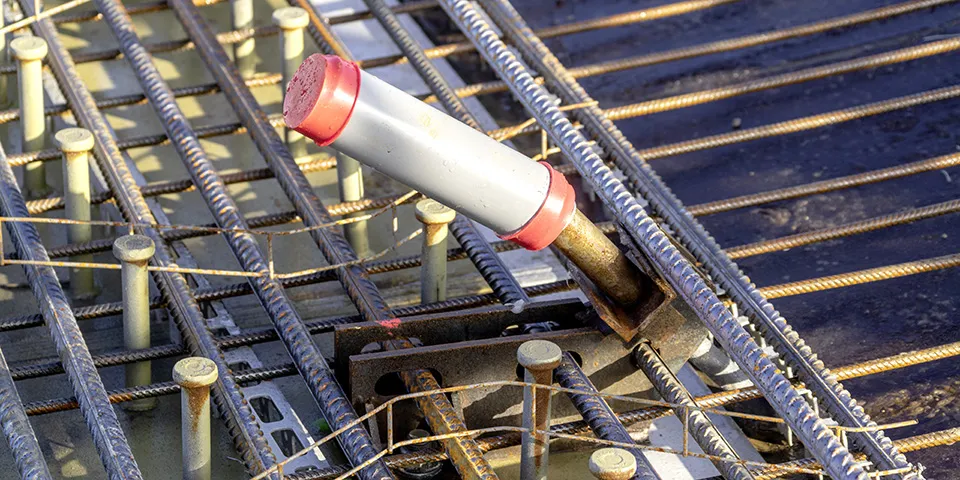
A bespoke cast-in shoe, based in form and concept on the standard cast-in shoe.
Pre-assembly on site
The formwork materials arrived on site in separate components, supplied either from the depot in Belgium or from abroad. Koen Lamers says: “The materials were delivered to the left or right bank, depending on where they were needed. The elements were pre-assembled on site, each comprising a support system with a 3-metre-wide panel. The panel size was determined during the design process. As the concrete is exposed, it is architecturally important for the joints between the formwork panels to form a symmetrical pattern. We also had to take this into account when determining the dimensions.” The formwork materials could also be reused for the different phases. Brecht Diependaele says: “However, we determined the quantity of formwork so that work could continue at all times, for example if the formwork from an earlier phase could not yet be removed. Any surplus materials were, of course, removed in good time.”
A challenge
The challenging nature of the project played to Doka’s strengths. “The more unusual the assignment, the more opportunity we have to stand out from the competition. We can always call on our competence centre in Austria. The cast-in shoe for Ingelmunster was therefore designed in consultation with specialists at our head office. We also stay in close contact with the client throughout. Our technical expertise, combined with our ability to develop, manufacture and supply large quantities of unusual components, are major strengths of Doka,” concludes Koen Lamers.
Question about this story? Ask your question
Who worked on it
Dorpsbrug in Ingelmunster
- main contractorArtes Depret
- formwork specialistDoka
Keep following this
Get an email when a new story is published. No account needed.
- ProjectDorpsbrug
- ThemeExtending the life of bridges and tunnels
- SubjectGeneral
- CompanyArtes Depret
- CompanyDoka







