









Successful, environmentally friendly concrete impregnation at former Ford site
Text Niels RouvroisImage Rewah
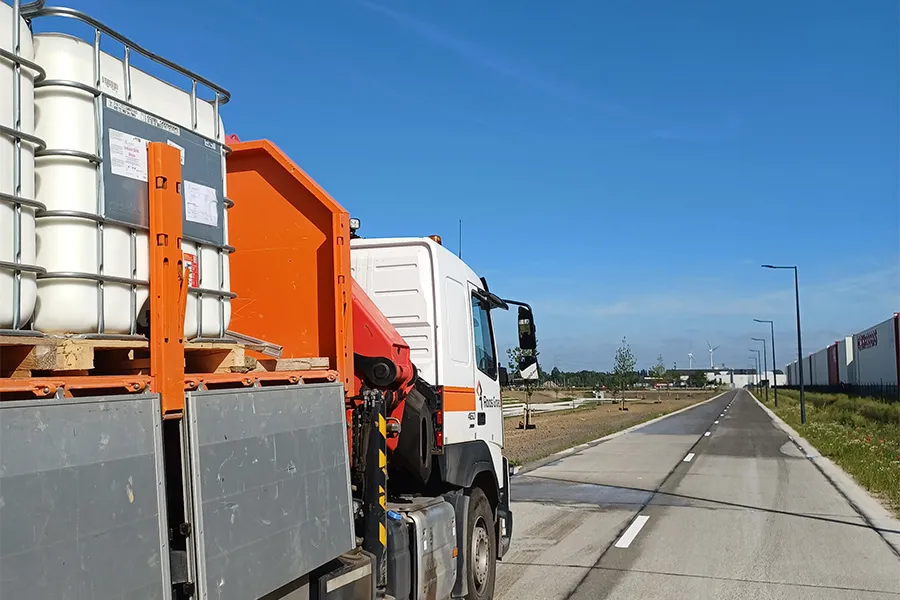
The entire site of the former Ford factory in Genk has been undergoing a transformation for several years, which will ultimately result in the new, thriving Logistic Valley Flanders business park. As part of a sub-project, at the end of May the Dutch company Roos Groep successfully impregnated no less than 29,000 m² of concrete surface at the site with Indusil SRM Aqua, on behalf of contractor Hoogmartens. To find the right product, Roos Groep called on the expertise of Rewah, the market leader in curing compounds and concrete treatments for roads, car parks and industrial sites.
Immediately after the closure of the Ford factories was announced in 2012, negotiations began with Ford over the acquisition of the site and the approach to its dismantling. Today, eight years after the actual closure, the master plan is entering its final phase. In time, Logistic Valley Flanders is expected to create 2,500 new jobs. Roos Group can confirm that work is still in full swing on the site. “Hoogmartens hired us for a number of jobs,” says Tom Roos, CEO of Roos Group. “As well as impregnation, Roos Group is also responsible for drilling dowel bars in various phases, and we provide operators for the concrete pavers.”
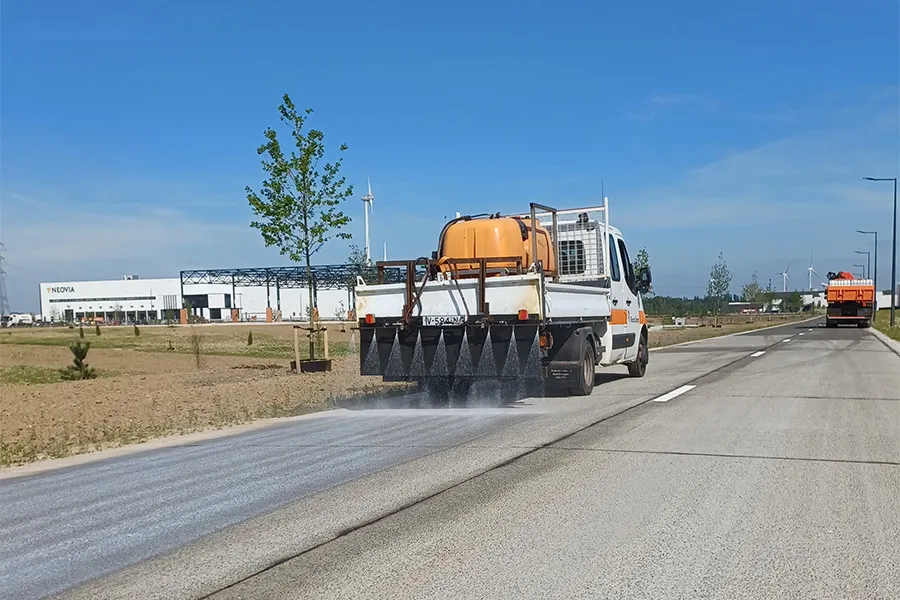
29,000 m²
Remarkably, on Tuesday 30 May, no less than 29,000 m² was impregnated to protect the concrete and joints from all weather conditions and contaminants. Tom Roos: “It was quite a challenge, as we had never before impregnated an area on this scale. We even converted one of our company vans into a mobile spraying unit to achieve the highest possible output. This allowed us to impregnate a width of 3.5 m in a single pass, at a maximum speed of 15 km/h, as coverage had to be guaranteed.”
Rewah’s Indusil SRM Aqua provides complete protection. The product is supplied ready to use and, once polymerised, protects concrete against a wide range of de-icing salts and agents, including chlorides, nitrites, metaborates, urea and glycols. Indusil SRM Aqua penetrates deep into the pores and polymerises to form a water-repellent layer without adversely affecting water vapour permeability. Its composition also bridges hairline cracks in existing concrete pavements, protecting them from premature wear.
More environmentally friendly
The choice of Indusil SRM Aqua is certainly noteworthy. “We have been working with Indusil SRM for decades,” says Herwig Stroobant, Rewah’s chief representative. “The key difference on this project was the choice of Indusil SRM Aqua. It is the same product, but water-based. Roos Groep has already completed a few smaller projects with this product, but this is the first time it has been used on a large scale. The benefits are clear: virtually no odour nuisance and no solvents, so there is no risk of damaging the bitumen joints. As it is a water-based product, it is of course important to take its sensitivity to frost into account during storage. In the past, there was a significant price difference between the Aqua version and standard Indusil SRM, but improved technical specifications and rising solvent prices have now virtually eliminated that difference. There is therefore nothing to stop contractors choosing this more environmentally friendly alternative.”
This environmental focus is certainly important to Roos Group. Tom Roos: “That applies not only to products, but also to our equipment. In the Netherlands, we are already being indirectly forced to take the environment into account. But we are also personally inclined to choose environmentally friendly products when they are in the same price bracket as traditional products. In the Netherlands, project prices are currently higher than in Belgium, and the authorities are also increasingly steering tenders towards environmentally friendly solutions.”
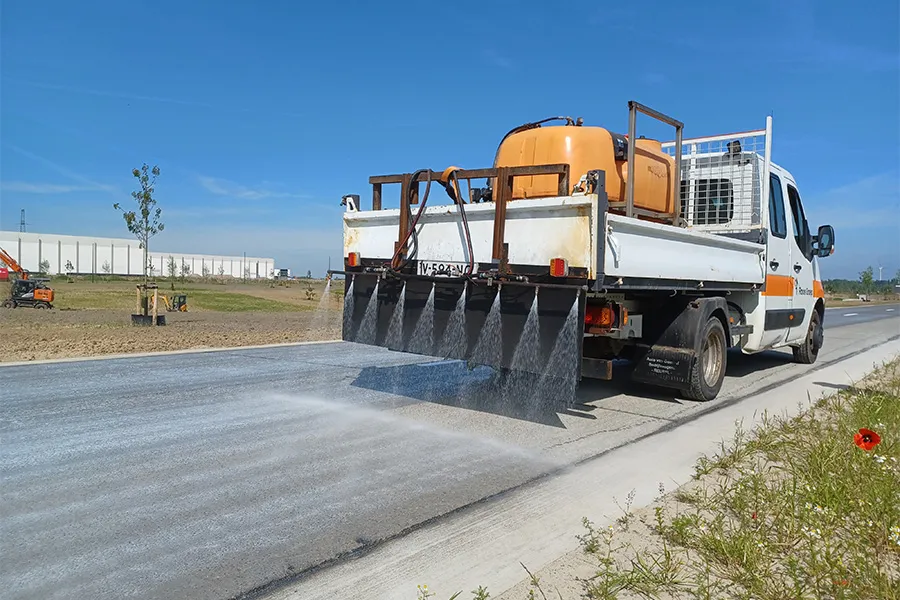
Flexibility
Indusil SRM Aqua should preferably be applied as soon as possible after the concrete has cured. Tom Roos: “This is to minimise contamination of the pavement. A sweeper and suction vehicle therefore passed over the surface first to get it as clean as possible. We had to be very flexible. We also had to take the weather into account. The afternoon before the work, we would decide whether we could go ahead the next day. This applied to concreting, filling the joints and impregnation. A minimum temperature of 10 degrees is recommended, and rain is absolutely out of the question. Tuesday 29 ultimately proved an ideal day to bring this challenging job to a successful conclusion,” says Tom Roos. ■
Question about this story? Ask your question
Wie aan Logistics Valley Flanders werkte
- impregnerenRoos GroepIn this story
- contractorHoogmartensIn this story
- Indusil SRM AquaRewahIn this story
Keep following this
Get an email when a new story is published. No account needed.
- ProjectLogistics Valley Flanders
- ThemeMaterials with a lower environmental impact
- SubjectConcrete
- CompanyRoos Groep
- CompanyHoogmartens
- CompanyRewah







