









Rainwater infiltration: precast concrete offers solutions
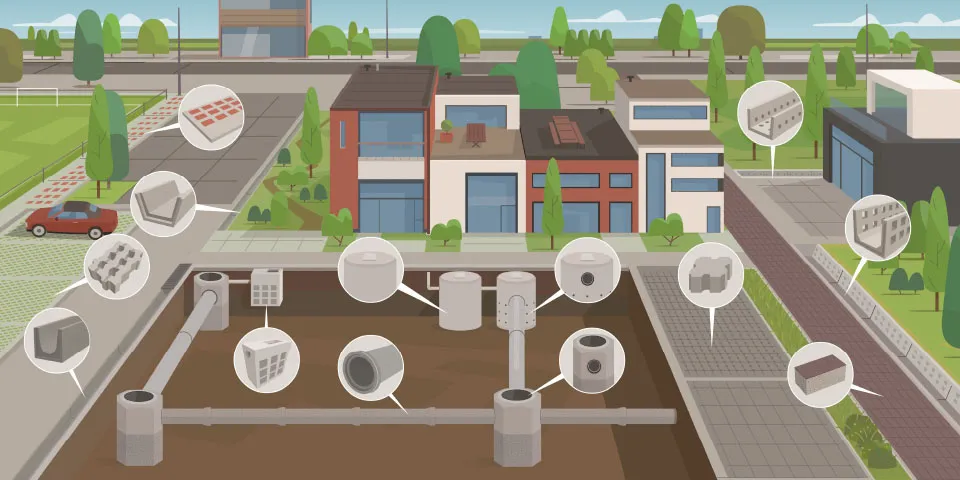
A range of precast concrete products makes permeable paving entirely feasible. It is simply a matter of choosing the right solution for the site. “An ideal infiltration system combines above-ground and below-ground infiltration options,” says Raf Pillaert, Infrastructure Product Manager at FEBE, the recognised trade association for manufacturers of precast concrete products.
Climate change is making our summers much drier, causing groundwater levels to fall sharply and take a long time to recover. Raf Pillaert says: “When it does rain, however, rainfall is often much more intense than it used to be. Our traditional sewers and waterways cannot cope with such sudden, large volumes of rainwater, which can lead to localised flooding. Both problems can easily be addressed by installing, among other things, above-ground and below-ground infiltration systems. These allow rainwater to infiltrate into the ground. Excess water can also be temporarily stored in below-ground facilities before being discharged. Precast concrete offers a wide range of solutions that can help.”
Above-ground and below-ground infiltration
Below-ground solutions include porous concrete pipes, infiltration wells and infiltration gullies. Above ground, options include permeable concrete paving blocks, concrete paving blocks with infiltration openings or widened joints, porous ditch elements and traditional grass pavers, used for car parks or ribbed strips. Raf Pillaert says: “There are also many aesthetically pleasing precast concrete products that can be used in private gardens, patios, driveways and public spaces. A full range of sizes and colours is now available, including porous blocks and blocks with infiltration openings or widened joints. In that sense, the term ‘depaving’, used in the context of the construction shift, is not entirely accurate. Precast concrete allows you to combine the convenience of a paved surface with a permeable solution. In other cases, precast products provide storage with a controlled outflow.”
Always tailored to the site
“An ideal infiltration system combines above-ground and below-ground infiltration options. In heavy rainfall, any excess water that cannot infiltrate above ground can still partly infiltrate below ground. But of course, everything also depends on the area you want to pave and the ground conditions. It is also important for the entire structure to be permeable. There is little point in laying porous concrete paving blocks on a sub-base that is not permeable,” concludes Raf Pillaert.
Question about this story? Ask your question
Keep following this
Get an email when a new story is published. No account needed.
- ThemeSpace for water and green infrastructure
- SubjectConcrete







