









Complex drilling work to investigate ways of improving freshwater availability
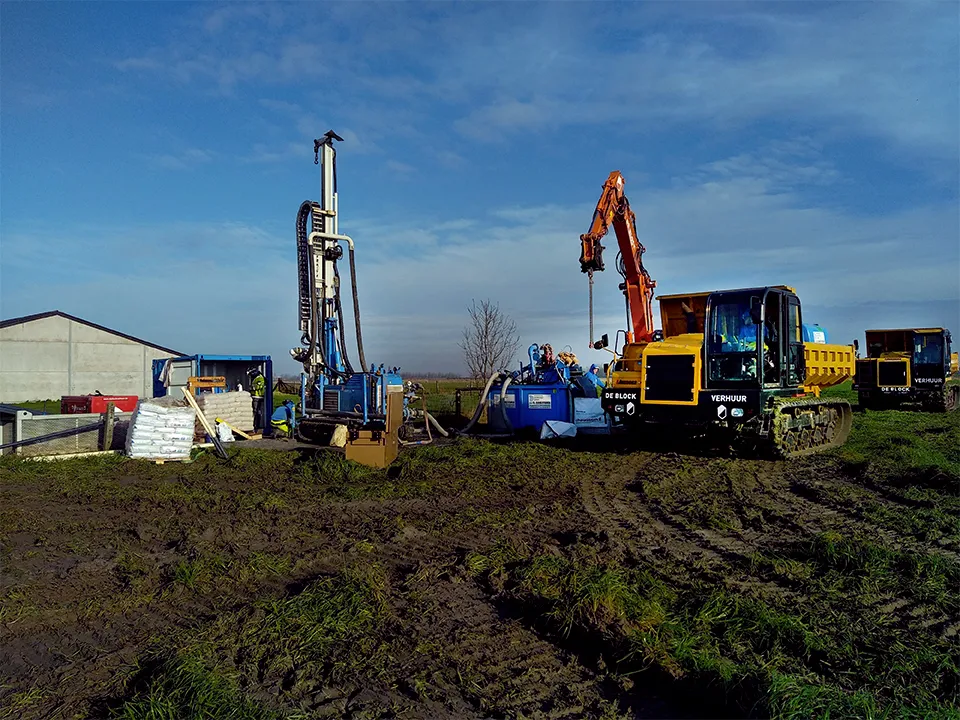
Since 2017, the VMM has been investigating groundwater salinisation in the coastal and polder area. The research is part of the European TOPSOIL project and has produced, among other things, new salinity maps.
To closely monitor changes in freshwater lenses, a new survey was needed to map current salinity levels in the phreatic groundwater of the coastal and polder area. The research also examines the extent to which local measures can increase freshwater availability. It therefore investigates ways of improving freshwater availability in the shallow subsurface.
Studies show that the polder area faces a water shortage in summer but a surplus in winter. One possible solution is to increase freshwater availability during the summer months by using creek-ridge infiltration. These ancient, sand-filled sea channels form slightly elevated ridges above the surrounding polder area, making them highly suitable for replenishing freshwater reserves.
Pilot project
The VMM is therefore planning to build a pilot project on Crocodillewedstraat in Veurne. The site was chosen because a creek ridge is located next to a watercourse that supplies sufficient good-quality groundwater during the winter months. To study the effects on groundwater around the infiltration system (horizontal drains), a groundwater monitoring network is being installed, consisting of several deep and shallow monitoring wells.
Following a negotiated procedure, the contract to install this monitoring network was awarded to G. Smeyers. G. Smeyers’ tender was judged to be the best on both financial and technical grounds. The drilling had to be carried out on an existing field. The necessary arrangements had to be made with the landowner regarding access to and use of the site. It was therefore essential to proceed with care.
5 deep monitoring wells
A total of 5 deep monitoring wells were drilled, to a maximum depth of 20 m below ground level. The wells were installed in holes drilled using rotary flush drilling. Before the wells were installed in the boreholes, geophysical borehole logging was carried out immediately after drilling over the full depth of each borehole. This was done to determine the freshwater-saltwater interface. A detailed borehole log also had to be prepared for each hole.
Finally, a data logger had to be installed in each monitoring well to continuously record water levels, which can be viewed online in real time. The work was carried out under the constant supervision of the VMM’s project officer and went very smoothly. The work for the VMM in Veurne is an important reference project for G. Smeyers. “It clearly demonstrates that, although we usually operate as a subcontractor, we can successfully carry out and coordinate complex drilling work as a main contractor, to the client’s complete satisfaction, in this case the VMM,” says G. Smeyers.
Een zakelijke vraag aan Smeyers nv? Get in touch
Companies in this story

Keep following this
Get an email when a new story is published. No account needed.
- ThemeUsing and protecting the subsurface
- SubjectGeneral
- CompanySmeyers nv







