









Cathodic protection as a lifeline for the Leonardtunnel roof slab
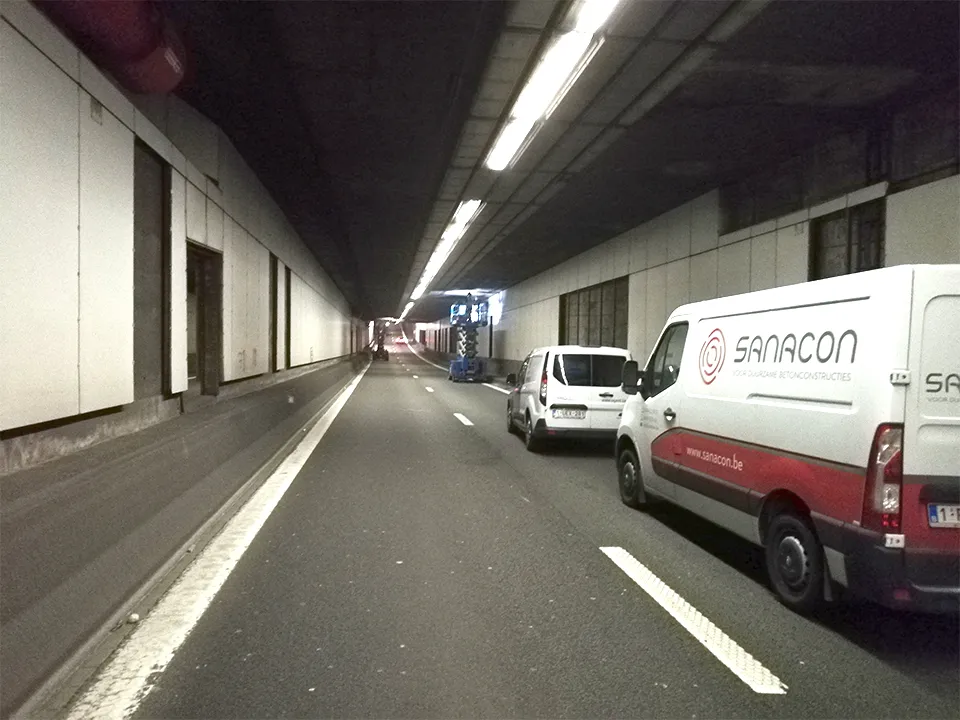
Agentschap Wegen en Verkeer, the authority responsible for regional roads and motorways in Flanders, is busy preparing a systematic renovation of the Leonardtunnel.
The concrete roof slab has also come under close scrutiny and is set for major renovation. The investigation is being led by SBE, an independent consultancy specialising in innovative structural and electromechanical designs, and SANACON, a young engineering firm specialising in concrete investigation and consultancy. “The preliminary investigation has been fully completed, the repair method has been determined and the system design is ready,” says Dr Mathias Maes, Managing Director of SANACON.
The six-year-old engineering firm SANACON, a spin-off from Ghent University led by Dr Mathias Maes and Dr Tim Soetens, became involved in the project in 2019. Mathias Maes explains: “This is a separate study assignment within a wider project examining and addressing various aspects of the Brussels ring road (R0). The Leonardtunnel had been affected by falling fragments of concrete, making a specialist investigation necessary. Agentschap Wegen en Verkeer therefore issued a separate contract, which we successfully bid for together with consultancy SBE. The partnership draws on Sanacon’s expertise in concrete investigation and cathodic protection. Concrete deterioration, specifically reinforcement corrosion, causes cracks in the concrete, leading to spalling and a reduction in the cross-section of the reinforcement. Possible causes of this corrosion include carbonation and chlorides. Identifying the exact cause of the damage is crucial in determining the most suitable repair method. In many cases, carbonation can be repaired using conventional methods, but chlorides cannot. In that case, cathodic protection (CP) is a repair option.”
Three phases
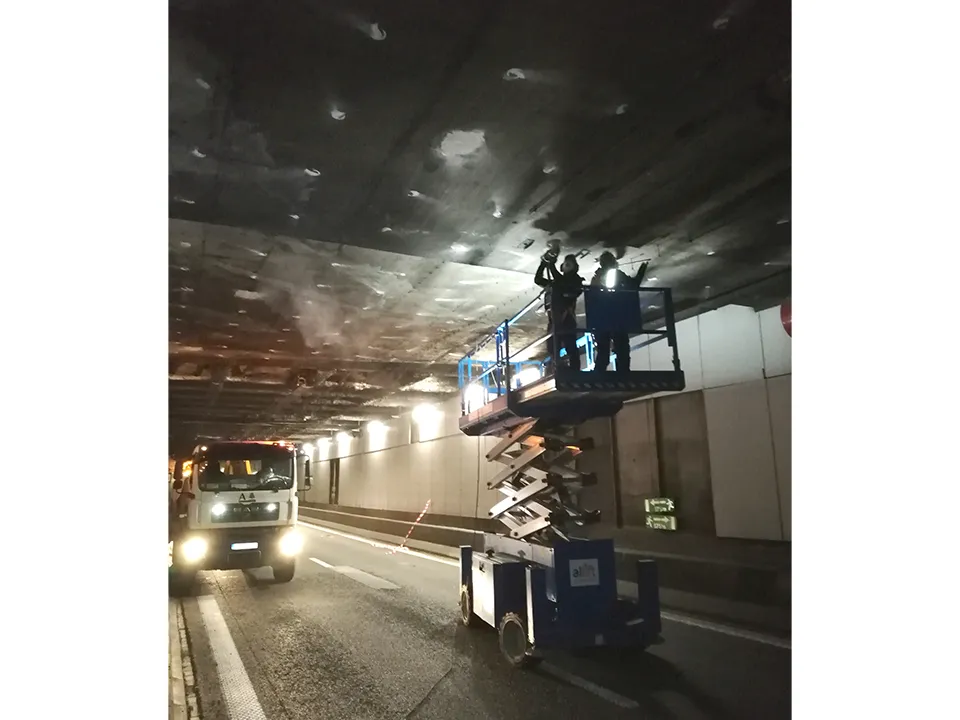
The concrete renovation of the Leonardtunnel is divided into three phases. “The first phase, and the largest for SANACON, was the preliminary investigation and advice on suitable repair scenarios,” says Mathias Maes. “The preliminary investigation establishes the current condition of the concrete roof slab in great detail and provides an estimate of its remaining service life. The most suitable repair and maintenance scenarios were determined on the basis of these findings. The investigation revealed very high chloride levels in the concrete, a finding also made during an earlier general inspection by the Expertise Staal en Beton department (EBS, which, like Wegen en Verkeer, is part of the Flemish Government). In the second phase, we prepared the design. Based on the preliminary investigation, we focused on impressed-current cathodic protection (CP) on the one hand and embedded anodes on the other. AWV opted for impressed-current CP. SANACON developed a design tailored to the structure and the client to achieve the intended extension to its service life. This will require large sections of the slab to be treated.”
Cost-effective in the long term
A CP system can last 25 to 30 years without requiring repairs. Mathias Maes says: “The initial cost of CP is higher than that of conventional concrete repair, but it is therefore more cost-effective in the long term. With impressed-current CP, there are several ways to establish current circuits in the concrete. These are aspects that we design and refine using our unique expertise. Parameters measured during the first phase of the project determine how powerful the system needs to be to drive current through the concrete. We also carried out potential measurements to identify the areas at greatest risk. Electrodes can be installed in the concrete, allowing us to monitor the system precisely and adjust it if necessary. The design was ultimately incorporated into tender documents, enabling Wegen en Verkeer to appoint a suitable contractor. It is not yet entirely certain whether SANACON will also be involved in the third phase, the actual works. We naturally hope so, as this would allow us to closely oversee the correct implementation of our own design.”
Specialist expertise
SANACON now has four employees with the second-highest qualification level for non-academics in CP structures under the Eurocode standards. “This specialist expertise is certainly one of our key strengths and adds value to projects of this kind. All too often, CP work relies on the knowledge of contractors and system manufacturers, which does not always serve objectivity well. We always aim to design concrete repair systems to suit both the structure and the client. By paying close attention to the client’s vision, we can act as an independent party,” concludes Mathias Maes.
Een zakelijke vraag aan Sanacon bv? Get in touch
Wie aan Leonardtunnel werkte
- engineering consultancySBEIn this story
- engineering consultancySANACONMentioned in Leonardtunnel as a reference project for sustainable concrete renovation
- clientAgentschap Wegen & VerkeerMentioned in Leonardtunnel as a reference project for sustainable concrete renovation
- contractorJan De NulMentioned in Leonardtunnel as a reference project for sustainable concrete renovation
- Preliminary investigationEBSMentioned in Leonardtunnel as a reference project for sustainable concrete renovation
Keep following this
Get an email when a new story is published. No account needed.
- ProjectLeonardtunnel
- SubjectGeneral
- CompanySBE
- CompanySanacon bv







